

If you’ve never attended the National Council for the Social Studies (NCSS) annual conference, imagine a theme park for social studies teachers: endless sessions, passionate crowds, and more resources than any carry-on bag can handle. As a first-timer in 2025 and a finalist for The Sandra Day O’Connor Prize for Excellence in Teaching Civics, I attended the conference courtesy of iCivics, but I was not fully sure what I was walking into.
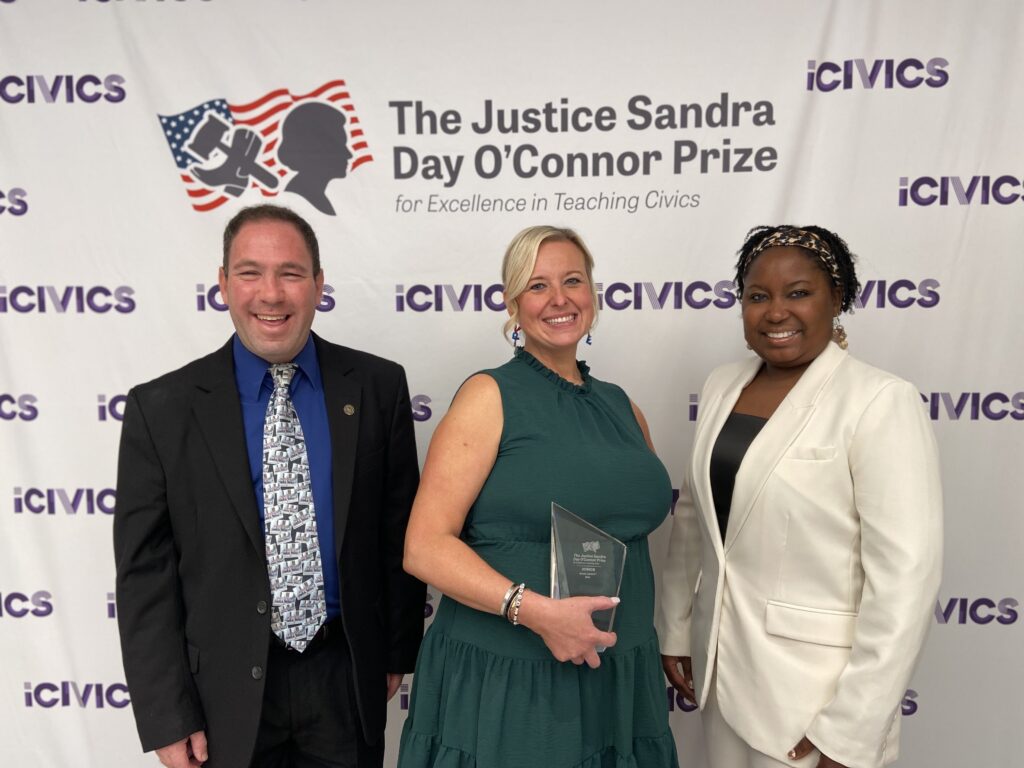
The Sandra Day O’Connor Prize
I have been to Washington, D.C., more than 100 times, including our annual school trip, vacations, teacher institutes, events, meetings, and visiting family. However, this trip seemed surreal. I was in town not just to attend NCSS, but also as a finalist for a prestigious award named in honor of one of my most revered Supreme Court justices.
Justice O’Connor was appointed to the court the same year that I was born, a coincidence I’ve always carried with a quiet sense of meaning. I grew up admiring that she was a free thinker. She didn’t automatically vote a certain way. She did it her way. To be associated with her—chosen by a committee that included former law clerks—was quite humbling. Before the award reception, I sat for an interview with the iCivics film crew and talked about how the justice influenced my teaching by instilling in me the idea that just because things have always been done a certain way doesn’t mean that they always have to be done that way. In my classroom, that mindset translates into endless possibilities! And while I didn’t win the award, I met some incredible people and got to reflect on what brought me to Washington.
#NCSS2025
When I first arrived at the massive Walter E. Washington Convention Center, I felt like I had arrived at London’s Heathrow Airport, scanning escalators and signage to figure out where to go. I clutched my iPhone and used the NCSS events app as if it were a treasure map. Thirty sessions in every time slot? It was a little overwhelming at first, but once I found my rhythm, the experience was nothing short of transformative. Luckily, I downloaded the NCSS events app and chose the sessions I wanted to attend ahead of time. I quickly found my bearings, and by the time I arrived at my first two featured speaker sessions, “How Hamilton vs. Jefferson Ignited the Lasting Battle Over Power in America” with the National Constitution Center’s Jeffrey Rosen and “What Democracy Demands: Congressman Hakeem Jeffries and Professor Hasan Jeffries in Conversation,” I realized I was in the middle of something remarkable: a national community of people who care deeply about the same work I do.
As the conference unfolded, each session was unique and inspiring, led by a teacher or professional at the forefront of social studies education. For me, highlights were Street Law’s look at the current Supreme Court term, virtual reality lessons in the social studies classroom, and Justice Ketanji Brown Jackson’s conversation—an hour I know I will remember for the rest of my life. Between the nationally known speakers and high-quality workshops, each session felt meaningful.
What also sets this conference apart is the opportunity to meet educators from across the country, all eager to share, exchange ideas, and collaborate. iCivics hosted a happy hour, which was the perfect catalyst for these conversations. I met a colleague from Florida who teaches a middle school civics class, and it was interesting to hear how she organized it. I met a teacher from Washington State who uses On Tuesday We Vote. Even Professor Hasan Jeffries stopped by, and I got to talk with him.
I would be remiss if I didn’t mention the exhibition hall, where educational nonprofits, services, institutes, museums, publishers, and historic sites had booths sharing resources. It was a reminder that the social studies ecosystem is far larger and more generous than I often realize during the school year. I wish I had brought a larger suitcase to fit all of the resources they gave me!
There’s something electrifying about standing in a place where every hallway, every room, and every conversation is anchored in the belief that social studies education shapes society. Some experiences broaden your practice; others broaden your perspective. NCSS, for me, managed to do both. My students will benefit from both my broadened practice and perspective. I’m excited to use what I learned to enrich their experience. I want that excitement to live on in my classroom, and I hope to find a way to attend NCSS next year and each year thereafter.
Written by Seth Harris
Seth Harris is in his 20th year of teaching middle school social studies. His passion is giving students authentic experiences in government, including his award-winning Law Day mock trial program at the Albany County Courthouse, We The People mock congressional hearings, listening to oral arguments at the Supreme Court of the United States, and attending local municipal board meetings. In addition to teaching, Seth served as deputy mayor of the Village of Menands for the past 12 years. He believes more people should get involved with their local government.
Through the iCivics Educator Network, the perspectives of teachers across the country contribute to the public conversation about civic education in the United States. Each contributor represents their own opinion. We welcome this plurality of perspectives.