
My approach to teaching has always been to prepare my students to be active, contributing members of their civil society. As I stated in my interview for my teaching position at Air Force Academy High School (AFAHS) years ago, the students of today are the Social Security payers of tomorrow—so I’d better make sure they’re taking care of me when I’m old!
In all seriousness, though, the majority of students at my school are Black or Brown, and many come into my classes not believing that they have a voice in our society. My mission is to change that. I work to make sure my students not only understand how they can participate in civil society, but why.
It’s not difficult for students to see how the civics lessons we cover in class impact them personally. They are watching tensions between our local and national governments play out on the news and in the streets. And they are drawing connections between their lived experience and the list of “injuries and usurpations” in the Declaration of Independence.
But it’s often challenging to get students comfortable with expressing their ideas and opinions in class. Students today are scared of being “wrong” or criticized for their beliefs. So, in my classroom, we spend a lot of time breaking that habit as I try to get students to understand that school is all about being wrong—that that’s generally how the learning process starts. I always tell students that we must debate the idea, not the person.
Recently, as part of the Civic Star Challenge, we did a deep dive into the Declaration. We started off by clarifying some key terms, such as “social contract,” “popular sovereignty,” and “natural rights.” I then asked students what Thomas Jefferson was trying to say in this “breakup letter” to King George III. What was his belief about the nature of government? As we talked, I watched the students put the pieces together in real time. One summed it up nicely:
“Governments exist to protect natural rights, like life, liberty, and the pursuit of happiness. Those governments are legit because the people agree to them. When the government stops protecting those rights, or starts hurting them, the people should change or end the government.”
As the other students nodded their heads and snapped their fingers, I couldn’t help but grin. I thought: I think we can really get something done in this class! Jefferson would be proud.
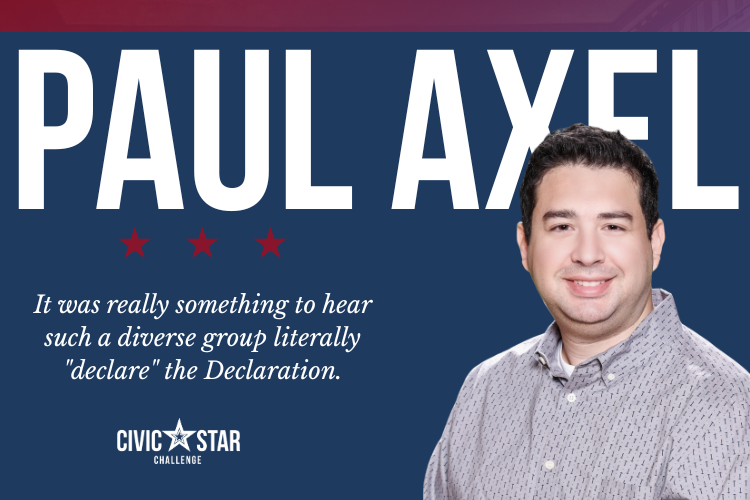
At the time it was issued, the Declaration would actually be “declared”—that is, it would be read aloud for everyone to hear. The language works better when you can emphasize and emote through speech. Every year, I ask my students to read the Declaration out loud, each taking a small part. My students are often a little nervous about doing that. My classes have a wide range of reading levels and English language comprehension. But recently, I was really gratified to see everyone giving it a shot. It was really something to hear such a diverse group literally “declare” the Declaration.
About Paul
- Teaching Experience: 14 years in education; 8 years teaching
- Currently teaching: social studies
Paul, a Chicago Public Schools teacher, endeavors to help students become thoughtful, empowered, and active members of civil society. When not doing that, he brings engaging stories to life as an accomplished comic book writer.