
While we often associate Presidents’ Day with deals and discounts on electronics, furniture, and other goods, for most of American history, it was a day for commemorating the first president: George Washington. In fact, according to federal law, the holiday is still designated as “Washington’s Birthday,” even though it rarely falls on his actual birthday. After the Civil War, another February presidential holiday emerged: Abraham Lincoln’s Birthday. The holidays were eventually consolidated, and Presidents’ Day became more inclusive of all U.S. presidents.
While celebrations for Presidents’ Day vary from wreath layings and concerts to formal dinners and balls, one of the best ways to involve students in the occasion is by learning about the presidents, the challenges they faced, and the choices they made, and contextualizing the circumstances and consequences of those decisions. Good news—there’s a game for that!
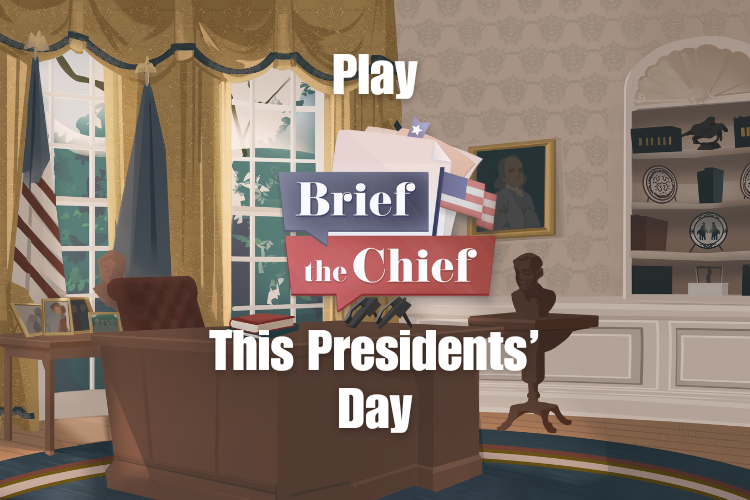
In 2024, the White House Historical Association partnered with iCivics to launch Brief the Chief, a history learning game that teaches evidence-based reasoning, decision making, and critical thinking. As of the end of 2025, the game has had more than 500,000 plays, with peak play months in November and—you guessed it—February!
Our initial framing for Brief the Chief called for three administrations to be featured in the game. We wanted to select ones that were consequential, as well as historical moments that are generally taught across different state standards. We settled on three administrations from very different time periods in American history: Thomas Jefferson (1801–1809), Abraham Lincoln (1861–1865), and Lyndon Johnson (1963–1969). We also wanted to highlight both a well-known and lesser-known historical episode for each president (Jefferson: Port of New Orleans and Trade with Haiti; Lincoln: Fort Sumter and Emancipation Proclamation; Johnson: Voting Rights Act and Decision to Run for Re-Election).
The personalities and politics of Jefferson, Lincoln, and Johnson varied extensively, as did those of the people around them—there are nearly 30 historical characters dispersed throughout the game! A student can encounter figures such as Alexander Hamilton and James Madison, as well as lesser-known individuals like Elizabeth Keckley and Zephyr Wright. This was part of our concerted effort to balance diverse perspectives and give learners more historical context for the times in which these people lived.
Beyond the characters, we also gave significant thought to the settings for every scenario. Using the presidential offices made sense because each president used a different workspace (Jefferson in today’s State Dining Room; Lincoln in today’s Lincoln Bedroom; and Johnson in the Oval Office). As a result, students also get to visually experience different historic spaces of the White House and see how those spaces have evolved and changed over time to meet the demands of the presidency as an institution.
While more modern spaces, such as President Lyndon Johnson’s Oval Office and the Second Floor Kitchen, are well documented and photographed, this was not the case with the interiors of the Jefferson and Lincoln White Houses. In fact, there are no known drawings or images from Jefferson’s time (aside from floor plans), and the only known photographs of the Lincoln White House are of his office. To overcome the lack of visual documentation, two scenarios are set outside, as there is an abundance of drawings, paintings, renderings, and other visuals of the White House exterior dating back to its very beginning.
It is important to note that we ultimately decided that students would play the role of advisor rather than president because it allows them to be a witness to history, ask good questions, and make recommendations based on the evidence they gather. It also adds nuance to the idea of presidential decision-making, as leaders often rely heavily on people around them for information, expertise, and advice. One of the key takeaways we hope students will learn is that they have a role to play in shaping history, both in the game and in civic life.
So, we hope you will consider playing Brief the Chief with your students this Presidents’ Day (or anytime really!) We thank iCivics for their partnership in helping make this resource available to educators nationwide.
Written by Dr. Matthew Costello
Dr. Matthew Costello is the Chief Education Officer and Director of the David M. Rubenstein National Center for White House History, where he holds the Gerard B. Lambert Foundation Chair in White House History. In this role, he oversees the Association’s education programs, historical research, digital archives, public programming, and partnerships. Costello joined the Association in 2016 as the Senior Historian after completing his Ph.D. and M.A. in American history at Marquette University. He has published articles in academic journals and magazines, as well as two books. The first, The Property of the Nation: George Washington’s Tomb, Mount Vernon, and the Memory of the First President, was a finalist for the George Washington Book Prize. He also co-edited the volume Mourning the Presidents: Loss and Legacy in American Culture.
On the Educator Blog, multiple perspectives contribute to the public conversation about civic education in the United States. Each contributor represents their own opinion. We welcome this plurality of perspectives.