
A few years ago, one of my colleagues invited Mary Beth Tinker to speak at our school—she was the student plaintiff in the landmark case Tinker v. Des Moines. It was an incredible experience to hear her calmly describe what it was like to participate in the case, recounting each choice she made without really knowing how important her actions would become for the whole nation.
She spoke to the students about the First Amendment in a way that was undeniably personal. But she described her legacy like this:
“My message is that when you find issues that you care about and that you want to change, then it’s a great way of life to use your First Amendment rights to speak up about those issues and to take action. You’re not going to win all the time, but it’s still a good way of life.”
My goal as an educator is to help my social studies students make this same connection between the text of the Constitution and their daily lives, their communities, and the real world. The Civic Star Challenge helped me create that bridge.
For example, it’s one thing to read the amendments; it’s another to use them to defend the rights of others. When students play the iCivics video game Do I Have a Right?, they take on the role of lawyers. Clients show up to their office with complaints; then the lawyers have to decide whether that grievance is covered by the Constitution and, if so, by which amendment. And the clients demand answers quickly! I love listening in as students check in with each other, discussing their tactics and understandings of the text. (“Oh no, I thought it was in the Fifth Amendment, but it was the Sixth!”) The game encourages critical thinking, creates community, and leaves students with a much richer understanding of their own rights. Plus, it serves as an informal assessment, with data coming at me in real time.
My class is often the first time students dive into content that asks them to reflect on human nature, current events, and who they are becoming. I emphasize that those who founded the country did not come up with these ideals and ideas themselves. Many of the founders were not much older than the students, and—like good students—when they looked for inspiration for a new government, they drew on their favorite thinkers, including Locke, Montesquieu, and Rousseau. The proof is right in the Declaration of Independence.
Mary Beth Tinker stressed the importance of knowing your rights and speaking up for yourself, no matter what age you are. Guided by her example, I tell my students that we are not studying history or civics, but rather that we’re living it. We study the past to navigate our present and to better understand what it means to have rights—not just for ourselves, but for everyone.
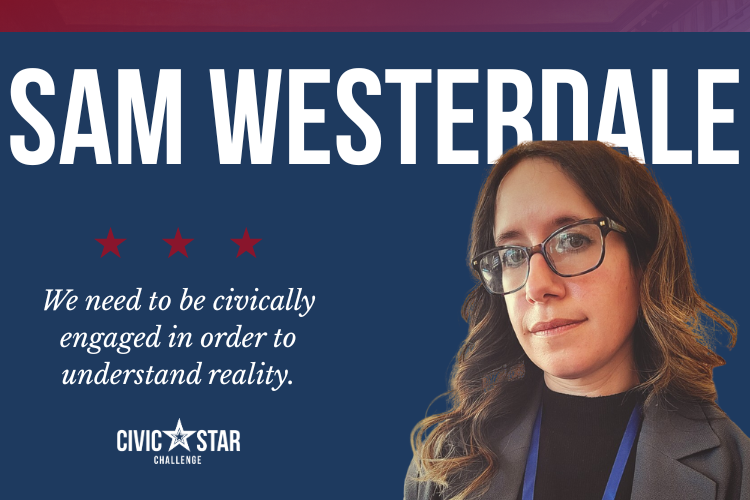
About Sam
- Teaching experience: 14 years
- Currently teaching: American Government, State & Local Government, Introduction to Political Science (all dual enrollment); African American Studies.
A recipient of the 2018 James Madison Fellowship for Colorado, Sam utilizes her Master’s degree in Political Science, teaching primarily 11th and 12th grade students the significance of civics, civic engagement, and the importance of making connections in the community.