

National Hispanic Heritage Month is a moment to inspire to honor the unique background Hispanic Americans share, something I wish I’d appreciated sooner. When I was growing up near the Philadelphia area, I regrettably saw my background as a struggle. It wasn’t until I moved to New Mexico for college that my relationship with my heritage changed for the better. I noticed a deep culture of civically engaged communities with their backgrounds at the forefront. It was in college that I discovered my passion for policy and civic education because now I could see myself and people like me in it.
Growing up as a daughter of Peruvian immigrants, my family never really discussed civics or government. While my peers’ families had multiple generations’ worth of knowledge and civic skills, I grew up never thinking civics had a place in my life because it was never discussed at my dinner table—which always consisted of the best Peruvian food—and I did not see people like me in social studies lessons at school. My family did, however, talk to me about where they came from and why we are here now. The possibilities of opportunities and liberty that they dreamt for our family were enough to take this leap of faith in moving to the United States. Stories ranged from experiences with strong communities and limited access to quality education to first-hand political violence and lack of democracy.
While pursuing my master’s degree, I worked on a research project that helped me better understand Peru’s history, the background of this political violence, and how it quantifiably affected the country’s democracy. Moments like this college project and the childhood stories told by my family connecting to a newly discovered passion of mine reassured me that I was where I was supposed to be.
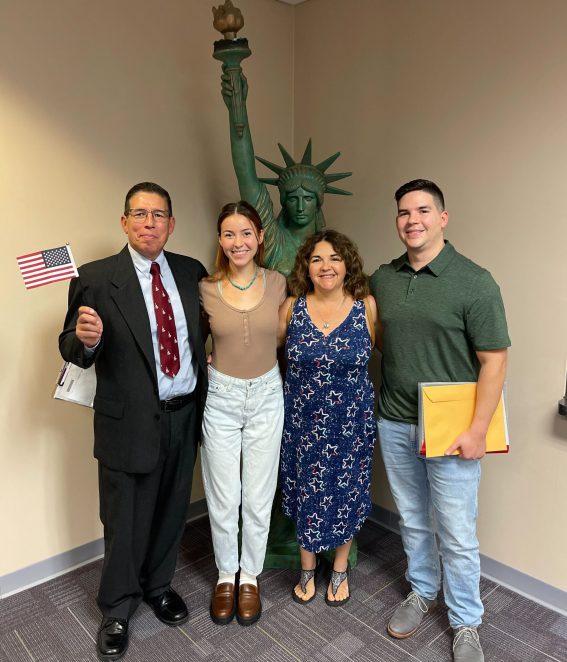
This past year, my parents passed their naturalization test and became U.S. citizens, joining my brother, who completed his in 2013. Political instability and increasing corruption in Peru’s democracy have often made it difficult to be excited about participating in a democracy. That changes now.
This November, we will—for the first time as a family—exercise our right to vote and participate in the U.S. democratic process. Since my parents are gearing up to participate in this process for the first time, we are experiencing new democratic practices as a family. We have been informing each other of current political events, identifying key issues, engaging in discourse, and my mom is even applying to be a poll worker now that she’s eligible!
Written by Andrea Benites
Andrea is the policy coordinator for iCivics, where she focuses on advocating for the civic education field, policy initiatives, and the work of CivxNow. She is passionate about nonpartisan, equitable solutions to foster an inclusive government.