
The Constitution is the foundation for nearly everything I do in my class, even if my students don’t always realize it. That’s by design: I weave it into lessons, discussions, projects, and more. It’s like a civics sneak attack! The goal is to make sure students understand the Constitution itself, as well as how it shows up in their lives. And they don’t have to look far.
Recently, as part of the Civic Star Challenge, my We The People class was learning about the 14th Amendment. At the same time, Indiana was making national news around changes in voting laws and procedures. So, we leaned into the moment. We looked at district maps and dug into our state’s history; we also identified periods when certain minority groups were disenfranchised or not allowed to vote. While my students hold a range of political beliefs, they generally align around the principle of one person, one vote. This leads to some great discussions about political power and how our elected officials hold onto it. As one student observed, “The Constitution didn’t change as much as who was protected by it.”
We also incorporated the First Amendment into our exploration of the issue. Students observed how fellow Hoosiers were exercising their rights by organizing grassroots efforts to influence policy and staging walkouts to protest it. Several were inspired to write to their legislators to express their opinions. They could see that democracy is not a spectator sport—and they became active players.
I also love teaching the Constitution through music. (I’m trained in musical theater, and I still direct and choreograph. So I try to marry my two loves—civics and the arts—whenever I can!) I have a unit coming up for my dual credit Government & Politics classes called “Soundtrack of Resistance: Protest Music and the First Amendment.” The playlist, alone, is worth a listen: it’s got hits from legends like Aretha Franklin, Sam Cook, and Bob Dylan, but also more recent tracks from Kendrick Lamar and HER. We’ll analyze lyrics and learn what animated the artists to write them. For example, we’ll consider Creedence Clearwater Revival’s “Fortunate Son.” I’m pretty sure even the students who have heard the song may not realize it was written in response to the Vietnam War.
We’ll also ask more fundamental questions:
- Is it an artist’s responsibility to exercise their First Amendment rights in this way?
- When can speech be limited?
- How does public opinion factor in?
These are questions I hope they continue asking as engaged voters and citizens long after they leave my classroom.
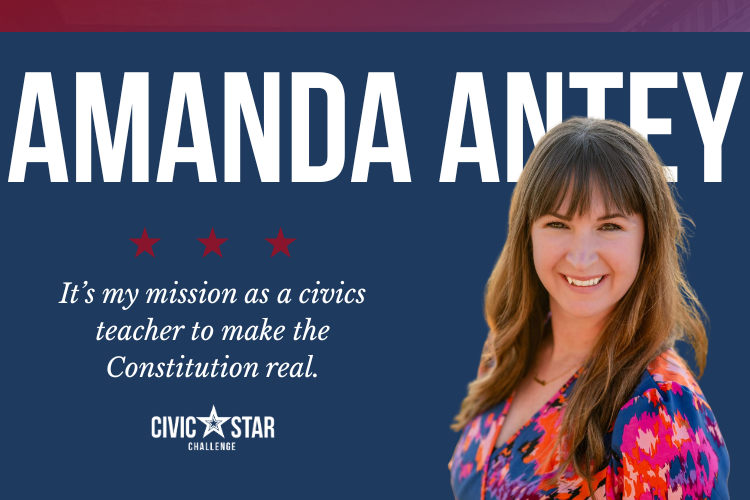
About Amanda
- Teaching experience: 20 years
- Currently teaching: Dual Credit American Government (University of Evansville), American Government, Sociology, and AP Government & Politics / We the People
Amanda Antey’s students are nine-time Southwestern Indiana Regional Champions and State Qualifiers in the We the People program. Amanda serves on the National Constitution Center Teacher Advisory Council and is a member of the iCivics Indiana Civics Cohort. She is the recipient of the 2026 Indiana Bar Foundation Champion of Civic Education Award and focuses on creating engaging, relevant lessons that make civic learning accessible and meaningful for all students.