

As global tensions rise in Europe and the COVID-19 pandemic enters its third year, there is an increased urgency to help students build an understanding of U.S. foreign policy.
Our new game, Convene the Council, created in partnership with the Council on Foreign Relations (CFR), uses digital gameplay to teach important foreign policy and global civics lessons in an engaging way. Students who play Convene the Council step inside the Situation Room and assume the role of the president of the U.S., making foreign policy decisions through 20 different fictional foreign policy scenarios that reveal how foreign and domestic policy are intertwined and how decisions made in one corner of the world can affect us all. The game’s scenarios challenge students to use critical thinking skills to determine how the U.S. should respond based on recommendations from the president’s closest advisors.
As two organizations with the shared goal of empowering students and lifelong learners with the know-how needed to be responsible citizens, we are proud to have partnered with CFR on this game and to bring global civics, which expands and modernizes the field of civics education for our globalized era, into the spotlight.
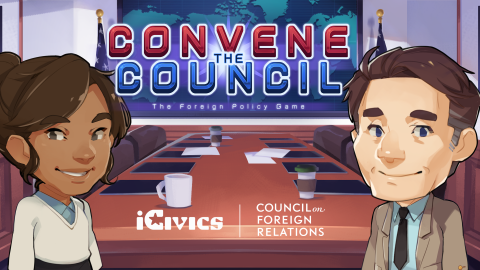
This game was made in partnership with the Council on Foreign Relations, with support from The Peter G. Peterson Fund – New York Community Trust.
Meet the Council on Foreign Relations
CFR Education focuses on global civics, providing students with the knowledge, skills, and perspective—the global literacy—required to navigate our interconnected world, and preparing them to confront our era’s most pressing issues.Global civics recognizes that the world is more interconnected than ever before; that we live in an era when ideas, behaviors, products, and news spread more quickly and broadly than at any other time in history; and that the challenges and opportunities that define our era don’t stop at one country’s borders.
CFR is working to put global literacy back into the spotlight by meeting students where they are with relevant, compelling case studies and innovative multimedia content.It also acknowledges that learners of all ages must be equipped with the tools necessary to steer through the churn of the daily news cycle and a social media landscape often littered with misinformation.
CFR Education’s teaching global civics has involved using the intense, international popularity of Korean pop music to help students understand concepts like soft power; serving up avocado toast as an example of how the global supply chain affects what’s for brunch; and going behind the firewall to highlight how computer viruses now operate as modern-day tools of foreign policy.
Explore global civics resources from the Council on Foreign Relations:
CFR’s two award-winning digital learning products, World101 and Model Diplomacy, provide an essential baseline for a global civics curriculum and encourage learners ages 14 and up to embrace a world that functions on the fundamental principles of democracy.
- World101 is a growing library of free educational resources that makes complex international relations and foreign policy issues accessible to all learners using videos, interactive maps, infographics, quizzes, and online teaching materials.
- Model Diplomacy is a free classroom simulation program that invites students to step into the shoes of decision makers on the National Security Council or United Nations Security Council to debate the world’s most pressing issues.
CFR also recently released its first-ever music video—a guaranteed bop!