This full week of resources contains everything you need for students to understand where many of the ideas in the Declaration of Independence came from. Each lesson builds essential skills—like analyzing evidence and forming arguments—by connecting big historical ideas to the democratic principles that shape our world.
In what ways did Enlightenment ideas fundamentally shape the democratic principles expressed in the Declaration of Independence?
Day 1
This lesson sets a foundation for your students as they examine the American colonists’ grievances. The teacher’s guide provides step-by-step instructions for you to guide your students through anticipating, reading, and completing activities that check for understanding.
Skill
Identify cause and effect
Analyze primary documents
Promote reading comprehension
Develop chronological reasoning
Lesson Plan
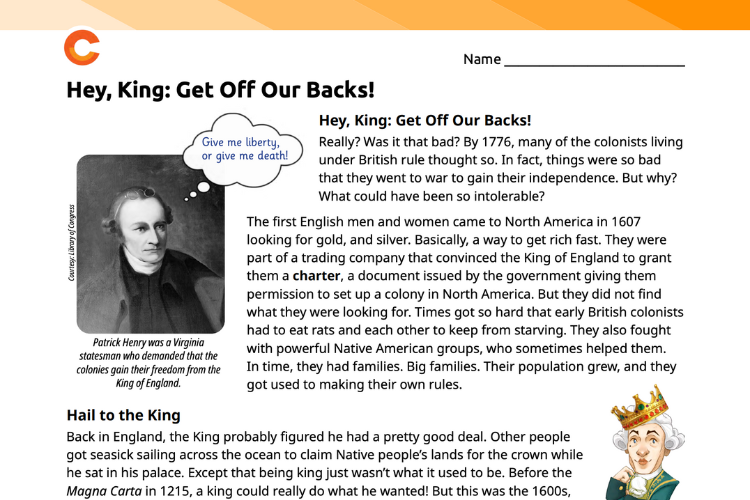
Hey, King: Get Off Our Backs!
Follow the grievances of the American colonists from oppressive British policies to the creation of the Declaration of Independence.
By reviewing why the colonists wanted independence, and then introducing the Enlightenment as the source of the Declaration’s core concepts, you build a bridge between historical events and the philosophical ideas behind them.
Through a guided reading and follow-up activities, students will learn to define and identify key principles like natural rights and the social contract.
Skill
Develop critical thinking skills
Analyze the meaning of the social contract theory
Lesson Plan
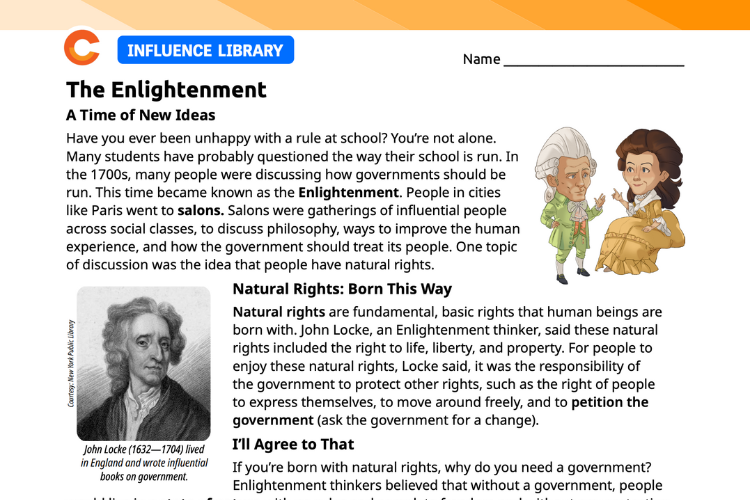
The Enlightenment Mini-lesson
Introduce students to the ideas of the Enlightenment, including Natural Rights, the Social Contract, Consent of the Governed, and Republicanism, identifying how these ideas influenced America’s founders.
Bridge the gap between parchment and pavement by prompting students to brainstorm and identify modern-day examples of the social contract in their own communities.
This lesson overlaps with the Enlightenment Mini-lesson, but it is a perfect homework assignment to reinforce key topics.
Skill
Identify the historical significance of Locke’s ideas
Practice reading comprehension
Day 3
Moves students from learning the theory to applying it directly to the primary source.
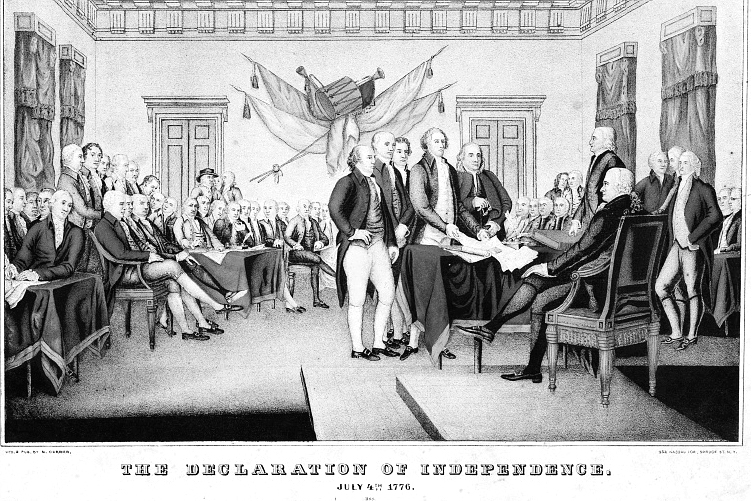
This Document-Based Questioning tool includes three primary sources for students to use. Students can use the self-guided mode to analyze the Declaration of Independence. We recommend that students stop after completing the analysis and share their summaries with the class.
Skill
Analyze primary source
Develop critical thinking
Practice reading comprehension
DBQuest
America's Founding Preambles
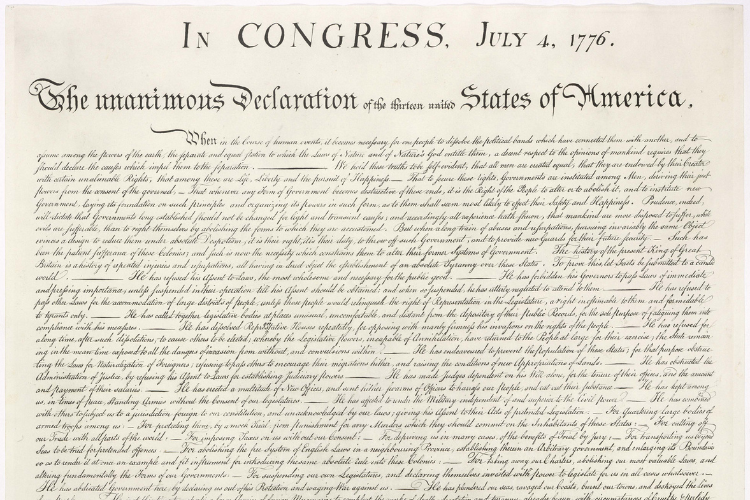
Guide students through a primary source analysis of the Declaration of Independence, asking why governments are created, where they get their powers, and when they should be changed.
In this culminating lesson, students transition from learning to application, actively using their new knowledge through gameplay. The post-game quiz or discussion questions can be used to reinforce key ideas.
Skills
Practice critical thinking
Identify cause and effect
Develop chronological reasoning
Identify historical significance of events, places, and ideas
Game
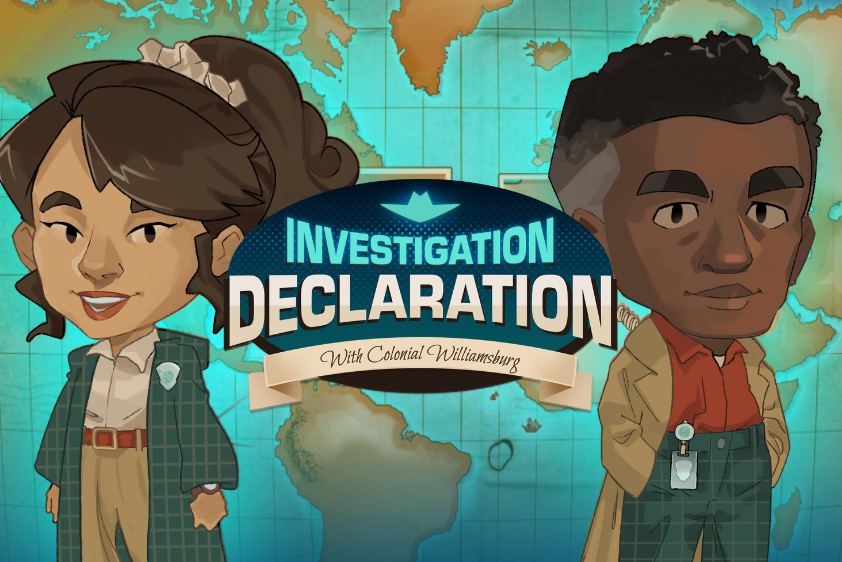
Investigation Declaration
Track Enlightenment ideas to and through the U.S. Declaration of Independence.
Join us in celebrating the 250th anniversary of the Declaration of Independence and showcase your students’ civic learning with the Civic Star Challenge.
Teaching with any of these resources qualifies you to enter your classroom and school to win prizes!