Three Branches and the Creation of Checks & Balances
This full week of resources for middle school students contains everything you need to teach your students about the system of checks and balances and how the three branches of government establish a balance of power.
Each lesson builds essential skills—like analyzing evidence and forming arguments—by connecting big historical ideas to the democratic principles that shape our world.
Guiding Question
How do the three branches of power create a system of checks and balances and a balance of power in the government?
Pre-work
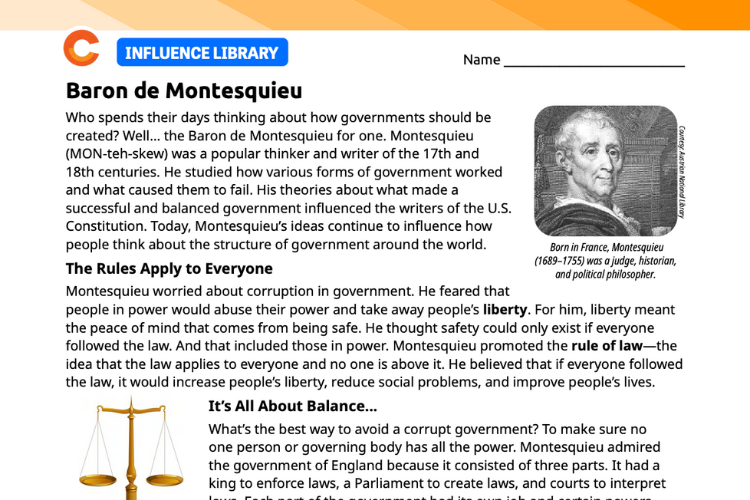
This pre-work sets the foundation for studying the balance of power. Students gain an introduction to Montesquieu’s ideas regarding the separation of powers and checks and balances.
Skill
Analyze information
Promote reading comprehension
Lesson Plan
Montesquieu Mini-lesson
Students gain an introduction to Montesquieu’s ideas regarding the separation of powers and checks and balances.
In this lesson, students examine real-life and fictional scenarios to understand why it is important to limit the government’s power.
Through guided reading and follow-up activities, students will learn about five basic limits on government.
Skill
Develop critical thinking skills
Analyze scenarios
Apply concepts to real-life situations
Promote reading comprehension
Lesson Plan
Limiting Government
Students explore the five basic limits on government through the true story of Peruvian president Alberto Fujimori, and other fictional cases of government power gone wild.
Go beyond learning to application with this WebQuest. By navigating curated online resources, students will analyze information to answer the question: Why does the U.S. government have three branches?
Skill
Promote reading comprehension
Apply concepts to real-world scenarios
WebQuest
Three Branches: Checks & Balances
Students dig deep to find out the role each branch plays and the ways it balances out the other branches.
In this lesson, students learn how the checks and balances of the three branches of government work. By creating a healthy school lunch menu, students role-play each branch’s responsibility in the law-making process. They then compare the simulation activity to a real-life example of a bill that became law.
Skill
Analyze and interpret situations
Practice reading comprehension
Apply solutions
Lesson Plan
Separation of Powers: What's for Lunch?
Students find out how the checks and balances of the three branches of government work.
In this lesson, Students actively using their new knowledge as they take on the roles and responsibilities of the Executive, Legislative, and Judicial Branches and turn as many bills into laws as possible.
The post-game quiz or discussion questions can be used to reinforce key ideas.
Skill
Practice critical thinking
Identify and apply concepts to real-life scenarios
Practice decision making
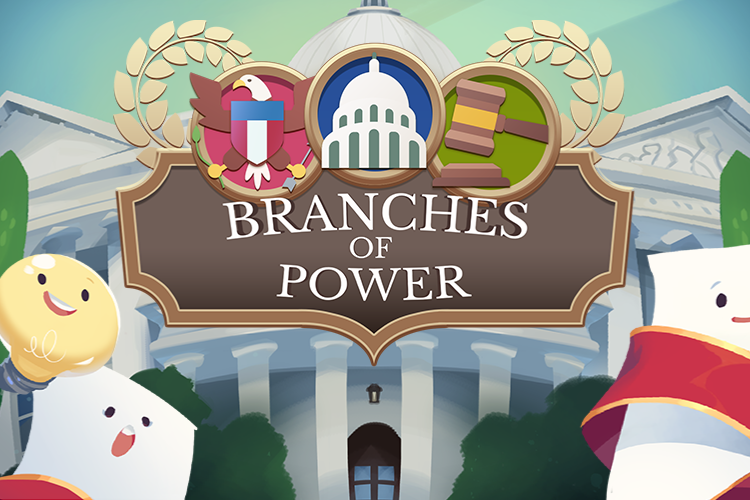
Game
Branches of Power
Learn to control all three branches of the U.S. government!
Conclude the week with some fun and creativity as students explain the three branches and the system of checks and balances.
Students analyze the Branches of Government video and then work in teams to develop other creative ways to explain this fundamental proponent of our government.
Skill
Develop communication skills
Analyze meaning
Practice working in groups
Video
The Branches of Government
Teach students about the branches of government with this music video in which Carla explains their roles to Max, using the players, referees, and coaches to illustrate the checks and balances.
Join us in celebrating the 250th anniversary of the Declaration of Independence and showcase your students’ civic learning with the Civic Star Challenge.
Teaching with any of these resources qualifies you to enter your classroom and school to win prizes!