
How can game content be more accessible to all learners, especially English and multilingual learners? By integrating it with other methods to create robust and engaging classroom experiences around complex disciplinary concepts. In other words, teach around the game.
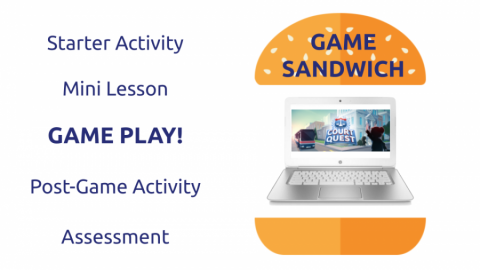
We call this approach the “Game Sandwich” because we’ve “sandwiched” opportunities for deeper learning around the game via our Extension Packs.
- The game is the “meat” of the sandwich
- The top “bun” consists of pre-game extension activities
- And the bottom “bun” features post-game practice

Extension Packs are made up of slides and a PDF document with printable activities. These provide tips, instruction, and guidance on making the most of our games in the classroom. Extension activities build reading, writing, listening, and speaking skills (as well as content knowledge!). They are great for all students, not just English (EL) and multilingual (ML) learners. The Extension Packs are flexible with a lot of pre- and post-game activities, so you can pick and choose what you’d like to use in class.
The slides include visuals from the game and offer additional support for visual learners. Each of the activities from the PDF has a corresponding interactive slide so that the activity can be displayed on a whiteboard or smartboard for modeling or whole-class instruction. You can download and make a copy of the slides to use while teaching. With your copy, you have the ability to add, delete, and edit slides.
Extension Packs include these components:
- Pre-game: We begin by activating and pre-teaching critical content with a starter activity and mini-lesson. ELL extensions highlight how to adapt activities for different proficiency levels. There are also guided graphic organizers students can use to write down notes and ideas.
- Vocabulary: Supporting language learners in vocabulary development is key, so each extension pack has game-specific Tier II and III vocabulary with practice activities. These can be done before or after the game to build or reinforce new vocabulary and academic language.
- Game: We include a teaching strategy for game play. We encourage partner or group play for all students. It adds another dynamic to the game because it gets students talking. For ELs/MLs, it’s a low-risk way to support oral language development as they talk to their peers.
- Post-game: There are a variety of post-game activities that create opportunities for students to reinforce what they have learned in the game. Some are very quick “can you show me you got it” comprehension checks, and others are more open-ended and ask students to dig deeper. They all include a Mini-Quiz assessment.
In the game-specific Extension Packs! Make sure you are logged into your educator account. Then simply click on “Game Extension” under the “Tags” section of the search feature from our “teach” page or access a game-specific one from the “Download Teacher Resources” button on a game’s page. When you open the PDF, you will find a link to the google slides under “Materials.”


For more ideas for English and multilingual learners, check our our landing page: iCivics & ELL: Resources to Engage your Multilingual Classroom