
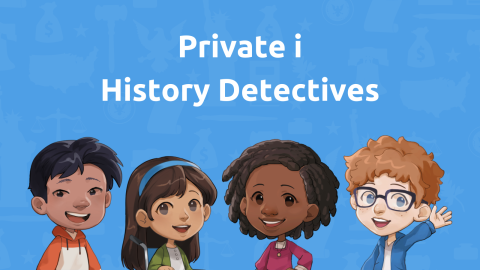
Private i History Detectives is iCivics’ first product made specifically for elementary students and fills a significant need for resources that teach the fundamentals of history and civics in K-5 classes. Product will be unveiled to teachers during a live webinar Nov. 1 for educators.
CAMBRIDGE, Mass. – October 25, 2022 – iCivics has released Private i History Detectives, a new curriculum for K-5 that taps into young learners’ natural curiosity and uses inquiry to teach the basic skills that students need to understand history and civics.
Private i History Detectives is a powerful new tool that elementary educators can now use to help their students build foundational historical and civic knowledge, as well as inquiry and critical thinking skills early in their education. This will ensure that students understand how history has and continues to shape our country’s institutions and our own roles as citizens as they continue through middle and high school and into adult life.
Born out of a collaboration between iCivics and History’s Mysteries, through the Library of Congress’s Teaching With Primary Sources (TPS) initiative, the curriculum challenges young learners to take on the role of history detectives. They must use primary sources and inquiry skills to answer “big questions,” such as “What does it mean to be a citizen?” It then guides them through age-appropriate discussions with teachers. The curriculum is easy to use and aligned with state standards.
Private i History Detectives is the first curriculum iCivics has developed specifically for the youngest learners, a segment of the learning population that is traditionally underserved when it comes to civics. Over the next few years, iCivics will continue to expand its K-5 resources.
“For civic education to be effective, we must approach the subject just like we approach STEM and literacy, teaching the fundamental skills starting in elementary school,” Taylor Davis, iCivics Director of Curriculum and Content, said. “Private i History Detectives, breaks historical inquiry skills into simple, easy to grasp concepts in a way that is fun and engaging so that we can meet young learners where they are.”
The full K-5 curriculum is now available for teachers to use, for free, on iCivics’ website.
“After working with many educators, it became clear to us that elementary teachers were hungry for quality, primary source based lessons that would excite and engage their students,” said Laurie Risler, Elementary Education Instructor at Westfield State University, and History’s Mysteries co-creator. “Private i History Detectives requires even the youngest students to think deeply and draw conclusions based on primary source evidence. In the role of history detectives, students do the work of historians as they answer questions using evidence from primary sources.”
Private i History Detectives will be officially unveiled at a launch webinar that is open to educators and school administrators on Nov. 1, 2022, at 7 P.M. EST. The webinar will feature Taylor Davis, Director of Curriculum and Instruction for iCivics, History’s Mysteries co-creators Kelley Brown and Laurie Risler, who are both educators, and Natacha Scott, Director of Educator Engagement at iCivics.