
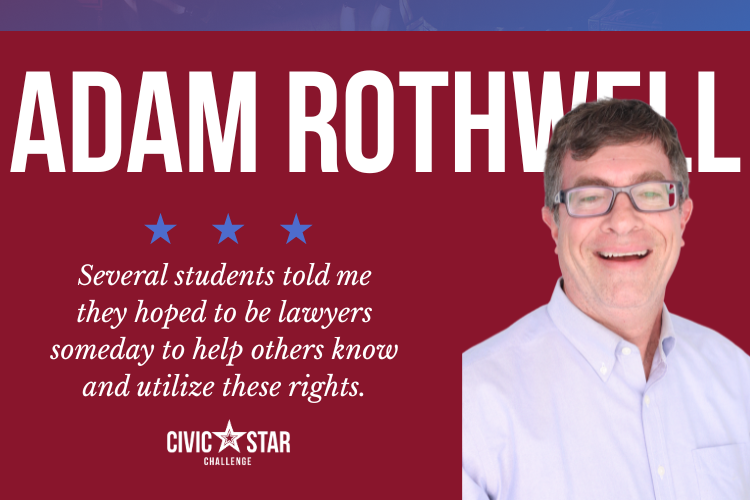
I’m the only teacher in Baltimore County Public Schools focused solely on Homeland Security. I sometimes describe the subject as “social studies with all the lessons coming from the last 30 years.” We mainly focus on the government response to threats – foreign, domestic, natural, and man-made. My classes are part of a pathway program that supports students as they explore a range of careers; from law enforcement to law school, even cyber security.
My students are especially interested in understanding their own rights, including at school. They ask direct questions: Can our phones be tracked? When can a locker be searched? Where is the line?
We ground the answers to those questions in the Constitution itself. In my Law class, we spend a lot of time talking about the Bill of Rights. I was searching for a resource that could help tie together ideas from across the unit and the Civic Star Challenge led me to Accused? Know Your Rights. It was exactly what I was looking for. The lesson considers the 4th, 5th, 6th, and 8th Amendments using a variety of formats, including narrative, match, and personal reflection. It spoke to students with a range of abilities, and I was impressed by the very high percentage completion rate.
I look for ways to extend learning beyond the classroom. As it happens, our area is resource-rich in lawyers! So following the iCivics lesson, I invited one to visit our class. Students were able to ask about how the rights we’d been discussing applied in a court of law. They were shocked to learn that the Miranda Warning they’d heard so often on TV wasn’t a common issue. Why? The proliferation of body cameras. But perhaps the ubiquity in pop culture is also part of the Warning’s effectiveness: students almost instinctively know they have the right to remain silent and request a lawyer. Now they also understand where those rights come from.
This year marks the 250th anniversary of the Declaration of Independence. It’s also the 25th anniversary of 9/11. For this course, those connections are immediate. To deepen that learning, I plan to take students to the 9/11 Memorial and Museum in New York City next fall. We are raising funds by selling small American flags, with a goal of 2,977, one for each victim. Students are also creating a display to honor those lives. It’s a way to connect what we study in class to real people and real events.
About Adam
- Teaching experience: 6 years
- Currently teaching: High school Homeland Security
Adam spent 20 years practicing immigration law before earning a Master of Arts in Teaching in Special Education. He now teaches the majority of a Homeland Security Pathway at Chesapeake High School in Baltimore County Public Schools. The views mentioned in this post are his own.