
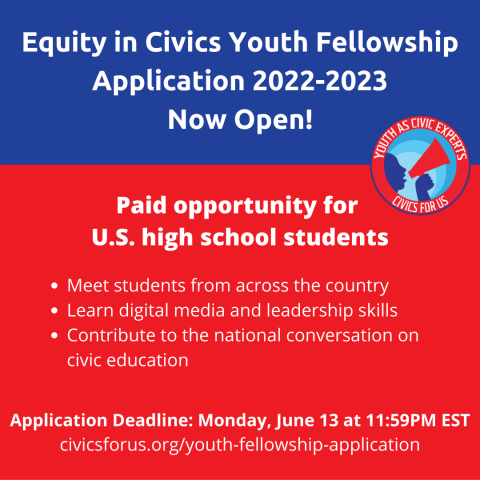
Do you have students entering 9th–12th grade interested in civics, education, equity, government, history, justice, or politics? They may be perfect candidates for the Equity in Civics Youth Fellowship.
This paid, 10-month fellowship brings together a talented group of high school students from around the country to think globally, act locally, listen to others, and build coalitions. Fellows will utilize their lived experiences to shed light on how civic education can include student voices and become more equitable.
During this virtual program, fellows will research issues of equity in civic education in their school communities and address the practices and policies related to their civic learning experiences. They will engage in group projects and guided discussion; build and lead student voice campaigns; and benefit from a variety of other experiences.
We welcome all high school students* who meet the following criteria to apply by June 13, 2022.
- U.S. student in high school* during the 2022–23 school year.
- Interested in civics, education, equity, government, history, justice, or politics.
- Ability to attend an in-person gathering in Washington D.C. in October 2022 (paid for by the fellowship program).
Interested students must complete the student application and also have an educator/mentor complete a nomination form to be considered for the program.
We hope you’ll share this incredible learning and civic engagement opportunity with your students. We appreciate all you do to help develop our nation’s future leaders.
*This program is for rising 9th–12th grade students living in the United States, District of Columbia, and Puerto Rico.