
My students love learning and they excel academically. And recently, I discovered that they also have a flair for the dramatic.
It was the beginning of the school year. As part of the Civic Star Challenge, I adapted a unit created by my mentor Jeannie Holloway. The goal was to help students see that the Constitution did not appear out of nowhere. It grew out of real arguments about power, rights, government, and human nature. I kicked things off with a short video introducing the Enlightenment thinkers: it’s a lecture/infographic featuring Thomas Hobbes, John Locke, Montesquieu, Jean-Jacques Rousseau, and others.
Then I asked the students to become those thinkers. In groups, they wrote skits that placed the philosophers in contemporary, sometimes wacky scenarios. Then they grabbed their scripts and got on their feet.
We were transported to a pizza parlor, where the thinkers tried to decide the best way to split a pizza – an allegory for the separation of powers. (Hobbes also argued that putting pineapple on pizza was evil.) Then we visited an extravagant hotel restaurant, where they debated effective leadership over pancakes. Another skit—considering life, liberty, and property—was set in a bank: Locke and Hobbes were security guards confronted by some would-be robbers, Jean-Jacques Rousseau and Montesquieu:
Montesquieu: (interrupting, now deeply focused on dividing the cash) Calm down, Hobbes. I’m simply restoring order—true order. (Starts separating the bills into neat piles.) Equal separation of power, just like how the government should work.
Hobbes: (near breakdown) This isn’t about power! You’re robbing the bank! We need strong laws, a king, someone in charge! Without that, everything falls into chaos—like this!
Rousseau: (shaking his head) Laws? Kings? Hobbes, you’ve been brainwashed by corrupt authority. Society is what corrupts people, not the other way around. We’re just taking back what society has stolen from us!
There were props (including tea cups and fake money), accents, and robust discussions after each performance.
America is a country founded on debate. Even the idea of establishing a federal government caused a vigorous disagreement, which continues to this day. I want students to understand that disagreement is not a problem to avoid. It is part of how our country was built. When students can step into different points of view, argue from them, and even laugh with them, they begin to see civic learning as something alive.
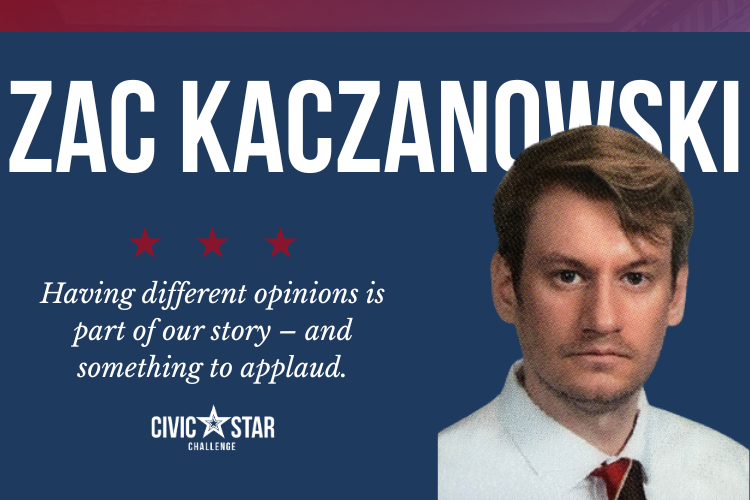
About Zac
- Teaching experience: 13+ years
- Currently teaching: 6th Grade World Geography, 7th Grade World History, 8th Grade US History
With experience in teaching in mainland China for 8 years, Detroit charter schools, and currently at a gifted and talented program, Zac brings a global and civic-minded perspective to social studies education. His work centers on civic education, constitutional literacy, and helping students think critically about democracy, government, and their role as informed citizens. He was recently named his district’s Teacher of the Year.