
On July 17, 2024, we were filled with excitement and anticipation to bring together 60 K–12 educators for our first iCivics Educator Convening held in Sacramento, California. This event was hosted in partnership with California’s Power of Democracy Civic Learning Initiative, sponsored by Chief Justice Patricia Guerrero to bring equity to civic learning across the state of California by connecting courts with educators.
The majority of the participants consisted of 44 educators representing 19 counties from across California, who were thrilled to connect with the educators who traveled from 14 other states: Alabama, Arizona, Florida, Idaho, Illinois, Louisiana, Nebraska, New York, Oklahoma, Pennsylvania, Rhode Island, Texas, Utah, and Virginia.
Teachers came to the convening with a vast range of personal goals, from learning how to “utilize strong resources in helping students understand our government and their role within it,” to “meeting with enthusiastic civics teachers, get[ting] inspired and energized.”
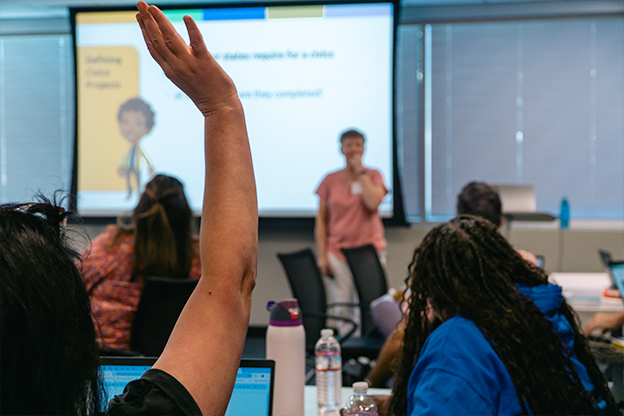
The agenda for the day was packed with learning opportunities, including a student panel discussion, two sets of breakout sessions exploring a variety of topics and resources, and a conversation about building relationships with the judicial branch. The two Californian students from the iCivics youth fellowship kicked off the day with a conversation around the importance of engaging youth in politics and sparking conversations that show how civics can be relevant in students’ daily lives and future career paths.
New and current iCivics educators got great insight into iCivics curriculum resources and how to implement them in the classroom. Sessions helped participants understand how to amplify their voice to advocate for civic education, teach the 2024 election using the iCivics Election Headquarters, engage students in civics projects using our step-by-step approach, bring U.S. Supreme Court cases from iCivics’ Landmark Library and games like Brief the Chief into civics classrooms, and integrate inquiry into classroom instruction.
After the interactive sessions, educators reconvened for a plenary session featuring Justice Judith McConnell, who presides over the state’s Fourth District Court of Appeal, and Santa Clara County Superior Court Judge Julia Alloggiamento. Together they presented why and how courts support educators in classrooms starting in elementary school. Teachers were invited to connect with the Power of Democracy’s Judges in the Classroom program, modeled after similar efforts in the state of Washington. Many put in their requests on the spot for visits this September, Constitution Month.
We worked hard to make sure that our iCivics Educator Convening felt unique. We were intentional about designing an experience for our educators that not only focused on the knowledge, skills, and dispositions of civic learning, but also modeled best practices for the classroom. Educators were given space to connect with peers, collaborate, and process the information they were exploring in sessions to help the learning stick a little bit stronger. And we were delighted this was reflected in participating educators’ feedback!
“I was SO impressed by the convening. I am used to being disappointed by professional developments... This experience was a full 180 for me. The civic project curriculum was DIVINE. ... [It] has SO much more than I have learned yet, and is perfectly and expertly laid out for students. I was also deeply heartened to be in a room full of teachers like me—that kind of solidarity is so precious and rare in K–12 education. ... You all inspired me to keep pushing for civics education—which presently does not exist at all for 6th graders in my district. I am going to be told that there ‘is no time’ to teach the election, and I feel much stronger and prepared to defend my stance now.”
Trina English, Middle School Teacher, California
“I felt very seen as an educator. I enjoyed getting to know people from around the country and making new friends. This has also sparked an excitement in me when I've been feeling burnt out and a bit hopeless… so thank you for re-lighting my spark!!”
Manuwella Allen, High School Teacher, California
“The tools and resources provided through today's convening illustrate how important civics education at the elementary school level needs to be implemented statewide. This education directly impacts the trust and understanding of our civic responsibilities and our democratic process; it shouldn't be a mystery or a ‘figure it out’ mindset.”
Linda Roberts, Elementary Teacher, California
Our first iCivics Educator Convening in California concluded with a sense of optimism and determination among educators to elevate civic education as a priority. We hope to make this an annual event to bring together educators to re-energize, build community, and leave with a deeper understanding of the amazing resources available for their classrooms.
Our great thanks to the Koret and Stuart Foundations for making this event possible as part of their commitment to supporting iCivics’ robust professional learning for CA civics educators.
Written by Natacha Scott
As the Director of Educator Engagement at iCivics, Natacha focuses on growing the engagement of educators in-person and virtually through professional development sessions, curriculum, and other experiences. Prior to joining iCivics, Natacha was an educator at Boston Public Schools for 14 years, serving in various roles from elementary classroom teacher to the district K-12 Director for History and Social Studies. She is passionate about place-based learning and engaging educators in meaningful learning experiences that can immediately translate into the classroom.