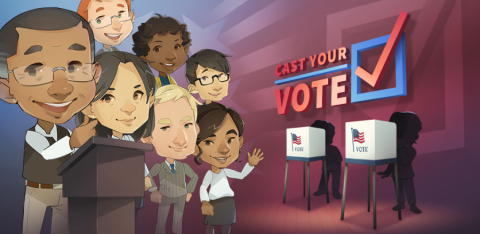
This year, we had 37,000 students test two of our best election games: Win the White House and Cast Your Vote. In the first, you are challenged to build a winning campaign for the presidency: strategic messaging, fundraising, and polling included! In the second, you must discover what it takes to become an informed voter – values, key issues, and candidates’ stances – before casting a vote in an imaginary local election. Both games were modified. Slightly.
Before game-play, students had to answer a short quiz. Questions assessed content knowledge (such as “What is an incumbent?”), but also civic dispositions – meaning a set of tendencies and qualities that lend to democratic character formation – such as “How likely are you to get involved in a political campaign?” or even “I plan on following the news around the next election.” Then, once they played the game, students answered those same questions.
The results exceeded our best expectations.
Students improved on every question. For questions touching on civics content, scores increased 26% on average; for questions touching on civic dispositions and behaviors, we saw an astonishing 38% jump. In other words, 30 pleasant minutes of gaming and a few clicks later: students gained knowledge on the Electoral College and voting, expressed greater personal interest in these topics as well as dispositions to take part in them.
Here is the good news: we have 14 more high-quality games that would benefit.
While simple on its face, such a tool has value for teachers. One Wisconsin civics teacher put it clearly, “pre- and post- assessments are a huge opportunity to determine what students are learning from playing the simulations.” We now have a model that can be replicated in all of our games. Moreover, questions could be personalized for the classroom or game, according to each teacher’s wishes. It would help them inform their classroom instruction on a national scale. To be clear, iCivics firmly believes that the best teaching involves, well, teaching. Games cannot replace educators – but they can empower their teaching.
iCivics has pioneered game-based philosophy since 2009. Educational games, when done well, are one of the great tools of modern learning. Games involve students in the learning. Through simulation, students step into a new civic world. They become the President, a lawmaker, a community activist, a pamphleteer in 1787 (with the fancy wig, too), a mayor, and so many other roles. With iCivics, they get to do their jobs and explore their world. Most importantly: they see where they fit in it.
Even at the tender age of 79, having never touched a video-game in her life, our founder Sandra Day O’Connor was convinced of the merits of edu-gaming. Today – nearly 12 years later – 120,500 teachers all across America agree. Beyond gains in knowledge and dispositions, games get young people to wonder, to ask questions, and to be open to learning. We inspire students for civics life. Only then do we teach it.
Written By Gabriel Neher
Gabriel oversees much of iCivics’ institutional fundraising, with a focus on foundation relationships. He serves as principal grant writer, and manages the grants and report calendar. Gabriel graduated from Northeastern University in 2015 with a degree in psychology and criminal justice.
This research was made possible through the generosity of the Stanton Foundation.