
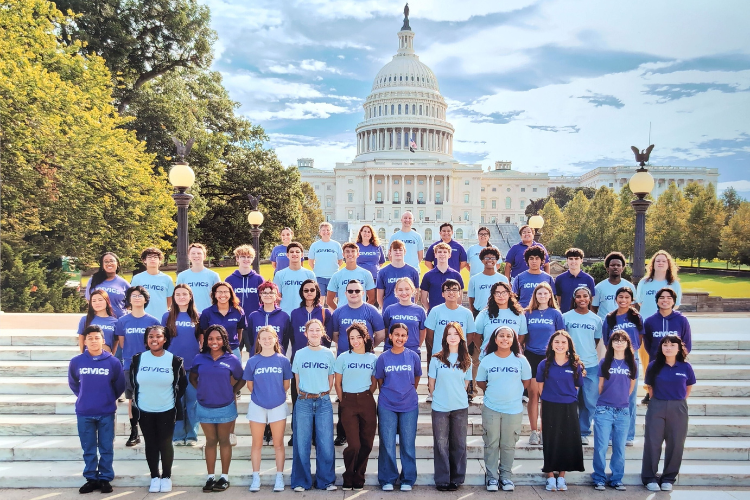
Huddled beneath umbrellas on a drizzly day in our nation’s capital, the newest cohort of iCivics Youth Fellows sat in small groups at the edge of the Tidal Basin. Deep in conversation, they reflected on the words and legacies of some of America’s most influential voices, encountered through the surrounding monuments and memorials. Though nearly complete strangers, the students engaged with one another’s perspectives as they looked ahead to the year they’ll spend together.
Held September 25–29, the Washington, D.C. Symposium serves as the in-person kickoff to the fellowship year. Fellows connected and built community while learning alongside alumni mentors and iCivics staff. They explored the home of the federal government with visits to the U.S. Capitol, the Supreme Court, and the White House, and spent time among the monuments and museums of the National Mall, including the Library of Congress, the National Museum of African American History and Culture, the National Gallery of Art, and the National Museum of Natural History.
Here’s some of what the Fellows had to say about the trip:
- “The iCivics Youth Fellowship has given me the opportunity to understand perspectives that I hadn’t otherwise interacted with. The amount of passion each fellow had for their platforms is a picturesque example of civic engagement and advocacy. Seeing other people my age lobbying for change gives me great anticipation for the future.” – Ava June T. (KY)
- “The trip to Washington, D.C. made me think about not only the foundations of American democracy, but my role within it; it made me question what it truly means to be civically engaged, and why civic engagement is so important. Seeing monuments like the MLK Jr. and Korean War memorials made me think about our moral obligation to stand for what’s right, not just as Americans, but as humans. Conversing with my peers expanded my mindset and helped me better understand varying perspectives, even when I didn’t always agree. Overall, the trip represented the very purpose of this program, which is to inspire students across the country to uphold America’s democracy.” – Camryn H. (OH)
- “I am very thankful for the D.C. trip. It helped me to see the real workings of our government in person, which I find really awesome. Thanks to iCivics, I was able to foster discussion with youth fellows who share a passion for civic engagement, and diversify both my own perspective and those of my peers.” – Bradley M. (Alumni Mentor, CA)
The iCivics Youth Fellowship is a paid, yearlong program for U.S. high school students to build a movement led by and for young civic leaders. Designed to elevate and center youth voices, the fellowship fosters a pluralistic, talented community of students from across the country. Over ten months, Fellows engage in an immersive civic learning experience, investigating, discussing, and sometimes debating questions like: How can I identify civic issues I care about and connect them to others’ experiences? How do we use civil discourse to find common ground in disagreement? And how can I share my voice as an advocate for civic learning and engagement?
The connections and friendships established in D.C. are invaluable as Fellows embark on building their Civic Engagement Portfolios throughout the year, selecting from a range of experiences in their communities related to local policy, news, decision-making bodies, and service. They also conduct and share Community Research Projects that highlight their lived experiences with civic education and engagement. Later in the year, Fellows collaborate on Student Panel Discussions focused on regional or national civic education topics that connect across their local communities.
Upon completion of the program, Youth Fellows join our ever-growing Alumni Network. This network provides myriad opportunities, including applying to serve as an alumni mentor to a new cohort of Youth Fellows, representing youth voice and the civic movement at various iCivics events, and collaborating on the creation of iCivics resources. They have even been featured in media such as The Wall Street Journal, Chicago Tribune, and WBUR in Boston.
Spending a long weekend with this group of students filled my cup as I got to know each of their unique stories and interests, engaged in critical thinking and dialogue together, and shared laughs over meals. As iCivics works to inspire young people for informed civic engagement, these young leaders will no doubt help shape the future of civic learning and engagement in our country.
Whether you’re a Youth Fellows alumnus who’d like to share how the D.C. Symposium impacted you, a high school student interested in applying for next year’s cohort, or an educator eager to learn more, I’d love to hear from you!
Contact: [email protected]
Written by Troy Petrie
As the Associate Director for Youth Engagement at iCivics, Troy leads efforts to empower young people to find their civic voice and engage in their communities. Before joining iCivics, his happy place was in the classroom as a National Board Certified social studies teacher. Troy’s work is driven by a deep belief that we all have more in common than we do apart and that young people are the real changemakers in our society.