
Teaching civics at a career technical school is sometimes an exercise in translation. Wayne County Schools Career Center hosts 26 programs for high school juniors and seniors; from animal science to culinary arts to sports medicine, it really runs the gamut. My students are sometimes skeptical that knowing about government will help them excel in their trades. I like to say, “You may not need the Pythagorean theorem every day, but you do need to know your constitutional rights! You need to know what the law is!” And it’s my mission to show them why.
I do that by bringing the trades into my lessons. With criminal justice students, we connect the Bill of Rights to the work they hope to do. With nursing students, we talk about Medicare, Medicaid, and the policies that shape patient care. With students in service fields, we talk about the rules, rights, and responsibilities that affect the people they will serve. And we talk about how WCSCC, itself, resembles our country in its earliest years: here, students from a dozen other schools come together in pursuit of a common goal.
One way I build that bridge is by helping students see civics in the places they already know.
Sometimes it’s helpful to see the connections on paper—specifically, on maps of our region. As part of the Civic Star Challenge, I built a series of classes based on the Northwest Ordinance and Ohio’s path to statehood. Students aren’t used to using physical maps these days – they look on their phones for directions. So it was a bit of a novelty when we broke out maps of Wayne County and I asked them to start plotting coordinates. They were struck by the tidy grid of our 16 townships, each 6 by 6 miles. That framework is lasting evidence of the Land Ordinance of 1785.
I pointed out that Section 16 of each of these townships was reserved for public education. Why? Because the founders understood that if people are going to live in a republic of self-government, it would be vitally important that they have access to education. And so, we can connect the Northwest Ordinance to the free public education enshrined in the Ohio Constitution.
I also explained that the way each township is zoned determines whether you live next to a farm, a store, a factory, or a new housing development. And of course, each township has a trustee. When my students turn 18, they will not just vote for president. They will vote for local leaders who make decisions that shape the roads, land, services, and neighborhoods around them.
I see it as a calling to produce educated citizens. Although I couldn’t serve in the military like my siblings, teaching is a way I can fulfill my patriotic duty and keep our nation thriving for generations. If I can make the US Constitution feel tangible and alive to my students, they’ll be more likely to defend and preserve it. From time to time, I’ll get a letter or a message from a former student who is serving overseas and I’m reminded that civic education is not abstract. They understand that the Constitution is not just something we study. It is something people serve, protect, and carry with them. That makes me incredibly proud. That is what I want for all of my students, whether they become nurses, mechanics, chefs, public servants, business owners, or members of the military. I want them to see that civics is not separate from their lives. It is part of the communities they will work in, vote in, serve in, and help shape.
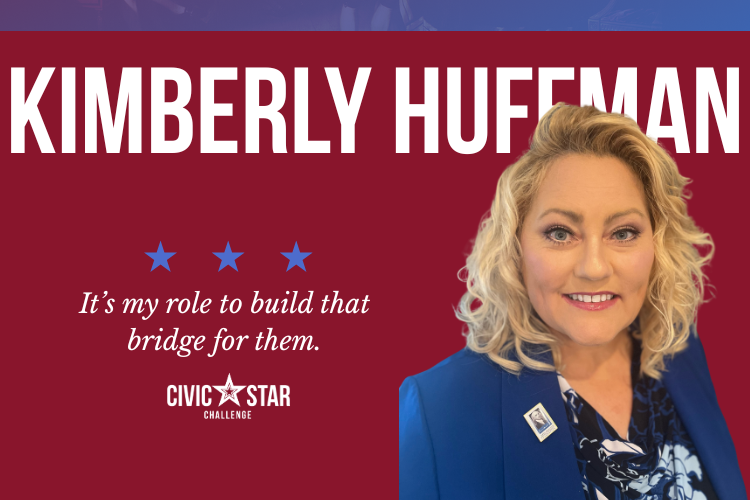
About Kimberly
- Teaching experience: 31+ years in Social Studies Education
- Currently teaching: American Government and CCP Political Science, Adjunct Professor
Kimberly Huffman is dedicated to helping young people enhance their constitutional knowledge and empower their political efficacy. Her teaching and leadership are shaped by deep commitments to promoting and encouraging democratic engagement. Through her service on NCSS and national educator networks, she hopes to elevate the importance of civic education across the country.