Cross-Country Connections: Perspective of a First-Time NCSS Attendee

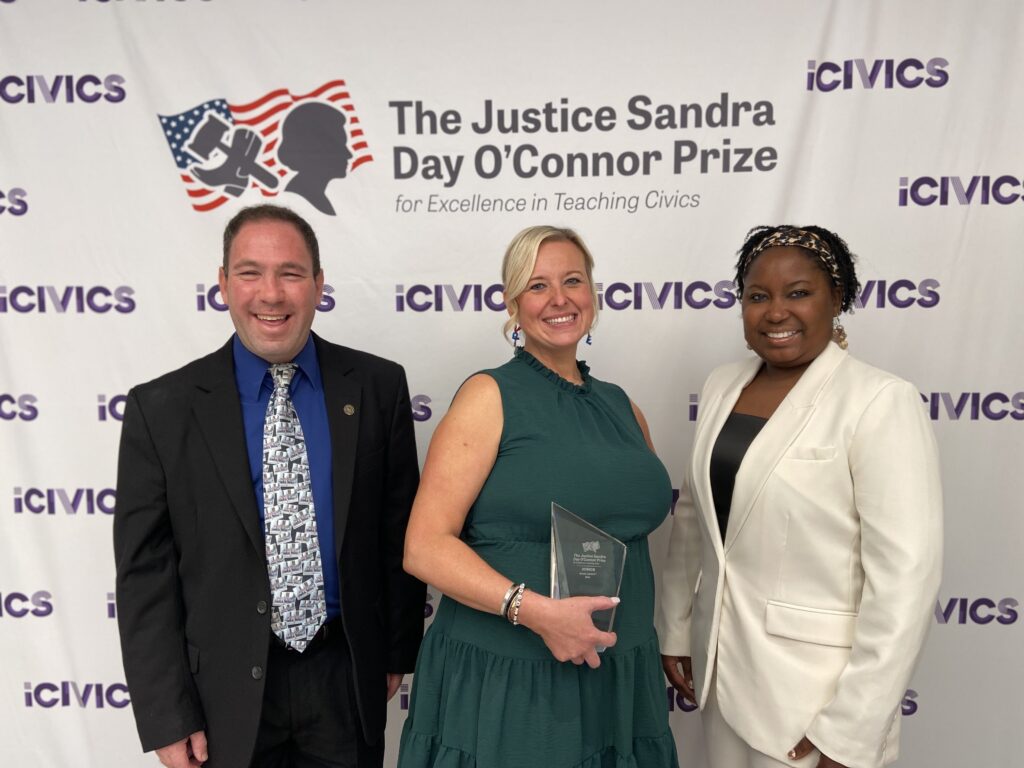
If you’ve never attended the National Council for the Social Studies (NCSS) annual conference, imagine a theme park for social studies teachers: endless sessions, passionate crowds, and more resources than any carry-on bag can handle. As a first-timer in 2025 and a finalist for The Sandra Day O’Connor Prize for Excellence in Teaching Civics, I attended the conference courtesy of iCivics, but I was not fully sure what I was walking into.

The Sandra Day O’Connor Prize

I have been to Washington, D.C., more than 100 times, including our annual school trip, vacations, teacher institutes, events, meetings, and visiting family. However, this trip seemed surreal. I was in town not just to attend NCSS, but also as a finalist for a prestigious award named in honor of one of my most revered Supreme Court justices.

Justice O’Connor was appointed to the court the same year that I was born, a coincidence I’ve always carried with a quiet sense of meaning. I grew up admiring that she was a free thinker. She didn’t automatically vote a certain way. She did it her way. To be associated with her—chosen by a committee that included former law clerks—was quite humbling. Before the award reception, I sat for an interview with the iCivics film crew and talked about how the justice influenced my teaching by instilling in me the idea that just because things have always been done a certain way doesn’t mean that they always have to be done that way. In my classroom, that mindset translates into endless possibilities! And while I didn’t win the award, I met some incredible people and got to reflect on what brought me to Washington.

#NCSS2025

When I first arrived at the massive Walter E. Washington Convention Center, I felt like I had arrived at London’s Heathrow Airport, scanning escalators and signage to figure out where to go. I clutched my iPhone and used the NCSS events app as if it were a treasure map. Thirty sessions in every time slot? It was a little overwhelming at first, but once I found my rhythm, the experience was nothing short of transformative. Luckily, I downloaded the NCSS events app and chose the sessions I wanted to attend ahead of time. I quickly found my bearings, and by the time I arrived at my first two featured speaker sessions, “How Hamilton vs. Jefferson Ignited the Lasting Battle Over Power in America” with the National Constitution Center’s Jeffrey Rosen and “What Democracy Demands: Congressman Hakeem Jeffries and Professor Hasan Jeffries in Conversation,” I realized I was in the middle of something remarkable: a national community of people who care deeply about the same work I do.

As the conference unfolded, each session was unique and inspiring, led by a teacher or professional at the forefront of social studies education. For me, highlights were Street Law’s look at the current Supreme Court term, virtual reality lessons in the social studies classroom, and Justice Ketanji Brown Jackson’s conversation—an hour I know I will remember for the rest of my life. Between the nationally known speakers and high-quality workshops, each session felt meaningful.

What also sets this conference apart is the opportunity to meet educators from across the country, all eager to share, exchange ideas, and collaborate. iCivics hosted a happy hour, which was the perfect catalyst for these conversations. I met a colleague from Florida who teaches a middle school civics class, and it was interesting to hear how she organized it. I met a teacher from Washington State who uses On Tuesday We Vote. Even Professor Hasan Jeffries stopped by, and I got to talk with him.

I would be remiss if I didn’t mention the exhibition hall, where educational nonprofits, services, institutes, museums, publishers, and historic sites had booths sharing resources. It was a reminder that the social studies ecosystem is far larger and more generous than I often realize during the school year. I wish I had brought a larger suitcase to fit all of the resources they gave me!

There’s something electrifying about standing in a place where every hallway, every room, and every conversation is anchored in the belief that social studies education shapes society. Some experiences broaden your practice; others broaden your perspective. NCSS, for me, managed to do both. My students will benefit from both my broadened practice and perspective. I’m excited to use what I learned to enrich their experience. I want that excitement to live on in my classroom, and I hope to find a way to attend NCSS next year and each year thereafter.

Written by Seth Harris

Seth Harris is in his 20th year of teaching middle school social studies. His passion is giving students authentic experiences in government, including his award-winning Law Day mock trial program at the Albany County Courthouse, We The People mock congressional hearings, listening to oral arguments at the Supreme Court of the United States, and attending local municipal board meetings. In addition to teaching, Seth served as deputy mayor of the Village of Menands for the past 12 years. He believes more people should get involved with their local government.

Through the iCivics Educator Network, the perspectives of teachers across the country contribute to the public conversation about civic education in the United States. Each contributor represents their own opinion. We welcome this plurality of perspectives.

iCivics Announces Inaugural Winner of The Justice Sandra Day O’Connor Prize for Excellence in Teaching Civics

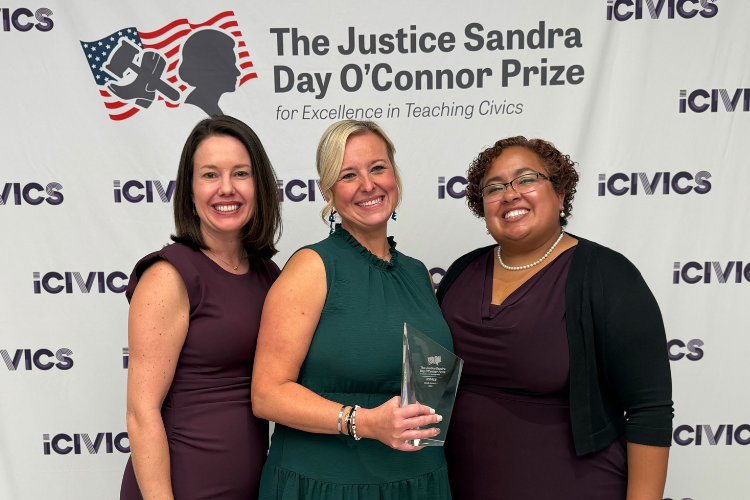
Shari Conditt, a U.S. history teacher at Woodland High School in Woodland, WA, is named the first recipient of the award that honors Justice O’Connor’s legacy in civic education

WASHINGTON, D.C. – [December 4, 2025] — iCivics, the nation’s leading civic education nonprofit and provider of free, nonpartisan civic education resources, today announced that Shari Conditt, a U.S. History Teacher at Woodland High School in Woodland, WA, is the inaugural recipient of The Justice Sandra Day O’Connor Prize for Excellence in Teaching Civics.

The award, presented at the annual conference of the National Council for the Social Studies (NCSS) in Washington, D.C., is named for Justice O’Connor, who founded iCivics after retiring from the U.S. Supreme Court. Seth Harris from Shaker Middle School in Latham, NY, and Dr. Shelina Warren from Paul Laurence Dunbar High School in Washington, D.C., were named as finalists for the award.

Unveiled just ahead of the 250th anniversary year of the Declaration of Independence (A250) in 2026, the prize was established by Justice O’Connor’s former law clerks to honor her unwavering commitment to civic education, a cause she considered her most important legacy and contribution to the nation.

Since she founded iCivics in 2009, the organization has grown to serve nearly 150,000 educators and 9 million students per year across all 50 states and 80% of U.S. counties.

Conditt has taught AP Government, AP U.S. History, and U.S. History for the past 25 years. She is a National Board Certified Teacher and a member of the iCivics EdNet. She was the 2024 Bill of Rights Institute National Civics Teacher of the Year, the 2016 Washington State History Teacher of the Year, and the 2025 Ft. Vancouver Region SAR History Teacher of the Year.

“Justice O’Connor adored teachers, and they in turn adored her,” said Louise Dubé, iCivics CEO. “She was their greatest advocate because she saw that they were the true stewards and protectors of this country’s constitutional democracy. Shari Conditt embodies everything that the Justice admired and held dear.”

The annual award recognizes exemplary members of the iCivics Educator Network, a group of more than 350 civics, history, and social studies teachers, who demonstrate particular excellence, dedication and innovation in teaching the foundations of democracy. The prize includes $5,000 and recognition at an iCivics reception during the NCSS Conference on December 4, 2025, in Washington, D.C. The finalists will also be featured in person at the Civic Learning Week National Forum in Philadelphia, March 9–10, 2026.

“The law clerks are pleased that their gift will recognize this year’s honorees, who are exactly the sort of effective, innovative, and dedicated educators that Justice O’Connor would be proud to honor,” said Kathleen Smalley, who clerked for Justice O’Connor in 1982.

Finalist Seth Harris teaches seventh-grade American history at Shaker Middle School. He runs the school’s Law Day mock trial and serves on the Student Council, has earned multiple awards for excellence in education, and has also served as deputy mayor of Menands.

Finalist Dr. Shelina Warren is the Director of the Eleanor Holmes Norton Law & Public Policy Academy at Paul Laurence Dunbar High School. A National Board-Certified educator with over 20 years of experience, she is an Army veteran and an award-winning leader in experiential, justice-centered civics education.

In addition to unveiling the prize at NCSS, iCivics will be highlighting valuable new educator supports designed to make teaching about A250 easier, more engaging, and more joyful for classrooms. The Civic Star Challenge helps educators bring the themes of the Declaration of Independence to life in the classroom—with the chance to win cash prizes. GoodEd.ai is a co-planning tool made for and by civics and social studies educators that helps teachers adapt trusted iCivics lessons and primary sources to the needs of their classroom and local community. The We Can Teach Hard Things initiative features educators sharing research-backed strategies for navigating difficult topics. Investigation Declaration, iCivics’ award-winning game, immerses students in a historical mystery that reveals how Enlightenment ideas shaped the Declaration.

iCivics also named the following educators as semifinalists:

  • Anne Hester, Lee County Schools, FL
  • Kimberly Huffman, Wayne County Schools Career Center, OH
  • Don Jenkins, Former teacher, Edmonton, MN
  • Linda O’Dwyer, Parker Junior High School, IL 
  • Sam Westerdale, Rangeview High School, CO
  • Christian Wrabley, Greater Johnstown Senior High School, PA
  • Ryan Werenka, Troy High School, MI

An Important Week to Honor Civic Educators

This week marks the second anniversary of the passing of Justice Sandra Day O’Connor—one of the greatest civic educators our nation has known. And at this moment, on the eve of the 250th anniversary of the Declaration of Independence, her legacy feels especially urgent.

As we remember her, thousands of civics, history, and social studies educators from across the country are gathering in Washington, D.C. for the annual National Council for the Social Studies (NCSS) conference. There, we will also name the first recipient of the Sandra Day O’Connor Prize for Excellence in Teaching Civics—an award honoring a teacher whose dedication reflects the values she championed.

Justice O’Connor adored teachers. She trusted teachers. She believed teachers were the beating heart of a healthy republic—our frontline defenders of constitutional democracy.

If she were still with us, she would be thrilled to see educators gathering in our nation’s capital to sharpen their craft, support one another, and reaffirm their commitment to preparing the next generation for civic life.

Justice O’Connor’s own story makes clear why she valued this work so deeply. Raised on the Lazy B Ranch, she grew up with responsibility, grit, and a deep sense of community. Those early lessons shaped her judicial philosophy: practical, independent, consensus-driven. Throughout her public life—from pioneering service in state government to becoming the first woman appointed to the U.S. Supreme Court—she embodied the civic virtues she hoped young Americans would learn.

After leaving the Court, she dedicated herself fully to strengthening civic education nationwide. She visited classrooms, championed educators, and urged policymakers and community leaders to take civic learning seriously. She was instrumental in sparking the early conversations that eventually helped catalyze a national movement around civics renewal.

If Justice O’Connor could walk the halls of NCSS today, she would immediately recognize the passion of the educators gathered there. Yet she would also see the unprecedented challenges they face:

  • culture wars that turn historical facts into political flashpoints,
  • declining trust in institutions and in one another,
  • the disorienting rise of artificial intelligence,
  • and a civic vacuum created by decades of underinvestment.

And still, teachers show up—every day, in every state. They teach students how to debate respectfully, analyze evidence, understand our constitutional system, and see themselves as contributors to their communities. They work with students to build the critical thinking, communication, collaboration, and creative skills to navigate the democracy and economy of the AI age. They do the work Justice O’Connor dedicated her later life to advancing.

The timing could not be more urgent. The kindergartners who entered school this fall will graduate in 2038—the 250th anniversary of the Constitution’s ratification. They are the “A250 generation,” coming of age amid historic levels of technological disruption and political division. What they learn about democracy today will shape the country they lead tomorrow.

The 250th anniversary of the Declaration of Independence in 2026 gives our entire nation a once-in-a-generation civic moment. Across the country, America250 commissions, museums, cultural institutions, tribal nations, and community organizations are preparing programs to reconnect young people with our founding principles and with the full, plural story of who we are.

Justice O’Connor believed every young person—regardless of geography, background, or politics—deserved access to high-quality civic learning. That is a worthy rallying cry this week especially. 

As NCSS educators gather in Washington, as communities across the country prepare for the 250th anniversaries, and as we reflect on two years without her, it is clear that we must carry her mission forward by supporting civics—and supporting civics teachers.

Lower the Temperature: How Amanda Perschall Teaches Hard Things

When I first saw the We Can Teach Hard Things initiative roll out from iCivics, I laughed. No, really, I chuckled pretty loudly. It’s a little unclear if I was laughing because of my students or because of myself. There’s a sign on my board that reads “You can do hard things,” as I encourage my students not to give up when they meet some resistance. I’m sure there are other educators out there who have had a similar experience with students post-pandemic; they simply give up faster than they used to. I spend a not insignificant amount of time encouraging, cajoling, and pushing students to work to their full potential, rather than stopping at the starting line. The deeper reason for my laughter, though, was about my own teaching experiences. Being a social studies teacher in rural Missouri is currently a challenge. Being a government teacher is an even bigger challenge.

This is my 20th year teaching social studies at the same large, public high school. Throughout this time, I have witnessed a shift in our national and state politics that has impacted my daily job. The Missouri in which I was educated was a purple bellwether state comprising a solid mixture of political parties. I entered the teaching profession when Missouri had a new Republican supermajority, which it has continued to hold since. My students think I’m making up fairy stories of our two-term Democratic governors. But the job of the government teacher is not to influence their politics. The job is to help them learn about our government, how it works, and how they can be involved. The work of many civics organizations has helped bolster my practices. I am eternally grateful for their continued support. 

The National Constitution Center focuses on distinguishing between a constitutional question and a political question. The temperature in the room during a discussion naturally lowers when you point students back to the Constitution, asking them to find textual evidence to support their ideas. Is this something that the government can do? Or is it something that we should discuss politically—if they should do it? Separating the two types of questions allows students to learn and discuss without focusing on opinions.

Checks and balances are a recurring theme of concern in government classrooms. I typically point students to the Constitution and legal precedent for what is textually there. What does the Constitution say? We will then discuss historical norms. What has typically been true in similar situations in history? The conversation then might shift to current headlines. Can Congress and the President do that? By focusing first on Constitutional and historical evidence, students can move beyond simply agreeing or disagreeing based on their political background.

iCivics’ games, like Branches of Power, help address the content while also overcoming another problem: engagement. Many students start the year with barriers to learning about our content. They’re overwhelmed and disgusted by the way society, especially on social media, engages with political questions. Nonpartisan games, like those of iCivics, help reshape the narrative into a more productive one. Suddenly, students are not as worried about Republican vs. Democrat, but are simply trying to win the game.

With some more controversial topics, I rely on resources from places like Streetlaw to help frame the lesson. Whether they’re the most engaged or least knowledgeable, having students all start from the same source material helps ensure they’re all on a level playing field for discussion. Shifting from a debate mindset, where there are winners and losers, to a deliberation mindset, where there is only conversation, has been a game-changer. Politics is not zero-sum; many things can be true at the same time.

Using eduprotocols and structures to shape the conversation is a must with controversial topics. Check out the Project Zero thinking routines from Harvard. Students are able to rely on the boundaries of the situation to keep each other on task. I am a big fan of assigning positions rather than relying on what students personally believe. Many students are still exploring their opinions. Some are less informed than others. Not all viewpoints will be equally shared by students. Assigning positions allows everyone to participate and a variety of viewpoints to be heard.

But before I dive into anything too deeply in my classroom, we spend considerable time establishing norms and behaviors for civil discourse. Especially in an era when our conversations have devolved, I want my students to learn how to excel in conversation. Drawing on resources from the Cato Institute’s Sphere, the National Constitution Center, and others, we learn about how to engage with each other and with topics that may cause dissension. Building norms, practicing empathy, and leading with curiosity change the temperature of hot-button discussions. You are much more likely to be able to discuss a sensitive topic with someone with whom you have a positive, appropriate relationship. My students would tell you I frequently tell them that I expect them to be better than the political pundits they see on television. I find that students are willing and more than able to exceed my expectations, having rich conversations.

What should you do when someone complains? Whether students, parents, administration, or community members, our content lends itself to objection. It’s become too easy to complain without knowing the full context. Grounding your practice in solid pedagogy with a variety of sources helps protect you from concerns. I would also encourage you to find your allies. Education is a team sport best played with others who are excited to support you. Remember that you are a trained professional, making learning choices purposefully. Share with others all of the work you’re doing. I’m always willing to meet and discuss with those who might be concerned; almost every time, this diffuses the situation. Everything I do in my classroom is easy to show to parents and administrators; there aren’t any secrets here. More than once, I have met with concerned parents who were simply missing the full context and breadth of the lesson. Upon seeing all we were doing, they switched from being concerned and upset to being some of my biggest cheerleaders. Clear, consistent communication is the key.

Some of the compliments I treasure most from across my career are when students have told me that what we discussed in class became the family conversation that night. You shared what we learned with your parents? You cited textual evidence for your thoughts? You elicited more dialogue with the people in your house? TEACHER WIN! No matter what they believe or what position they take, fostering more civil conversations is a huge success.

My best advice to other educators is not to shy away from the hard things. You’re doing an amazing job and literally changing the world. Your students are learning because of you. Don’t give up!

Written by Amanda Perschall

Amanda Perschall has been teaching social studies at Lebanon High School for the past twenty years, currently covering Government (dual-credit, honors, and on-level), U.S. Women’s History, and World Religions while serving as the department chair. While working on her MAE from Truman State University, she did her student teaching internship in Bamberg, Germany, on a U.S. military installation. Each spring, she leads a trip for her seniors to Washington D.C., Philadelphia, and New York City. Among other commitments, Amanda is a board member for the Missouri Council for History Education and is in the iCivics Educator Network.

Through the We Can Teach Hard Things initiative, the perspectives of teachers across the country contribute to the public conversation about civic education in the United States. Each contributor represents their own opinion. We welcome this plurality of perspectives.

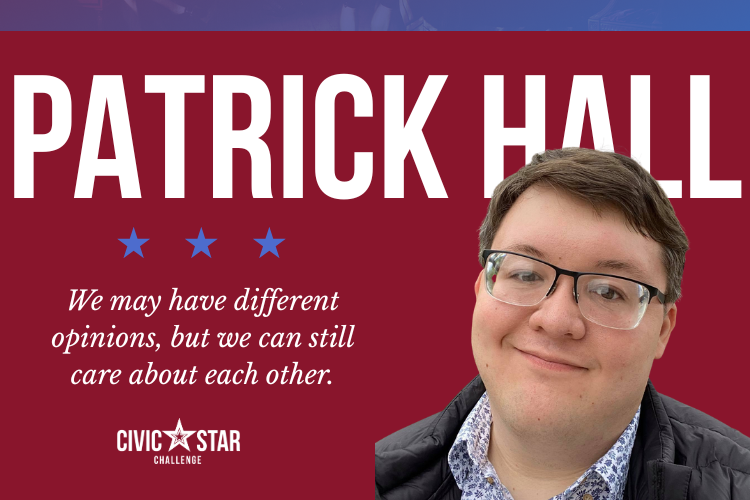
Patrick’s students explore natural rights with Civic Star Challenge

Recently, my political science class participated in the Civic Star Challenge. Jumping off the iCivics Enlightenment Mini-Lesson, we took on the idea of natural rights. Now I admit that, as with many civics concepts, the subject can come across as very dry. But after defining the Lockean approach, I threw it to the students: “What does it mean to be free?”

It’s a question teenagers are rarely asked.

I’m lucky to engage in spirited discussion with my adult colleagues. Fun fact: I’m also a graduate of Hazard High School. And I remember what it’s like to be sitting in class, thinking about where I might fit into my town and the world beyond. I was able to push my students to consider this, as well, using the iCivics graphic organizer and reflection activities (log in to view these resources). This mindset proved key to getting them talking.

“What does the right to life, liberty, and property mean to you?”

One student immediately focused on healthcare: “If we have the right to life, then doesn’t that mean we also have a right to healthcare?” Another identified the Second Amendment: “Liberty means that I have the right to my firearms, right?” (We live in rural Kentucky, and hunting is a popular pastime, of course!)

Pretty soon, the students were discussing the topic like the philosophers of the Enlightenment. Sure, the vocabulary was different. But there was something kindred in the spirited exchange of ideas. I reminded them that all the great figures across time and history were, on one level, just regular people—regular people who went on to do extraordinary things.

When we treat politics as if it were a sport and become obsessed with crushing the other side, it can become easy to lose sight of the fact that we are all living, breathing humans worthy of dignity and respect. We’re a school of just 300 students, and each one has so much heart. If something happens within our community, the response is all hands on deck. Bobby Jo from down the street may have a different political opinion from you, but she’s your neighbor, and she will bring you an apple pie when you get sick. We may have different opinions, but we can still care about each other. We have to hold both of those things at once. My students have shown me that they are eminently capable of that.

About Patrick:

  • Teaching Experience: 6 years
  • Currently teaching: World History, U.S. History (regular and dual credit), and Political Science/Civics

Born and raised in Perry County, KY, Patrick is passionate about identifying and building connections between Appalachian Kentucky, the rest of the Commonwealth, and the wider world for his students. He also serves as a Regional Network Lead in the University of Kentucky-Jewish Heritage Fund Holocaust Education Initiative (UK-JHF HEI) and a steering committee member of the Kentucky Council for the Social Studies (KCSS).

High Schoolers use Private i Lesson to Teach Kindergarteners

For elementary teachers, time is precious. How and what they teach is constantly balanced between the important and the urgent. Oftentimes, social studies is pushed aside—taught only if there’s time left in the day. But there’s a lot elementary teachers can do to teach civics and promote good civic practices. It doesn’t have to be limited to lessons about presidents, checks and balances, or the Constitution. Being an engaged citizen often starts with a question—and through iCivics’ Private i History Detectives curriculum, students in grades K–5 get a solid foundation on what it means to be a good citizen.

In an effort to embrace and engage younger students in the democratic process, my AP Government & Politics students built civic engagement lessons using iCivics’ Private i units. Last June, three students—Lyla, Rachel, and Desi—visited a kindergarten class at the Slaybaugh School in Egg Harbor Township. The goal was simple, yet challenging: the high school students needed to build a lesson that had a civic component without being obviously partisan or too difficult for the kindergarteners to grasp.

The AP Government students found the lesson cleverly designed. Framed as a detective story, it asks students to investigate what makes a good leader. My high schoolers first went through the lesson themselves and then adapted it into an interactive, age-appropriate activity for their younger buddies. Rachel, one of the seniors, said, “I liked how the resources can be used for all ages. My friends and I could play in class, or I could use it to teach the little kids.”

The senior team simplified the content, created visuals, acted out leadership scenarios, and led discussions with the kindergarteners about what it means to be kind, fair, and responsible.

Watching my students take ownership of the material and find ways to connect it to five-year-olds was a powerful teaching moment. It gave them a chance to reflect on leadership traits in a deeper, more personal way and reinforced the idea that civic values can—and should—be taught at every age.

The kindergarteners were fully engaged—asking questions, pointing out good (and not-so-good) leader behavior, and even coming up with their own “classroom leader” rules. The partnership between older and younger students added a level of connection and mentorship that went far beyond a traditional classroom lesson.

Lyla told me that what she liked most about the experience was the early exposure to civics—without it being explicitly labeled as “civics.” She said, “I liked how the Private i resource made it easy for the kindergarteners to begin building knowledge and establish good habits about civics and leadership at a young age.”

iCivics has always done a great job of making civics accessible and engaging, but this experience using Private i: What Makes Someone a Good Leader? in a cross-age teaching format was exceptional. In just one hour, the kindergarten students learned a lot about leadership, developed civic learning skills, and came together as one classroom community.

If you’re an elementary teacher new to using iCivics, I highly recommend the Private i lessons to foster leadership, empathy, and a sense of civic responsibility across age groups.

Written by Michael Martirone

Michael Martirone teaches AP Government & Politics and World Cultures at Egg Harbor Township High School in New Jersey. He is also an adjunct professor at Richard Stockton University. In 2016, Michael was a finalist for the New Jersey State Teacher of the Year, and in 2020, he was named the Gilder Lehrman History Teacher of the Year for the state of New Jersey. He has been a member of the iCivics Educator Network since 2017.

Through the iCivics Educator Network, the perspectives of teachers across the country contribute to the public conversation about civic education in the United States. Each contributor represents their own opinion. We welcome this plurality of perspectives.

We Can Teach Hard Things Like Due Process

You’re a social studies teacher, and it’s time to teach due process. Unless you’ve been living in a cave or severely limiting your media diet (which is hardly an unreasonable habit), then alarm bells may be starting to go off in your head. Don’t worry! We’ve got you covered.

As always, the first thing you want to do is consult your state standards. Let’s use an example.

To pick a state, I decided to throw a dart at the map on my office wall. Unfortunately, it’s a world map from 1986, and I’m bad at darts, so it landed on Czechoslovakia. Let’s go with California, since that also starts with a C. Sorry, Colorado. You, too, Connecticut.

Exhibit A. Evidence of Emma’s super below-average dart-throwing abilities, which has been leveraged in defense of my husband’s new rule that “Emma is not allowed to throw darts in the house”. I checked, and the rule does not apply to the kids or the dog, so I’m filing an appeal on strict scrutiny grounds.

Here’s what Standard 8.2.6 for Grade Eight United States History and Geography: Growth and Conflict in the History-Social Science Content Standards for California Public Schools says: Students analyze the political principles underlying the U.S. Constitution and compare the enumerated and implied powers of the federal government.

  1. Enumerate the powers of government set forth in the Constitution and the fundamental liberties ensured by the Bill of Rights

Here’s what Standard 12.5.1 for Grade Twelve Principles of American Democracy and Economics says: Students summarize landmark U.S. Supreme Court interpretations of the Constitution and its amendments.

  1. Understand the changing interpretations of the Bill of Rights over time, including interpretations of the basic freedoms (religion, speech, press, petition, and assembly) articulated in the First Amendment and the due process and equal-protection-of-the-law clauses of the Fourteenth Amendment

We’ve got the standards! We’re making progress. Now, it’s time to craft the perfect lesson plan.

But first, remember when I said that you’re allowed to turn off “Breaking News” notifications on your devices? I meant it, but I can’t help but share with you these wild “due process-related” headlines:

  • Man claiming to be a U.S. citizen held for deportation (Ng Fung Ho v. White)
  • President signs order forcing all people from a certain country to report to detention camps (Korematsu v. United States)
  • Florida man denied counsel in misdemeanor case; sentenced to 5 years state prison (Gideon v. Wainwright)

You’re probably on to me. You know these are historical headlines, not current ones. Here’s the thing: you and I both know the overwhelming majority of our students couldn’t tell us if these things happened yesterday or over 100 years ago, as is the case with the first bullet point. That presents an opportunity to “Use historical examples instead of current ones.”

Based on the direction I’m taking here, this presents an opportunity to “Use primary sources, secondary readings, and/or digital media as ‘grounding texts.’” Here are some I recommend, although please don’t think you need to use all of them!

Primary Sources

  • The Fifth and Fourteenth Amendments of the Constitution; Article 1. Section 9 of the Constitution
  • Supreme Court decisions in Ng Fung Ho v. White, Korematsu v. United States, and Gideon v. Wainwright

Secondary Sources

Educational Media

As students learn about and evaluate historical examples, it’s only natural that they make comparisons to the present day and current events. That’s perfectly fine, and brings us to another piece of We Can Teach Hard Things guidance: Build compare and contrast skills by asking students to distinguish current events as typical or not typical.

How is what they’re seeing today similar to or different from the way things have unfolded historically? That said, be sure to help students identify unfair or false comparisons. A controversy today may evolve very differently from the way it would have appeared to evolve in the past, but are we truly comparing two identical episodes? What makes them similar? In what ways are they different?

Also, be cautious of complex Supreme Court decisions that involve multiple holdings or holdings that may have been reversed or weakened by subsequent decisions.

And lastly, if a student raises their hand and says something to the effect of, “Aren’t we deporting people now without hearings or trials?” or “I heard the government is putting everyone who looks Hispanic in detention camps. Is that true?” I encourage you to refer back to the guidance we provided in our previous blog post on teaching about the separation of powers. The great part about that guidance is that it’s content agnostic! No matter what the student’s question is, assuming it’s not grossly inappropriate, it is always appropriate to acknowledge and address it at a later time.

Admin Tip: Take a look at your state standards related to due process. This will give you confidence in your ability to field any inquiries or challenges from off-campus stakeholders. As always, tell your social studies teachers you are there to support them!

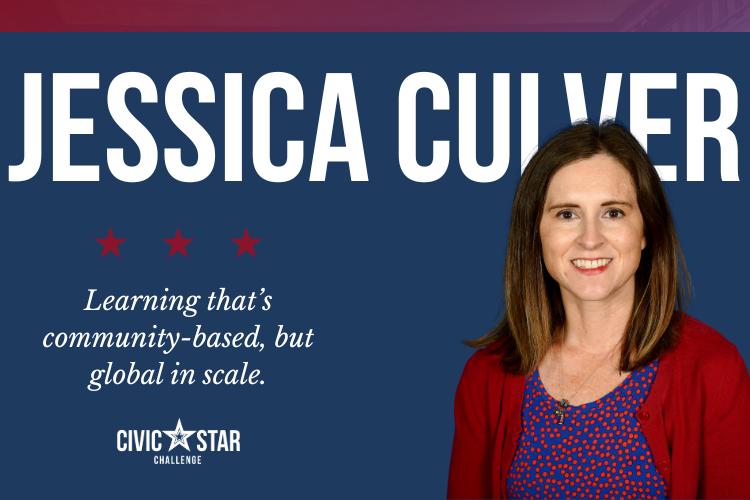
Jessica transports students to American Revolution through Civic Star Challenge

Our school is nestled in the Ozark Mountains of Arkansas, and it’s a real hub of the community — it seems like nearly everyone’s mom, dad, or grandparent works as a teacher, bus driver, or secretary. We graduate about 120 students a year, and I’ve known most of them since birth. Though we’re rural, we’re far from isolated. Travel is a passion of mine, and I’ve shared it with students through fellowships and trips: from meeting Gen. Colin Powell in D.C. to studying in France. And soon my students will be part of Senator John Boozman’s youth cabinet in Little Rock.

Still, some of the most transporting experiences happen right in my classroom. That’s what the Civic Star Challenge is all about. When we learn about the American Revolution, I try to turn my class into a time machine.

That starts by challenging the students to walk in the shoes of colonists. We learn about what they wore, how they created their clothes, and even how they brushed their teeth. We also learn colonial era dances! Then we create life-sized portraits of Federalists and Anti-Federalists. The students trace their bodies on giant pieces of paper, then complete the portrait. Students are able to see – and feel – history come to life. Rather than it just being something listed in a book, they can imagine what it’s like to be these people.

From there, we talk more about what it would be like to experience the tumult of the Revolution first-hand. In one class, we took all the events of the American Revolution and they had to write a text to their friend explaining what was going on:

Guess I won’t be sending letters anytime soon. #quittaxingus (Stamp Act, 1765)

The water in the Boston Harbor smells like chamomile! #ThrowTheCratesOverboard #TeaParty (Boston Tea Party, 1773)

The Treaty of Paris has been signed! #NewCountryWhoDis (Treaty of Paris, 1783)

Students are often tempted to parrot back the definitions and explanations they find in their textbooks. While that type of learning is important, I find it’s crucial to find ways for the students to make civics their own. I often say, “You have to say it in your own words or it doesn’t count.” Last week, we spent a whole class decoding the Preamble to the Constitution. Actually, they did the decoding. I stood in the back of the room while the students parsed those 52 words and came up with their own version:

We, in the USA, want a better country.

We will have fair laws.

We will have a peaceful country.

We will have a military to take care of our people.

We will care for our people.

We want to bless the future people.

Now we will put the rules down for this country.

We also find ways to engage the system directly. Each year, the students research Arkansas’s D.C.-based elected officials. They’ll write them letters. And, soon after, the officials will write them back. It’s always so exciting to watch the students hold the Capitol Building stationery up to the light to see the watermark. From there, we’ll set up a call on Zoom – again, I’ll stay at the back of the classroom and let the students run the show. And that’s where I really see the impact of civics learning: students understand how to both model and participate in respectful civic engagement. Even when they disagree with their elected officials, they speak thoughtfully and respectfully, grounded in the work we’ve done together.

After the call, there’s always a buzz in the classroom. The students say, “Wow, I can’t believe this person knows me!” It’s representative democracy in action, and proof that their voice matters.

About Jessica

  • Teaching experience: 23 years in Arkansas public schools
  • Currently teaching: High school Civics/Economics and concurrent college credit history courses

The Gilder Lehrman 2024 History Teacher of the Year for Arkansas, Jessica is the president-elect of the Arkansas Council for the Social Studies and has worked with a number of educational organizations from across the country. She is passionate about educational travel, community engagement, civic involvement, and rural education; she looks forward to completing her doctorate at the University of Arkansas in the spring of 2026.

Bill of Rights Institute and iCivics Announce First Round of Winners in Civic Star Challenge, a Nationwide A250 Initiative

Sixty-three educators have been awarded $300 each for integrating themes from the Declaration of Independence into their teaching in the lead-up to the 250th anniversary of the signing of the Declaration of Independence.

WASHINGTON, DC [November 10, 2025] The Bill of Rights Institute and iCivics have named the first round of winners of the Civic Star Challenge, a nationwide initiative to inspire millions of acts of civic learning in the lead-up to the 250th anniversary of the signing of the Declaration of Independence.

The Civic Star Challenge makes the teaching of the Declaration of Independence digestible and relatable to today’s youth by providing educators with a repository of adaptable lesson plans and activities that teach the key themes of the founding document. The resources are available at civicstarchallenge.org. Once educators have taught at least one of 11 themes, they can submit a log of their activities for a chance to win from a cash prize pool totaling more than $200,000.

The Challenge includes four rounds of random drawings, each awarding $300 to selected teachers, and an essay contest that has a $10,000 grand prize for the winning teacher’s school district.

The Civic Star Challenge is made possible through generous support from Griffin Catalyst, civic engagement initiative of Citadel Founder and CEO Ken Griffin; the Stand Together Trust; and The Pedersen Foundation.

Today, the 63 winners of the first round of drawings have been announced. The teachers represent more than 25 states.

“The Civic Star Challenge honors the educators who keep America’s founding principles alive in their classrooms,” said David Bobb, President and CEO of the Bill of Rights Institute. “Their work reminds us that civic knowledge and virtue are essential to sustaining liberty for the next generation and to helping students see their role in preserving a free society.”

“The celebration of the 250th anniversary of the Declaration of Independence is an incredible moment to engage in the teaching of our founding documents and in civic education in general – and this has never been more critical,” iCivics CEO Louise Dubé said. “We’re proud to be able to reward teachers for their efforts to connect the themes and ideals from the Declaration to the present.”

The winners are listed below:

Meredith Baker

Andrea Bauck

Jason Bennett

Nicole Bloodgood

Laura Bowersox

Patricia Capobianco

Stacey Clark

Allison Collie

Rachel Cox

Jessica Culver

Scott Cvelbar

Deborah Damboise

Marin Fairbanks

Taneeta Fair

Lauren Feld

Kristina Fischer

Jami Forrester

Randall Furash-Stewart

Jayme Gafford

Nicole Gasparik

Heaven Gomez

Andrew Gordon

Donna Gustafson

Evelyn Homan

Jeanette Hooks

Andrew Hutchinson

Andrea Jandt

Lindsay Kahoe

Samantha Keaton

Bridget Kaiser-Munday

Kennady Longhurst

Jeffrey Maendel

Laura McFarren

Amanda Meyer

Austin Migoski

Lindsay Miller

Katrina Neubrandt

Rachel Newman

Jackie Osborne

Beth Oswald

Michelle Palmer

Patrick Pavelchik

Victoria Pierce

Samantha Rumbaugh

Amanda Runkel

Anne Schmitt

Tiffany Smith

Tracy Son

Donna Stark

Adeline Steger

Adam Sturm

John Suter

Rachel Tate

Hailey Thomas

Deborah Torrens

Sam Westerdale

Holly Wittwer

Daryl Workman

Bryon Wren

Kymberli Wregglesworth

Nicole Wright

Blanche Wulfekoetter

Greg Yarnall

Teaching with The Constitution EXPLAINED

iCivics resources have proved invaluable to every one of my social studies classes, from Civics to African American Studies, to my dual enrollment courses in American Government. Supporting students in their learning about the Constitution is no easy task, as there is so much to cover in a semester course regarding all things civics (as I’m sure many other educators can empathize with—especially those who teach AP Government in a semester, you’re rockstars!). One resource that I would highly recommend to support students in their learning is the Constitution EXPLAINED video series. The videos provide a solid foundation in teaching the big ideas of complex constitutional thinking.

The Constitution EXPLAINED videos that teach the three branches of government are required content resources in my classes because they effectively summarize and condense the big ideas in just a small handful of minutes. For example, when teaching the Legislative Branch, there are numerous videos to select from to support students, one of my favorites being The Do’s and Don’ts of Congress. This is because it provides a solid understanding of the powers and limitations of Congress, while also giving students an opportunity to critically think for themselves about how they think Congress should act by asking, “Do you think the Elastic Clause has been stretched so far that it gives Congress too much power?” Without even having to ask, my first hour automatically launched into their own small group discussions, and it was wonderful to watch.

Whether they were making connections to what they’ve learned so far in class, in other classes, or with current events, the students all seemed very ecstatic to share what they believe. It’s also a conversation I know I can easily revisit, as they really enjoyed their time processing ideas or concepts they would like to see in their lives regarding the ‘dos and don’ts’ of Congress, which is impressive for their age. I love seeing this type of learning come from a resource that is less than 3 minutes long because it turned into a 10-minute conversation, and I’m sure it could have gone on for the rest of the period as well. Each class responded a little bit differently, had different suggestions on what implied powers Congress should or shouldn’t have in a modern society, and had questions on how to create changes within Congress’s power, as well as the other branches of government.

From the educator point of view, the supports that come with each video are also fantastic. The transcripts for each video allow me to provide supports for students with different learning abilities and students who are multilingual learners. The Teacher’s Guide explains how to create a lesson from the video, including vocabulary supports, guiding questions, and learning supports, which are also written in Spanish. There’s even a Claim, Evidence, Reasoning prompt that I plan to use when I teach with these resources next semester, where “students work in pairs to find examples of when the Elastic Clause was used in history. Students should find evidence to support the claim that the use of the Elastic Clause increased Congress´s power. Students can then prepare a one-minute speech explaining their reasoning. They can record their speeches (video or audio) and use visuals for support.” This is a great example of how iCivics provides scaffolds for both new and seasoned educators alike, and offers educators a way to think about teaching differently in the future while also increasing the rigor of their students’ constitutional thinking within our current reality.

Written by Sam Westerdale

Sam Westerdale is in her 14th year of teaching high school social studies in Aurora, Colorado, with classes in Civics and African American Studies. With the support of a James Madison Fellowship awarded in 2018, she earned a master’s in Political Science and also teaches dual enrollment classes in American Government, State & Local Government, and Introduction to Political Science. Sam is a member of the iCivics Ednet Teacher Network, the National Constitution Center’s Advisory Council, and is a Retro Report Teacher Ambassador. She is also a Board Director for the Colorado Council of the Social Studies, a member of the Civics for Colorado Coalition, and supports and trains student teachers through a local university. Sam has a strong passion for creating connections for her students on how to be involved in their community through a rigorous and culturally responsive civics background, along with what it means to support and care for others in an ever-changing world.

Through the iCivics Educator Network, the perspectives of teachers across the country contribute to the public conversation about civic education in the United States. Each contributor represents their own opinion. We welcome this plurality of perspectives.