
We Can Teach Hard Things Like Civil Rights

"The arc of the moral universe is long, but it bends toward justice."

That’s not a typo you see in the attribution above. While the oft-cited quote is chiefly credited to Martin Luther King, Jr., who did indeed speak those brilliant words during more than one speech, it was originally coined by 19th-century Unitarian minister and radical abolitionist from Boston, Theodore Parker.

Sources matter, especially in a blog post that promotes primary sources to teach civil rights. But first, why are we talking about civil rights in a series dedicated to “teaching hard things” — a series predicated on teaching traditional civics topics that have become controversial in this moment or in response to current events?

I’ll admit: civil rights wasn’t on my radar when we first conceived the “We Can Teach Hard Things” series. I was thinking more about the rule of law, due process, separation of powers, immigration, citizenship, and other government-related topics that have dominated recent news cycles. I wasn’t thinking about slavery, the rise of Twentieth-Century fascism, or the civil rights movement. But when we asked teachers, these topics kept being mentioned. Thus, here we are. Let’s talk about teaching civil rights.

We often teach history as eras, movements, or moments in time, and civil rights is no different. The phrase immediately conjures images of 1950s-60s America, and if you locate it in the index of a high school textbook, the page number will surely bring you to a chapter covering these decades. In other words, folks could be forgiven for mistakenly assigning it to a finite period in our nation’s history.

We know better. We know civil rights represents a tapestry we’ve been weaving since the very beginning of our nation, and we are certainly not done. In this way, civil rights is aspirational. It is also, I believe, inspirational. Nowhere is this truer than in the primary sources comprising the Americana canon.

WE hold these Truths to be self-evident, that all Men are created equal.

Darkness cannot drive out darkness; only light can do that. Hate cannot drive out hate, only love can do that.

The way to right wrongs is to turn the light of truth upon them.

Of all the great speeches, poems, letters, and more, the one that has always touched me the deepest is Frederick Douglass’ famous (and famously long-winded) What, to the slave, is the 4th of July?

In the opening sentence of his fourth of 71 (!!) paragraphs, he asks and answers his stinging question: “What, to the American slave, is your 4th of July? I answer: a day that reveals to him, more than all other days in the year, the gross injustice and cruelty to which he is the constant victim. . . .”

He continues his speech. Oh, boy, does he continue. It is scathing. It is raw. It is unflinchingly honest. Douglass pulls no punches.

I know what you’re thinking, “How is that inspirational or even aspirational?”

Stay with me. Stay with Douglass. His hope emerges in stark relief in his closing:

[. . . .] the Constitution is a GLORIOUS LIBERTY DOCUMENT. Read its preamble, consider its purposes. Is slavery among them . . . While I do not intend to argue this question on the present occasion, let me ask, if it be not somewhat singular that, if the Constitution were intended to be, by its framers and adopters, a slave-holding instrument, why neither slavery, slaveholding, nor slave can anywhere be found in it. . . . I hold that every American has a right to form an opinion of the constitution, and to propagate that opinion, and to use all honorable means to make his opinion the prevailing one. . . . 

Now, take the Constitution according to its plain reading, and I defy the presentation of a single proslavery clause in it. On the other hand it will be found to contain principles and purposes, entirely hostile to the existence of slavery…

Allow me to say, in conclusion, notwithstanding the dark picture I have this day presented of the state of the nation, I do not despair of this country. There are forces in operation, which must inevitably work the downfall of slavery. ‘The arm of the Lord is not shortened,’ and the doom of slavery is certain. I, therefore, leave off where I began, with hope. While drawing encouragement from the Declaration of Independence, the great principles it contains, and the genius of American institutions, my spirit is also cheered by the obvious tendencies of the age. . . .

When I think of Douglass’s speech in its entirety, I view it as the embodiment of what Alexis de Tocqueville referred to as “reflective patriotism.” In the Educating for American Democracy (EAD) report, reflective patriotism is described as “appreciation of the ideals of our political order, candid reckoning with the country’s failures to live up to those ideals, motivation to take responsibility for self-government, and deliberative skill to debate the challenges that face us in the present and future.”

Here are a few tips for making this speech, or any other source from the deep and wide library of American civil rights thought leadership:

  • As always, be sure to consult and follow your state standards, plan for a structured lesson with clear objectives tied to those standards, and communicate with stakeholders ahead of time if you have any reservations.
  • If you’re using Douglass’s speech or any other source from the 19th or 20th Century, you’re already following two pieces of guidance for teaching hard things: using primary sources as “grounding texts” and using historical examples instead of current ones. I would also suggest adopting an inquiry-based approach. A great focus for Douglass’s speech is the concept of distance. Perhaps you might ask, “How does Douglass use the concept of ‘distance’ to explain why he cannot join the Fourth of July celebrations?”
  • Don’t be afraid to “tamper with” the document — to alter it in ways that make it more accessible to students. Douglass’s speech is over 10,000 words long, and that’s only part of what makes it so daunting. I suggest following the advice of Sam Wineburg and Daisy Martin (2009)* and focusing, simplifying, and adjusting the presentation of the source. Shorten it. Cut or replace confusing words. Use a large font size, provide ample white space, and don’t be afraid to italicize critical points or provide a vocabulary legend. Sure, the purists may decry your “assault” on the original brilliance of the source, but between that and never showing it to students at all, I’m willing to face their criticism.

Something worth noting is that Douglass follows our guidance to focus on the office or institution rather than the person or party. He refers to lawmakers, the President, the Secretary of State, Congress, the Continental Congress — his is not an indictment of any person or politician so much as it is a nation struggling to live out one of its highest ideals: equality.

Our students deserve an education rich in this philosophy, and few topics in our discipline provide the seeds for this rich soil as much as civil rights. Yes, civil rights can be hard to teach, so lean into the primary sources that have paved the way toward our more perfect union. While many of their authors were surely not viewed as patriots in the 1850s or the 1950s, I challenge anyone today to tell me that Martin Luther King, Jr., Frederick Douglass, and Ida B. Wells were anything but.

iCivics has an entire unit dedicated to civil rights, but here are some of my favorite resources.

Admin Tip: It doesn’t take much to inspire and empower your weary history and civics teachers. A simple, “I’m really excited for our students to learn about civil rights from you,” would go further than you can imagine.

*Wineburg, S., and D. Martin. “Tampering with History: Adapting Primary Sources for Struggling Readers.” Social Education, September 2009. Accessed 12 February 2026 at www.socialstudies.org/social-education/73/5/tampering-history-adapting-primary-sources-struggling-readers

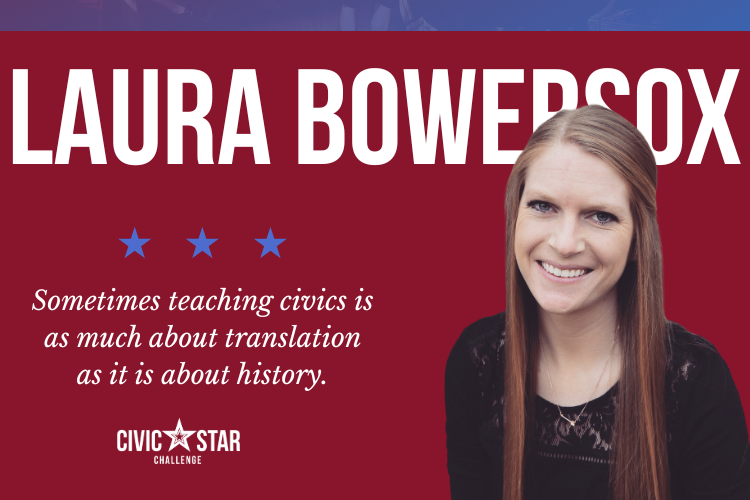
Laura uses pop culture to make the Declaration relevant to students for Civic Star Challenge

Sometimes teaching civics is as much about translation as it is about history.

As part of the Civic Star Challenge, I teamed up with my colleague, Laura McFarren. We wanted to come up with a way to help our students really plug into the Declaration of Independence. Our biggest challenge is making complex, old texts accessible to middle school students. We found that the best “way in” is to break it down for them—but first we have to grab their attention.

That’s where AI can be a help. We gave it grievances from the Declaration and asked it to paraphrase them in a style we knew would be familiar to the students. By catching their attention with pop culture icons and using language that is more familiar, students are able to better understand and, crucially, remember the original text.

Pop quiz! See if you can match the original grievance with the contemporary translation.

Note: We weren’t able to get the actual Taylor to give us an actual lyric, nor are the others direct quotes. But AI definitely channeled their voices!

  1. “For cutting off our Trade with all parts of the world.”
  2. “For depriving us in many cases, of the benefits of Trial by Jury.”
  3.  “For Quartering large bodies of armed troops among us.”
  4. “He has plundered our seas, ravaged our Coasts, burnt our towns, and destroyed the lives of our people.”
  5. “For imposing Taxes on us without our Consent.”
  1. “They demanded our money without asking. Typical. Theft, disguised as law. Charming.” – Wednesday Addams
  2. “He wrecked our oceans, trashed the coasts, set our towns on fire, and straight-up ruined lives. Total villain behavior.” – a Gen Z-er
  3. “You took away our right to speak, to fight, to be heard — like justice was just another thing you burned.” – Taylor Swift
  4. “He blocked our hustle, cut the cords to the globe — no deals, no flows, just chains on the growth. This ain’t freedom, it’s control. And we see it.” – Kendrick Lamar
  5. “He basically let a bunch of angry army dudes crash at our place without asking… like, bro, this isn’t the Krusty Inn.” – SpongeBob SquarePants

The students really leaned in—this was vocabulary that made sense to them. When Kendrick Lamar is spinning rhymes about the Declaration, all middle school ears perk up!

We even challenged our students to abandon words altogether! For example, the students recently looked at primary sources for events leading up to the American Revolutionary War. Then they had to analyze how colonists might have reacted to each event and boil it down to emojis. (We saw lots of tea cups and thumbs down!)

No matter the language, it’s my goal for the ideas in these historic documents and scenarios to resonate with the students—and stick with them. With the help of Taylor, they do!

About Laura

  • Teaching experience: 11 years in education
  • Currently teaching: 8th grade social studies

Laura Bowersox believes collaboration with other educators is an integral part of education and loves to seek opportunities to learn from others. She strives to help her students become intelligent, informed, and involved citizens.

(Pop quiz answers: A4, B3, C5, D2, E1)

Bill of Rights Institute and iCivics Announce Second Round of Winners in Civic Star Challenge, a Nationwide A250 Initiative

Sixty-three educators have been awarded $300 each for integrating themes from the Declaration of Independence into their teaching in the lead-up to the 250th anniversary of the signing of the Declaration of Independence.

WASHINGTON, DC [February 6, 2026] The Bill of Rights Institute and iCivics have named the second round of winners of the Civic Star Challenge, a nationwide initiative to inspire millions of acts of civic learning in the lead-up to the 250th anniversary of the signing of the Declaration of Independence.

The Civic Star Challenge makes the teaching of the Declaration of Independence digestible and relatable to today’s youth by providing educators with a repository of adaptable lesson plans and activities that teach the key themes of the founding document. The resources are available at civicstarchallenge.org. Once educators have taught at least one of 11 themes, they can submit a log of their activities for a chance to win from a cash prize pool totaling more than $200,000.

The Challenge includes four cycles of random drawings, each awarding $300 to selected teachers, and an essay contest that has a $10,000 grand prize for the winning teacher’s school district.

The Civic Star Challenge is made possible through generous support from Griffin Catalyst, civic engagement initiative of Citadel Founder and CEO Ken Griffin; the Stand Together Trust; and The Pedersen Foundation.

Today, the 63 winners of the second round of drawings have been announced. The teachers represent more than 30 states.

“The Civic Star Challenge honors the educators who keep America’s founding principles alive in their classrooms,” said David Bobb, President and CEO of the Bill of Rights Institute. “Their work reminds us that civic knowledge and virtue are essential to sustaining liberty for the next generation and to helping students see their role in preserving a free society.”

“The celebration of the 250th anniversary of the Declaration of Independence is an incredible moment to engage in the teaching of our founding documents and in civic education in general – and this has never been more critical,” iCivics CEO Louise Dubé said. “We’re proud to be able to reward teachers for their efforts to connect the themes and ideals from the Declaration to the present.”

The winners are listed below:

Natalia Allen

Jon Barnes

Andrea Bauck

Jason Bennett

Sherry Blenman

Laura Brucato

Cady Burstein

Cindy Cantu

Avery Keese

Morrow Kerins

Steven Leavitt

Andrea Longstreet

Laura McFarren

Linda McGinness

Joseph McGuire

Sarah Mensinger

Lisabeth Mikolajczyk-Harper

Laura Mirt

Evangeline Mitchell

Stephanie Nichols

Stacey Clark

Melanie Claros-Rodriguez

Christopher Crawford

Artur Da Silva

Daniel Dawson

Lauren Feld

Brittany Ferguson

Thomas Fulbright

Charles Oliver

Beth Oswald

Amy Palo

Kristen Parise

John Phillips

Shine Ray

Kristal Reeves

Stephanie Richards

Richard Rineberg

Kara Robinson

Michele Rowley

Shannon Salter-Burghardt

Jamie Shannon

Randall Furash-Stewart

Nicole Gasparik

Jennifer Graham

Anne Hester

Jean Hiller

Kimberly Huffman

Kevin Jackson

Jaclyn Jecha

Dawn Skelton

Craig Specht

Molly Stanley

Tabby Talbourdet

Shelly Tanner

Michael Thomas

Brande Vogele

Anne Walker

Nadia Westen

Kymberli Wregglesworth

Blanche Wulfekoetter

Gregory Yarnall

Heather Yates

ABOUT iCIVICS

Founded in 2009 by Supreme Court Justice Sandra Day O’Connor, iCivics is a nonpartisan organization dedicated to advancing civic learning by providing educators and students with the knowledge, skills, and resources needed to embrace and engage in our civic life together. iCivics empowers educators and leads the movement to make civic education a nationwide priority so all young people have the confidence to shape the world around them and believe in our country’s future. To learn more, visit www.icivics.org.


ABOUT BILL OF RIGHTS INSTITUTE
The Bill of Rights Institute is a nonpartisan, nonprofit organization that works to advance civic and history education through market-leading curricula and programs for educators and students. To learn more, visit www.mybri.org


ABOUT GRIFFIN CATALYST

Griffin Catalyst is the civic engagement initiative of Citadel founder and CEO Ken Griffin, encompassing his philanthropic and community impact efforts. Tackling the world’s greatest challenges in innovative, action-oriented, and evidence-driven ways, Griffin Catalyst is dedicated to expanding opportunity and improving lives across six areas of focus: Education, Science & Medicine, Upward Mobility, Freedom & Democracy, Enterprise & Innovation, and Communities. For more information, visit griffincatalyst.org.

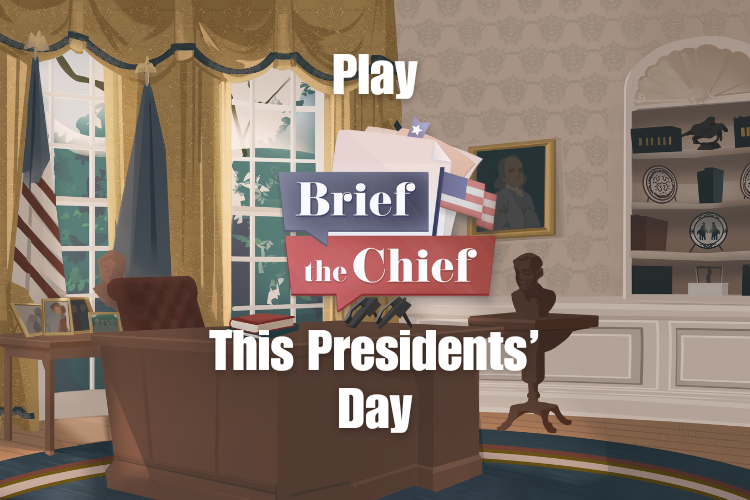
Play Brief the Chief this Presidents’ Day!

While we often associate Presidents’ Day with deals and discounts on electronics, furniture, and other goods, for most of American history, it was a day for commemorating the first president: George Washington. In fact, according to federal law, the holiday is still designated as “Washington’s Birthday,” even though it rarely falls on his actual birthday. After the Civil War, another February presidential holiday emerged: Abraham Lincoln’s Birthday. The holidays were eventually consolidated, and Presidents’ Day became more inclusive of all U.S. presidents.

While celebrations for Presidents’ Day vary from wreath layings and concerts to formal dinners and balls, one of the best ways to involve students in the occasion is by learning about the presidents, the challenges they faced, and the choices they made, and contextualizing the circumstances and consequences of those decisions. Good news—there’s a game for that!

In 2024, the White House Historical Association partnered with iCivics to launch Brief the Chief, a history learning game that teaches evidence-based reasoning, decision making, and critical thinking. As of the end of 2025, the game has had more than 500,000 plays, with peak play months in November and—you guessed it—February!

Our initial framing for Brief the Chief called for three administrations to be featured in the game. We wanted to select ones that were consequential, as well as historical moments that are generally taught across different state standards. We settled on three administrations from very different time periods in American history: Thomas Jefferson (1801–1809), Abraham Lincoln (1861–1865), and Lyndon Johnson (1963–1969). We also wanted to highlight both a well-known and lesser-known historical episode for each president (Jefferson: Port of New Orleans and Trade with Haiti; Lincoln: Fort Sumter and Emancipation Proclamation; Johnson: Voting Rights Act and Decision to Run for Re-Election).

The personalities and politics of Jefferson, Lincoln, and Johnson varied extensively, as did those of the people around them—there are nearly 30 historical characters dispersed throughout the game! A student can encounter figures such as Alexander Hamilton and James Madison, as well as lesser-known individuals like Elizabeth Keckley and Zephyr Wright. This was part of our concerted effort to balance diverse perspectives and give learners more historical context for the times in which these people lived.

Beyond the characters, we also gave significant thought to the settings for every scenario. Using the presidential offices made sense because each president used a different workspace (Jefferson in today’s State Dining Room; Lincoln in today’s Lincoln Bedroom; and Johnson in the Oval Office). As a result, students also get to visually experience different historic spaces of the White House and see how those spaces have evolved and changed over time to meet the demands of the presidency as an institution.

While more modern spaces, such as President Lyndon Johnson’s Oval Office and the Second Floor Kitchen, are well documented and photographed, this was not the case with the interiors of the Jefferson and Lincoln White Houses. In fact, there are no known drawings or images from Jefferson’s time (aside from floor plans), and the only known photographs of the Lincoln White House are of his office. To overcome the lack of visual documentation, two scenarios are set outside, as there is an abundance of drawings, paintings, renderings, and other visuals of the White House exterior dating back to its very beginning.

It is important to note that we ultimately decided that students would play the role of advisor rather than president because it allows them to be a witness to history, ask good questions, and make recommendations based on the evidence they gather. It also adds nuance to the idea of presidential decision-making, as leaders often rely heavily on people around them for information, expertise, and advice. One of the key takeaways we hope students will learn is that they have a role to play in shaping history, both in the game and in civic life.

So, we hope you will consider playing Brief the Chief with your students this Presidents’ Day (or anytime really!) We thank iCivics for their partnership in helping make this resource available to educators nationwide.

Written by Dr. Matthew Costello

Dr. Matthew Costello is the Chief Education Officer and Director of the David M. Rubenstein National Center for White House History, where he holds the Gerard B. Lambert Foundation Chair in White House History. In this role, he oversees the Association’s education programs, historical research, digital archives, public programming, and partnerships. Costello joined the Association in 2016 as the Senior Historian after completing his Ph.D. and M.A. in American history at Marquette University. He has published articles in academic journals and magazines, as well as two books. The first, The Property of the Nation: George Washington’s Tomb, Mount Vernon, and the Memory of the First President, was a finalist for the George Washington Book Prize. He also co-edited the volume Mourning the Presidents: Loss and Legacy in American Culture.

On the Educator Blog, multiple perspectives contribute to the public conversation about civic education in the United States. Each contributor represents their own opinion. We welcome this plurality of perspectives.