
Educators as Frontline Civic Workers: Teaching Elections

Education Week recently ran an article entitled, “Why Most Teachers Won’t Be Talking About the Election in Their Classrooms.” 

First, I want to clarify an important point, and then take up the larger underlying issue. While the article rightly notes that “most teachers don’t plan to address the 2024 presidential election” in referring to a broad survey of teachers across subjects, it is absolutely the job of our social studies teachers to leverage this teachable moment, and I know for a fact that many intend to do so.

To address the larger underlying issue, I share what the late U.S. Supreme Court Justice Sandra Day O’Connor frequently said, which led to her founding iCivics: “The practice of democracy is not passed down through the gene pool. It must be taught and learned by each new generation.”

As we near the 250th anniversary of this audacious experiment in self-government that we call the United States, it is essential for the next 250 years and beyond that each new generation be prepared to pick up the mantle.

That means we can’t shy away from tough topics. As one student noted, “We don’t stop algebra when it gets hard. We work through it.” I would argue we need that mindset at least as much for democracy as any other subject. 

I’ve been in this civic education business for more than 20 years. I know there are three co-equal branches in our government. I know how the Electoral College works. I know that we hold national elections on the first Tuesday after the first Monday in November because when else would we do it?

I know all of these things because I WAS TAUGHT ALL OF THESE THINGS. Sorry for shouting. This is my passion.

And I wasn’t just taught these things through textbook pages and worksheets unattached to the sometimes exciting, sometimes horrifying current events happening all around me. On the contrary, I was taught these things through current—and, yes, oftentimes controversial—events happening all around me.

No matter how messy things were, no matter how scared or uncertain I felt, I always knew that I could walk into my social studies class where a passionate, college-educated subject-matter expert would help me navigate the madness. Mr. Madden, Mrs. Stecker, Mr. Wilkner, Mrs. Moyer, Mrs. Tozzi, Mr. Beasley didn’t always have all of the answers. But they knew what I now know: that young people need structured, intellectual spaces to make sense of it all—to talk about current events, to discuss contentious issues, and to have their viewpoints both validated and challenged in a nurturing educational environment.

This year’s presidential election is unprecedented in a number of ways, and we do our kids a disservice if we don’t help them navigate these waters and, while we’re at it, help them see why they should care enough to dive in. 

This brings me to another important point. Every year, we hear the same thing: young people are apathetic.

That’s just not true.

It’s not that kids don’t care. It’s that WE—the “adults”—seem to have decided that we care so much that we’ve made politics taboo, controversial, and too incendiary for polite or even scholarly conversation.

In fear of appearing political, we’ve embraced, modeled, and encouraged disinterest. In doing so, we risk undermining the very mission of public schools to prepare young people for their roles as citizens in our democratic republic.

For the love of George Washington’s wooden, wine-stained teeth, can we please take a breath and teach the next generation a thing or two about the government they are to inherit?

Civic Engagement for a Global World

Fostering global competency in students is essential in today’s interconnected world. This is why iCivics has teamed up with Global Cities to host a two-part workshop series that explores new ways to connect local civic engagement to global topics and impacts while elevating your existing teaching curriculum. Stipends are available to participating teachers upon completion of at least one workshop. 

This workshop series, which takes place Oct. 7 and 8, equips you with the tools and strategies to foster your students’ capacity to advocate for and contribute to local, regional, or global improvement.

Learn more about each workshop:

Workshop 1: Advance Your Curriculum with the Codebook for Global Student Learning Outcomes

October 7, 2024 7:00 p.m. ET

This workshop focuses on using the landmark Codebook for Global Student Learning Outcomes to integrate global competency into curriculum and instruction. The Codebook allows educators to determine how well students are demonstrating global learning in any program or classroom.

Workshop 2: Explore Inclusive Problem-Solving Using Community Surveys

October 8, 2024 7:00 p.m. ET

Join us for a second workshop to explore how to teach attitudes and skills for inclusive problem-solving using community surveys. You will walk away from this workshop with the tools to actively engage your students with their communities.

By taking advantage of this learning opportunity, you’ll earn a small stipend for your professional development. Participants who attend one workshop will receive $25; participants who join both workshops in the series will receive an additional $50; and all participants, up to the registration limit and with preference given to those who attend both workshops, will be eligible to participate in a follow-up focus group on December 12 or December 17 from 7–8 p.m. ET for an additional $100. (The total stipend could be $175.)

For more information about Global Cities, visit their website.
For more information about Global Cities research, view the Codebook for Global Student Learning Outcomes.
To sign up for the workshop series, visit the registration page.

Reading Between the Lines of the United States’ Founding Document

Today is Constitution Day, which is especially worth celebrating in the midst of a contentious presidential election.


A special thanks to our partners in civic education at the National Archives in Washington, D.C.,  who gave me permission to post an image of the U.S. Constitution as part of this piece. It is a beautiful thing to behold, with its exquisite script flowing from the iconic “We the People” opening.

But underlying the words lie some fundamental values and commitments that are valuable to remember today. The first subtext is the essential importance of compromise. As the National Archives notes on its website, “The Constitution acted like a colossal merger, uniting a group of states with different interests, laws, and cultures [and uniting] its citizens as members of a whole, vesting the power of the union in the people. Without it, the American Experiment might have ended as quickly as it had begun.”

Under enormous pressure, the drafters and Constitutional Convention participants navigated innumerable difficult (and woefully imperfect) compromises to establish the United States of America.

Coming together for the common good is only possible through believing in something greater than oneself and embracing the humanity of those who may have different concerns, creeds, and circumstances. Even as majorities of Americans support compromise in our national politics, too many of our national leaders who presume to represent us seem to have lost sight of this in recent years. That has made the jobs of educators, local officials, and other civic actors harder in many cases.

Thankfully, our work at iCivics provides plenty of anecdotal evidence that our fellow citizens, including the rising generations, are transcending tribalism and partisanship to solve problems together in their communities. Cases in point are the 34 new iCivics youth fellows from diverse sociopolitical and geographic contexts across the United States who will be traveling to Washington, D.C., soon to continue their civic learning and leadership journey together.

The second subtext that speaks to me when I look at the U.S. Constitution is the sense that it’s nothing more than paper without the commitment of each successive generation to teach and learn it. iCivics is proud to support more than 145,000 teachers who reach more than 9 million students a year with our civic education resources, including a new Civic Digital Literacy initiative that provides nonpartisan, evidence-based, classroom-ready resources to help prepare students to skillfully verify the various pieces of information encountered online.

We are continually in awe of the educators we work with who are bringing the Constitution and other civic lessons into the classroom, even amidst the challenges too many are facing for simply doing their jobs in an increasingly polarized climate. Now, more than ever, it is important that our educators know they have our full faith and trust in this important endeavor.

Let’s use this Constitution Day to celebrate the subtexts, reaffirming our commitment to civic compromise, civic education, and civic educators. As our iCivics founder, the late U.S. Supreme Court Justice Sandra Day O’Connor, said, “The fact is that knowledge about the Constitution…is not something that is handed down through the gene pool; every generation has to learn it.”

If you’re interested in more information to help with Constitutional conversations in your classroom, around your dinner table, or anywhere else, visit our new iCivics website.

Reflection: National Hispanic Heritage Month

National Hispanic Heritage Month is a moment to inspire to honor the unique background Hispanic Americans share, something I wish I’d appreciated sooner. When I was growing up near the Philadelphia area, I regrettably saw my background as a struggle. It wasn’t until I moved to New Mexico for college that my relationship with my heritage changed for the better. I noticed a deep culture of civically engaged communities with their backgrounds at the forefront. It was in college that I discovered my passion for policy and civic education because now I could see myself and people like me in it.

Growing up as a daughter of Peruvian immigrants, my family never really discussed civics or government. While my peers’ families had multiple generations’ worth of knowledge and civic skills, I grew up never thinking civics had a place in my life because it was never discussed at my dinner table—which always consisted of the best Peruvian food—and I did not see people like me in social studies lessons at school. My family did, however, talk to me about where they came from and why we are here now. The possibilities of opportunities and liberty that they dreamt for our family were enough to take this leap of faith in moving to the United States. Stories ranged from experiences with strong communities and limited access to quality education to first-hand political violence and lack of democracy. 

While pursuing my master’s degree, I worked on a research project that helped me better understand Peru’s history, the background of this political violence, and how it quantifiably affected the country’s democracy. Moments like this college project and the childhood stories told by my family connecting to a newly discovered passion of mine reassured me that I was where I was supposed to be.

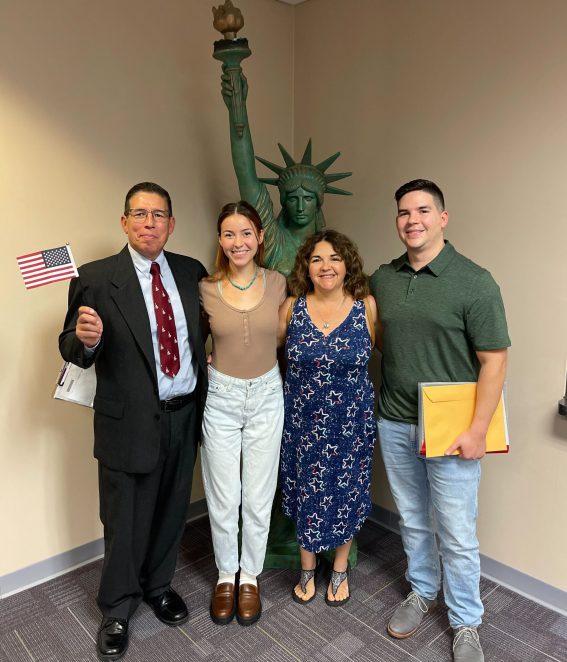
This past year, my parents passed their naturalization test and became U.S. citizens, joining my brother, who completed his in 2013. Political instability and increasing corruption in Peru’s democracy have often made it difficult to be excited about participating in a democracy. That changes now. 

This November, we will—for the first time as a family—exercise our right to vote and participate in the U.S. democratic process. Since my parents are gearing up to participate in this process for the first time, we are experiencing new democratic practices as a family. We have been informing each other of current political events, identifying key issues, engaging in discourse, and my mom is even applying to be a poll worker now that she’s eligible!

Citizenship pic

Written by Andrea Benites

Andrea is the policy coordinator for iCivics, where she focuses on advocating for the civic education field, policy initiatives, and the work of CivxNow. She is passionate about nonpartisan, equitable solutions to foster an inclusive government.

New Online Game Uses Eve of the Revolution to Teach Critical-Thinking Skills to Upper Elementary School Students

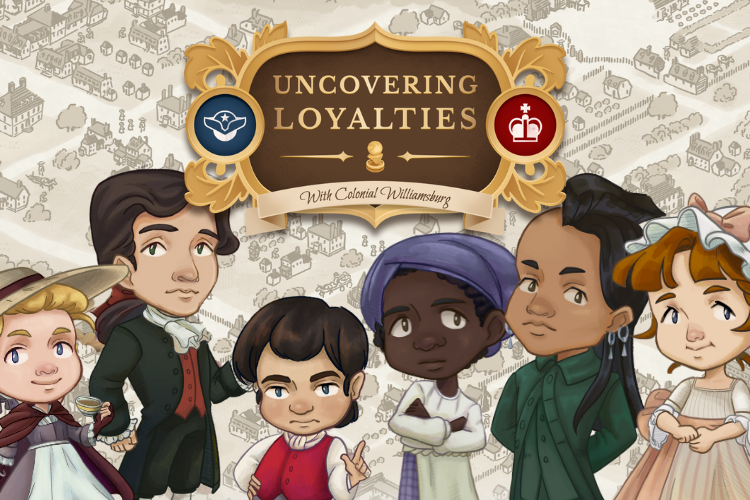
WILLIAMSBURG, Va. (Sept. 3, 2024)Today, The Colonial Williamsburg Foundation and iCivics released a new game that uses the eve of the American Revolution to teach upper elementary students how to apply critical-thinking skills and engage with multiple perspectives.

Uncovering Loyalties with Colonial Williamsburg helps young learners in grades 3–5 understand the tensions of pre-revolutionary Williamsburg and encourages them to learn how people from different backgrounds brought unique perspectives to American history.

Funded by the Bob and Marion Wilson Family, Uncovering Loyalties is set in 1774 Williamsburg, Va. With independence in the air, Lord Dunmore, Virginia’s last royal governor, asks players to explore the colonial city and see if rumors of revolution are true. Players engage with young people across different social classes and life experiences, identifying clues to determine if loyalties in colonial America stay true to Britain or lie with soon-to-be American patriots.

Clues vary from conversational snippets to found items. A ledger at a local pub shows that Thomas Jefferson had visited and that sentiment for a revolution may be moving south from Boston. The teapot found at the silversmith’s home is decorated with anti-British Stamp Tax sentiment, and a conversation about trade demonstrates the neutrality of a character in the marketplace.

All of the artifacts that students explore are renderings of items found in the Colonial Williamsburg museum collection. Players ultimately report their findings to the governor and in the end, they must decide whether they feel pulled toward the loyalist or the revolutionary cause.

Uncovering Loyalties merges the game-building expertise of iCivics and the historical expertise of The Colonial Williamsburg Foundation, which lent a team of historians to make the game true to history. Museum specialists, historians and onsite interpreters collaborated with the game team at iCivics to bring to life both well-known and underrepresented historical characters, including indigenous people, enslaved and free Black residents, and those from the political elite and artisan classes.

Uncovering Loyalties represents a new frontier in Colonial Williamsburg’s nearly 100-year storytelling tradition. This new digital offering brings the world’s largest U.S. history museum to classrooms across the nation, encouraging students to thoughtfully consider the motivations that led to the American Revolution so they can make up their own minds about America’s shared history,” said Mia Nagawiecki, Colonial Williamsburg’s vice president for education strategy and civic engagement.

Uncovering Loyalties is the first game that iCivics has created exclusively for elementary students, representing a further expansion into the K–5 space. It is also the first game that iCivics has developed that focuses on a specific place in U.S. history.

“We are incredibly excited about partnering with The Colonial Williamsburg Foundation to develop a new game about the pre-revolutionary period just in time for the anniversary of the United States’ independence in 2026: Uncovering Loyalties,” iCivics Chief Executive Officer Louise Dubé said. “Civics and history education, like math and literacy, needs to start early so that we can teach young people the skills they need to become informed and engaged citizens. Uncovering Loyalties is a building block to teach young people how our country came to be.”

The game is available in English and Spanish and includes robust educator support materials designed to inspire deeper learning, engagement, and conversation in classrooms. In the spring of 2024, more than 200 students in grades 4–8 previewed the game, reporting a 93 percent approval rating.

David Ritter

In his 45-year career as an engineer, executive, consultant, coach and investor, David Ritter has consistently helped to build successful teams, products and companies. He enables organizations to adopt collaborative, outcome-driven ways of working that create differentiated results – and allow all stakeholders to have good days at work.

​ David is currently a Senior Advisor to the Boston Consulting Group. He resides in Cambridge, Massachusetts.

Posted in Bio

Our Moment of Consequence

We are experiencing a national civics moment like none other in my lifetime. Americans are seeing why our institutions and political systems matter.

Increasing political divisions and distrust have separated Americans from one another, and our young people wonder about their place and purpose in our civic life. Too many are losing confidence in our country —​ and in democracy itself. ​We risk losing a generation’s desire to help build “a more perfect union.”

To meet this moment and seize possibilities to protect, preserve, and strengthen our constitutional democracy, I am excited to provide this update about iCivics’ vision and plans. 

At iCivics, we know that the best way to strengthen our democracy is to teach it.  Building young people’s faith in our democracy starts with teaching them how to participate in it.

That matters now more than ever. ​

We need civic education that is relevant, meaningful, and engaging for each new generation. Civic education that not only inspires a belief in our nation, but also instills in youth a sense of belonging and a confidence to shape the world around them and work with others to solve problems together.

The New iCivics: Advancing Education, Leading a Movement

As we head toward our nation’s 250th anniversary in 2026, iCivics is continuing to expand its vision and mandate by

We empower educators and lead the movement to make civic education a nationwide priority so all young people have the confidence to shape the world around them and believe in our country’s future.

Through iCivics Education, we are providing a wide variety of high-quality civic education resources and tools that are nonpartisan, standards-aligned, and inclusive of all learners.

Through our leadership in the civic education field and CivxNow, we are joined by more than 300 organizations working to make civic education a nationwide priority and provide the research, policy, and institutional practices that empower educators, administrators, students, parents, and community members to help all young people build confidence in themselves, each other, and our country’s future.

And we know that building confidence extends ​beyond the classroom​. Students who experience high-quality civic education are more likely to:

  • complete college and develop employable skills;
  • vote and discuss current issues at home; ​
  • be confident in speaking publicly and communicating ​with elected representatives ​about their ideas and priorities; and
  • volunteer and work on community issues.

In short, when young people see their role in helping to shape our country, they believe in its future.

Our Moment of Consequence

As our nation prepares to mark the 250th anniversary of the signing of the Declaration of Independence on July 4, 2026, our most urgent charge is to ensure the next generation has the confidence and character to engage in our democracy for the next 250 years and beyond.

Now is a moment of great consequence. By joining together, committing to our youth, and transforming civic education for all of us, we will step up to meet it.

Let’s get to work!

10-Year Reflection

As I enter my second decade with iCivics, I wanted to take a moment to reflect on what a ride it’s been!

During my interview dinner with iCivics Founder Justice Sandra Day O’Connor in May of 2014, I remember not speaking more than three words between people coming up to her and mostly listening to her bold vision.

I was conflicted about accepting the position. Friends were dubious about taking a position with a small (6 staff) and financially unstable nonprofit that was reliant on a high-visibility champion. As one iCivics board member stated, “when you work at a more mature organization, you get paid whether you raise money or not. Here, if you do not raise the funding, you don’t get paid.” That was sobering.

I weighed those concerns against what I saw: an incredible product with a dedicated fan base on an issue I cared deeply about preparing young people for civic engagement.

The founding team had done the hard work. Abby Taylor, Jeff Curley, Carrie Ray Hill, Allison Atwater, Julie O’Sullivan, and so many others designed products with unusual attention to, and care for, educator needs. They understood what teachers needed: meeting state standards while crunched for time and striving to hold student attention. Justice O’Connor truly listened to educators and allowed her team to design what was needed. They were meticulous and connected with users frequently. In my 20+ years in education, I had rarely seen that.

What’s more, I remembered my son using Win the White House while in 4th grade. At the time, I was skeptical about games as homework, but he told me, “All of school should be like iCivics.” That won the day.

The first couple of years were stressful. In the first few weeks, we got a transformative gift from the MacArthur Foundation, which gave us the runway to grow. From there, we built on the assets the founding team had developed and sought to make Justice O’Connor’s vision a reality.

By 2017, it was clear that if we wanted civic education to have an impact, we would need a nationwide movement to make civic education a priority. That year, the Carnegie Corporation of New York invested in and supported our development of the “Democracy at a Crossroads” conference, expanding the visibility of civic education and incubating the CivxNow coalition.

But at a time of great division, such a movement needs a north star. What kind of civic education does our country need? Along with 300 colleagues, we sought to answer that question, culminating in Educating for American Democracy in 2021. 

This vision of a thriving American democracy supported by informed and civically engaged young people animates us today. Our resources are now used in every state in the nation to serve 9 million students every year. We have hundreds of resources to support educators and added services to our product mix. This expanded reach and support for students and educators is made possible today by a staff of 70 across 25 states, and a budget that has grown tenfold.  

Most of all, we have had an impact. We have helped more than quadruple federal funding for civic education. Our coalition—now 340-strong—has helped pass policies to advance civic education in 24 states.  We know that states where strong quality civic education has been implemented have better results on assessments of civic learning.

I am deeply grateful to iCivics and to the team who has done an enormous amount of hard work over the years. I am also grateful to our extraordinary supporters, who have shared their insights as well as their financial resources to make this work possible.

iCivics is growing up! Here’s to the next 10 years…

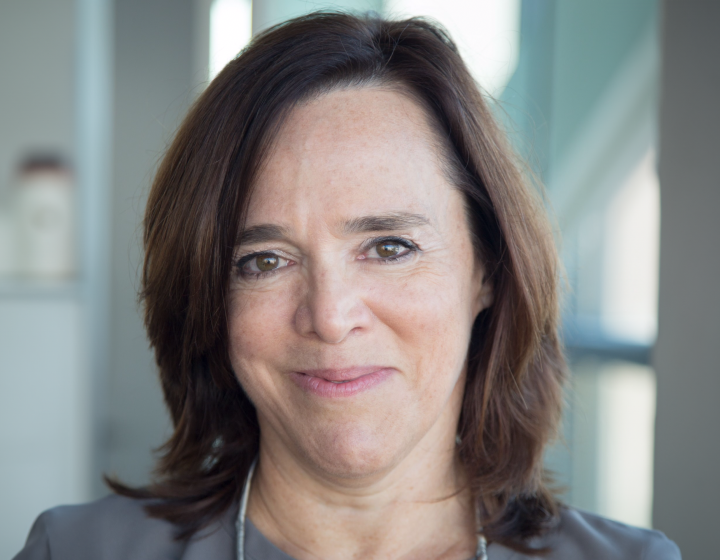
Louise Dubé

Louise joined iCivics as its Chief Executive Officer in July 2014.

Louise discovered the power of education in the early 1990s as a co-founder of CASES, a New York alternative-to-incarceration program for youthful offenders where education helped reshape lives. Inspired by a deep commitment to creating pathways to lives of learning and purpose, she has devoted her career to ensuring that all students are prepared for civic life.

Louise has successfully led K-12 growth organizations that use educational media to improve student achievement across the private and nonprofit sectors. Most recently, as Managing Director of Digital Learning at WGBH, Louise helped launch PBS LearningMedia, a platform with more than 87,000 classroom-ready digital resources reaching 1.5 million educators.

Louise has received national recognition for her work. She received a Civvys award from Bridge Alliance, the People’s Voice Award from the Diane Von Furstenberg/Barry Diller Foundation, and was selected as a Donaldson Fellow in 2019 at Yale SOM. She is also a Draper, Richards, Kaplan Fellow. As a civic education expert, Louise has published and been interviewed widely in national and education press.

Louise began her career as an attorney in Montreal, Canada. She holds a law degree from McGill University and an MBA from Yale’s School of Management.

Louise, a native of Quebec, has two children who share her love of travel, reading, debating, and learning.

Interested in interviewing Louise or having her as a speaker? Contact [email protected]

Amanda Donley

On Civic Education and the iCivics Youth Fellowship

I was fortunate to get one of the best civic educations possible when it comes to the iCivics Youth Fellowship and my 8th grade “We the People” class. As a result, I know my constitutional rights and I feel very prepared to vote and otherwise engage. 

But there were 200 other students in my grade level who opted out of civics, and I’m not sure a lot of my peers understand much about what is going on in government, how they are affected by it, and how they can affect it in return.

As part of the iCivics fellowship, I interviewed two groups of students—those who got the same classes I did those who did not.. The first group gave long, elaborate answers and there was open communication between the students. But when I interviewed kids who did not get this form of civic education, they gave one- or two- word answers, didn’t seem to really be familiar with the word “civics” or what it entailed, and didn’t really talk to each other. This exercise really put into perspective how even one single class can alter a person completely.

On the State of the Nation

It’s hard to imagine that there was a time when members of opposing political parties could “agree to disagree”—or even come together on certain issues. Today, it seems our elected officials are punished for working with members of another party, yet that’s the very foundation of the U.S. Constitution. As someone who is civically engaged, such actions don’t feel like serving the community—they feel antithetical to what they teach us in civics class.

When I think about what our nation could be, the word that springs to mind is “open.” Open to differences of opinion—not always having to be right. More open to listening to each other, and not always yelling.

On iCivics

With iCivics, it’s not just about supporting a program or a website. but actively supporting the next generation of this country. What iCivics does is amazing: it helps young people find the answers to questions they’re too afraid to ask. If “the next generation will “fix it,” then we need tools, knowledge, and support systems. We need the space to meet up a few times before figuring it all out and supporting programs that provide just this—a space to try, and mess up, and try again, and succeed—it fosters a true interest in our country.It’s about supporting an entire generation that can finally find its voice, and that will want to create a better world for all.