
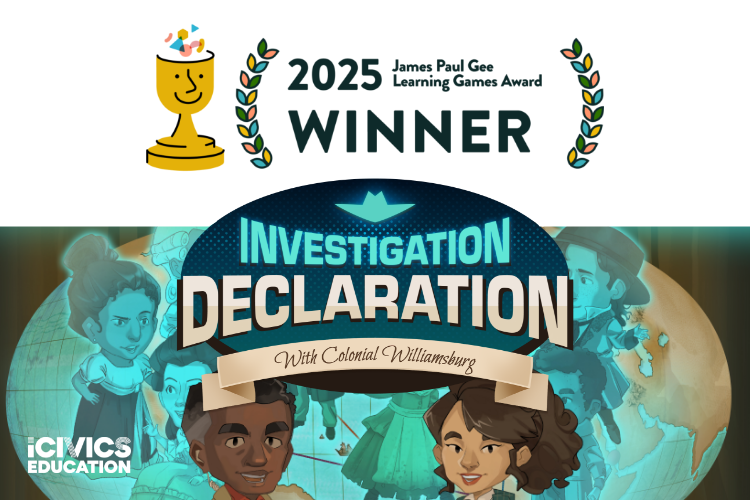
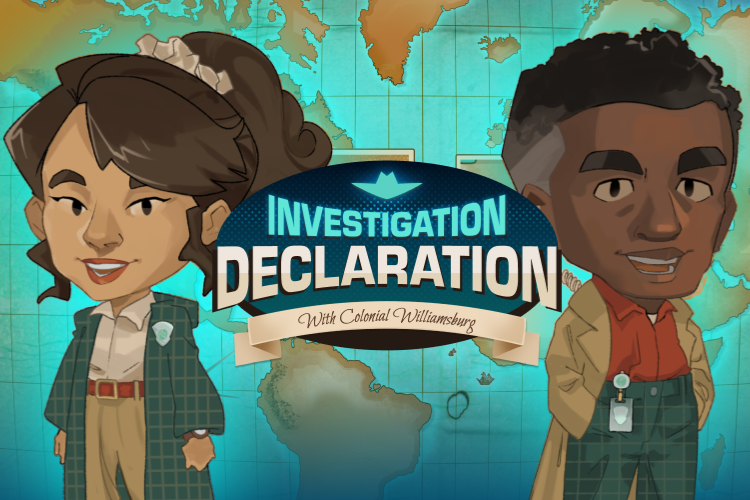
iCivics’ newest game, Investigation Declaration, won the Formal Learning category at the annual GEE! Learning Game Awards, which recognize excellence in educational game design.
Winners were announced on Aug. 21 at the Play Make Learn Conference, which is hosted by the UW-Madison School of Education’s Department of Curriculum and Instruction and the office of Professional Learning and Community Education (PLACE).
“Play Make Learn is a fantastic opportunity to gather with folks that share a desire to create really great experiences for all kinds of learners,” said Senior Director of Digital Learning Carrie Ray-Hill. “It was incredible to hear our game announced as a winner.”
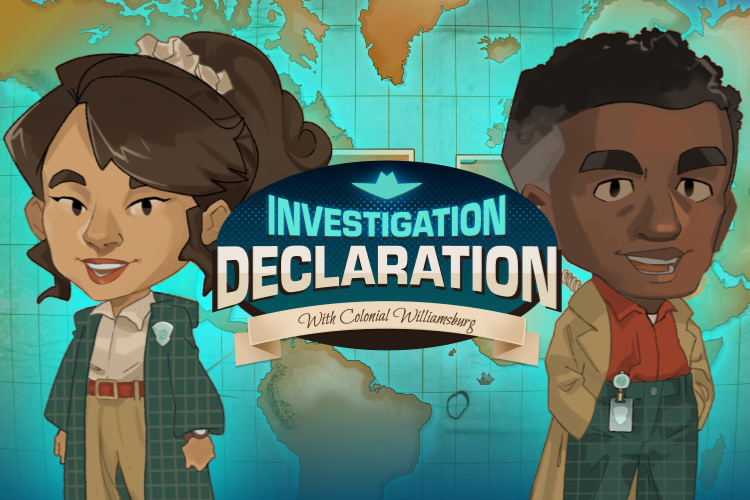
The game, developed in partnership with The Colonial Williamsburg Foundation, challenges middle and high school students to track how Enlightenment ideas informed the Declaration of Independence, which then went on to influence declarations of rights and freedoms abroad. Its design takes notes from classic games such as Where in the World is Carmen Sandiego? and includes puzzle and strategy elements of more modern games like Case of the Golden Idol and Return of the Obra Dinn. This complexity aims to help students discover how the ideas that influenced and shaped the Declaration of Independence went on to shape global history.
According to the official announcement, Investigation Declaration impressed judges with its aesthetic, engagement, gameplay, and accessibility features. One judge noted, “I found this a clever way of drawing connections across history. Too often we learn about one country’s perspective, not realizing the global context.”
“I was glad to see the judges appreciated Investigation Declaration’s gameplay,” Ray-Hill said. “We intentionally designed it to embrace student discovery. Players may figure out how the game works before their teachers, and that’s okay! The game gives them the freedom to play through one ‘path’ or several, empowering them to create their own narrative.”


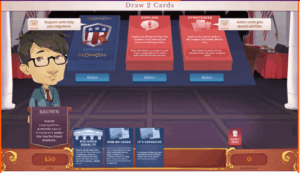 Then they must identify the Constitutional arguments used to support the argument. Once identified, they must build an argument based on Action cards and Support cards. They offer a rebuttal to the opposing side by quickly choosing correct supporting arguments. This game’s strength lies in the variety of gameplay. Not only can you choose between several cases, but you can also choose which side to support and the argument to build. You cannot simply click your way through the game successfully. It takes reading and critical thinking skills to make your way through, but it is not at such a difficulty level that the average student would quit out of frustration.
 and in the years since, I am continuously surprised by how few people have heard of it! Keeping the name of Supreme Decision, iCivics took the original storyline and developed a truly interactive simulation through the decision-making process.