
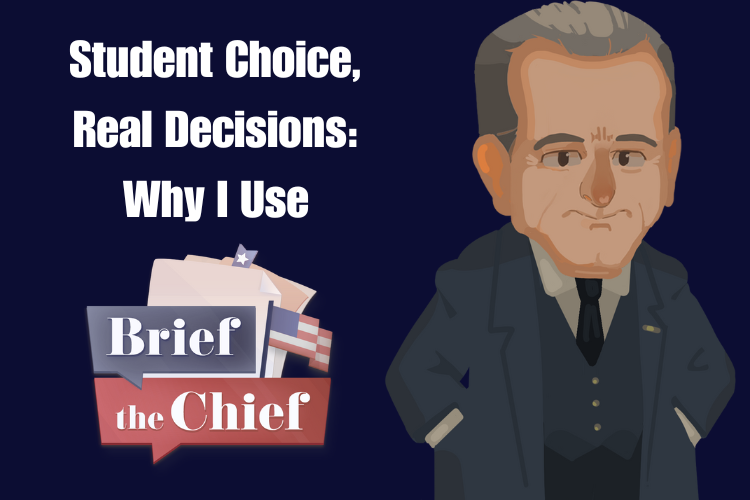
There’s something powerful about putting students in the driver’s seat of history. When students play iCivics’ Brief the Chief, they get to help real presidents make real decisions that shaped our nation.
In this game, students take on the role of presidential advisors, guiding Thomas Jefferson, Abraham Lincoln, and Lyndon Johnson through high-stakes moments in American history. Unlike a worksheet, choosing the right “answer” isn’t the point here. This learning game focuses on asking good questions, thinking critically, and making tough calls under pressure.
For example, if a student chooses Abraham Lincoln, they might need to decide whether or not to issue the Emancipation Proclamation. They can interview his Secretary of State, a military leader, or other advisors to figure out the risks and rewards. With Jefferson, students might dig into trade policy with Haiti or the importance of securing the Port of New Orleans. And if they pick LBJ, they’ll confront civil rights issues or help him decide whether to run for re-election.
What I love most is how into it the students get. The game helps them take notes, but I like to encourage students to keep their own notebook to organize their thoughts and lock in the learning. I love when students share their experiences and their decision-making strategies with their classmates. Sometimes they’ll debate what was the best move in each scenario. Even the quiet kids come alive and explain their learning as I wander the classroom and get down on their level to check in.
And because students get so much choice, the game is different each time they play. Students choose which president to advise, which challenge to tackle, and how they spend their time. The gaming is fun and the learning is rich. They’re doing history, but also practicing evidence-based reasoning, decision making, and critical thinking.
For teachers considering Brief the Chief, give your students some background knowledge before they play. It helps slow them down and take the reading seriously. Encourage note-taking and make sure they interview everyone. Definitely use the Extension Pack which includes lesson plans, slides, and handouts. (What a time-saver!) And don’t skip the post-game reflection! That’s where some of the best connections happen.
If you’re looking for a way to bring energy and real-world thinking into your civics or history class, Brief the Chief is a win. It’s interactive, meaningful, and gives students a chance to lead. And honestly, students deserve a chance to shape history as they’re learning it!
Written by Christian Wrabley
Christian Wrabley is an award-winning civics and American history educator with over a decade of classroom experience. He is a member of the iCivics Educator Network and contributed to some fun work with the Design Squad. As a National Constitution Center Constitutional Fellow and a PBS Digital Innovator All-Star, he blends innovative teaching with real-world civic engagement. Christian has created national resources for PBS, WQED, and Junior Scholastic, and is a founding member of Pennsylvania’s Democracy Bowl. His work inspires students to lead, think critically, and participate in democracy long before they’re old enough to vote. Christian lives in Johnstown, PA, with his wife and three kids.
Through the iCivics Educator Network, the perspectives of teachers across the country contribute to the public conversation about civic education in the United States. Each contributor represents their own opinion. We welcome this plurality of perspectives.