
“Raise your hand if you are eligible to vote.”
Only a few hands went up, but there were some confused looks.
“Raise your hand if you know when you vote.”
More confused looks.
“Where you vote.”
The more questions I asked my senior Government students about the voting process, the more bewildered faces I saw. Students looked around to see if anyone knew the answers to my questions, but no one did. I have been teaching for 15 years (13 in my current district), and every year I get the same responses, the same confused looks.
These students are about to become adults, but many have no idea how or when to participate in one of the most fundamental acts of citizenship: voting.
At some point, it hit me—who is actually teaching students how to make their voices heard? There are classes on calculus, literature, culinary, personal finance, automotive technology, and numerous others where students learn valuable skills, but where is the class on voting and civic participation? Where’s the guide for becoming an active, informed participant in our democracy?
For Texas, it’s in your Government class. Those skills are covered in the Texas Essential Knowledge and Standards Chapter 113, Subchapter C, sections (d)13 and (d)14. My students do not arrive with an innate understanding of how they can participate in our democracy. It is my job to assist them in ways they can engage with their government and the voting process.
Historically, youth voter participation has been extremely low in comparison to voter turnout in other age groups. It’s a trend that we teach in our classes. As the educators of these young voters, we have the opportunity to increase their level of engagement in their own democratic government, which relies so heavily on citizen participation.
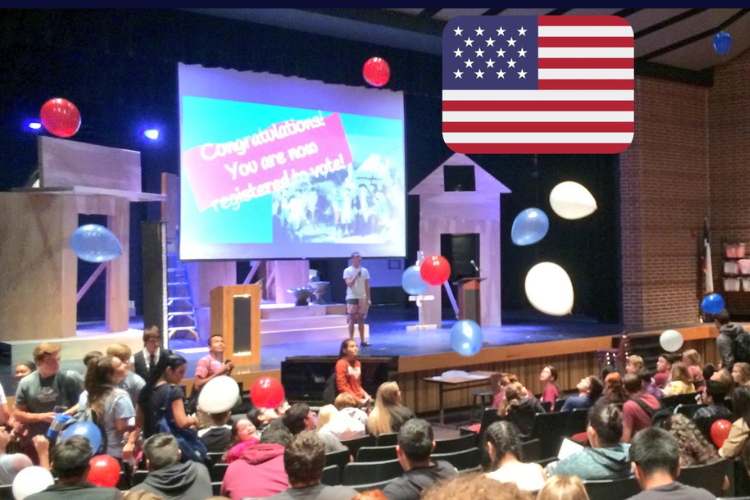
In order to accomplish this, I have spoken to election officials within my county to ensure that I was up to date on election codes regarding high school voter registration, as well as received guidelines from the Texas Secretary of State. One year, I partnered up with a student group I led and, together, we created a presentation for their peers. They created a program to present to their senior class in the auditorium. They discussed voter registration requirements, upcoming election timelines with sample ballots, and ways to research offices and candidates on nonpartisan websites. At the end, we had a balloon drop! It was so much fun, and I was so happy to see the students invested and developing lifelong civic participation habits.
I’ve also used resources like the iCivics game, Cast Your Vote, which is very impactful regarding the burden a citizen faces in a democracy in the quest to become an informed voter. And I’ve used the lesson plan, Voting: Will You Do it?, as an icebreaker. I have found that students engage more when they are given agency within the assignment or task, as well as understanding the purpose or the “why.”
Democracy cannot function without citizen participation. My goal is for students to understand how crucial their participation is if they want their government to reflect their beliefs and needs. I bring up examples where students were able to bring about change by getting involved. The purpose of this is for my students to understand that there are no gatekeepers to the government or creating change.
Written by Brittany Marrs
Brittany Marrs is a National Board Certification candidate and veteran social studies educator with over a decade of experience teaching Government, AP Macroeconomics, and Dual Credit courses at Magnolia High School in Texas. A passionate advocate for civic education, she serves as an Ambassador for the iCivics Educator Network, a member of the National Constitution Center’s Teacher Advisory Council, Association of Texas Professional Educators, and Texas Community College Teachers. She also served on the Social Studies TEKS Streamlining Committee for Government and Economics. At Magnolia High School, Brittany serves as the Senior Class Faculty Sponsor. She is also a College Board AP Macroeconomics Reader and an active member of several community organizations, committed to equipping students with the knowledge and tools to become informed and engaged citizens.
Through the iCivics Educator Network, the perspectives of teachers across the country contribute to the public conversation about civic education in the United States. Each contributor represents their own opinion. We welcome this plurality of perspectives.