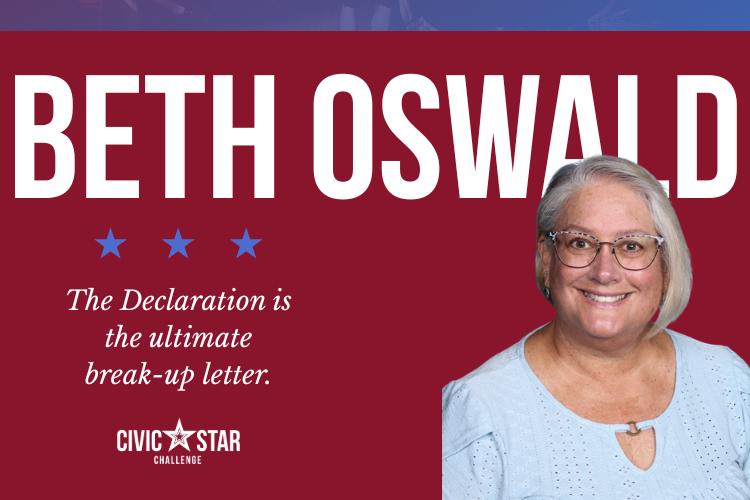
Beth engages her students with the Declaration by making it relevant to their lives

I recently broke up with Culver’s.

Let me explain.

In my classroom, civic literacy isn’t about memorizing documents. It’s about learning how those ideas live, travel, and show up in students’ real lives.

As part of the Civic Star Challenge, we took a close look at the Declaration of Independence. As the students were annotating the document, I put on my ultimate break-up playlist. (It kicked off with Neal Sedaka’s “Breaking Up is Hard to Do,” of course!) Then I threw it to the students: using the Declaration as a format, how might they write their own break up letter to someone or, even better, something?

Each letter had to include some key elements, including: a preamble explaining the need for separation, a statement of basic rights, a list of grievances, quotes from the original, and a final declaration of independence.

I mused that I was giving Culver’s the boot: I’d attempted reconciliation by trying the fast food chain’s salads, but they were just no match for their butter burgers. For that reason, an ongoing relationship would be unsustainable. 

The students immediately ran with it. One student, a worrier, wrote a break-up letter to her stress. Another wrote to her annoying little sister, reasoning that it would be better for their relationship if she got her own room: “It doesn’t mean that I don’t love you. As the Declaration of Independence states ‘as we hold the rest of mankind, Enemies in War, in Peace Friends’”.

I thought a student’s letter to Homework was particularly inspired. They wrote, “You force me to wrap my head around your nonsensical phrases without clear explanation with the threat of dishonor and failure, a remnant of years passed harder to let go of than a bandaid of duct tape.” (See the full letter below.)

And like other important documents, the students got feedback on their drafts. In my class, we’re often sharing work with each other, getting input and ideas. As I overheard the murmur of conversation, I could tell that they’d connected deeply with the concept and the material. Plus, as they shared with each other, they were teaching and learning from each other. And that’s always been the most powerful thing for me. 

At the end of the class, a student showed me a letter addressed to the manager at her after school job. She explained “At the end of this year, just before I go off to college, this is going to be my letter of resignation.”

Dear Homework,

I’m not gonna start with a bunch of flattering language: we need to break up. Breaking up is hard to do, so I’m just going to rip off the bandaid. But, as it says in the Declaration of Independence, “a decent respect to the opinions of mankind requires that they should declare the causes which impel them to the separation”. 

This relationship has felt one sided. I have a right to myself, my time, and my life. I would say “life, liberty and the pursuit of happiness”, but you were a fair execution of those rights. I should not have to depend on others for my own happiness, especially when the likes of something so selfish that they cannot even fathom the idea of another having problems. I made a list of issues we have that are too late to fix: 

  1. You keep making me find your x and solve your problems. I am happy to find the scale of your shapes and angle of your curves but I am tired of picking up the remains of your past that are meant to be yours to find. 
  2. You ask me to dig into the shallow shores of phrase instead of letting me dig deep into the endless wells of symbolism and metaphor, and even when you do you still make me try to find purpose in what has already found it.
  3. You try to make me correct the good and try to correct me on my word despite the fact it is mine and mine alone and is carefully crafted to near perfection. 
  4. You stole time I could have used in the pursuit of happiness and togetherness. You stole my hours with your desires and forced me into action and work in the bedroom when I wish I could have time to spend with my family and friends.
  5. You force me to wrap my head around your nonsensical phrases without clear explanation with the threat of dishonor and failure, a remnant of years passed harder to let go of than a bandaid of duct tape.
  6. You limit my ability to write beautiful rivers of meaning and mountains of conflict by constricting me with prompt and censorship unless it is to your own delight.
  7. We had beautiful and exhilarating times uncovering the mysteries of problems and finding patterns in the stars between meaning, and yet when I try to find problems of my own, you give me complex translations of your design filled with repetition that turns my mind to machine in a repeating pattern of simple and bland. 
  8. You make me do work of no importance purely to keep my smile from being shared. 

We have tried to mend our pain with the twine of love and sacrifice. We have tried to give ourselves the time and effort we deserve, but you have broken my heart too many times to count, and I am tired. I need rest and work of interest and purpose and you have gone back to your tricks of time again and again. So I am sorry about this choice, but I need to make it final. You have made me an also-ran far too many times to count.

We are done. I am now free of your bondage. I can now run free and find solace in the love and care of family and friendship. No longer shall we share a room of question and solution, but we shall now find our own paths. I would offer friendship, but you are the sun and friendship is wings of wax, and if I get too close I shall fall into despair. I will live on and dream of love and beauty, and I’ll forget you but I will never forget the smallest one who ever lived.

Sincerely,
A Student

About Beth

  • Teaching experience: 30 years teaching, including 26 years teaching middle school world history. 
  • Currently teaching: 9th-12th grade social studies

The 2008 Wisconsin State Teacher of Year, Beth earned her doctorate in Teacher Leadership in 2016. She is a member of the iCivics Educator Network and serves on the Wisconsin History Center Lead Teacher Council, providing input in advance of the new Wisconsin Historical Society’s museum (opening in 2027). She is passionate about project-based learning and enthusiastic about supporting her students as they design social studies projects and participate in her seminars.

We Can Teach Hard Things Like Immigration

I began my career as a social studies teacher in September 2001. By my second week in the classroom, the attacks of September 11th had reshaped not only the nation, but also my understanding of what it meant to teach history. I became acutely aware of the students in my classroom whose families had emigrated from the Middle East. As fear and anger filled the news, I found myself asking, “How could I guide students through turbulent current events while ensuring every child felt safe, seen, and valued?”

Over time, I developed a guiding principle for navigating difficult topics, even before I had language for it: politically neutral and morally steadfast. I strive to create space for students to form their own opinions without signaling what they “should” think. At the same time, I remain anchored in the core values of human dignity, empathy, and respect. Neutrality does not mean indifference. It means encouraging inquiry while protecting the humanity of every student in the room.

Balancing content knowledge with historical thinking skills is central to this approach. I want students to be curious about the world they inhabit, not simply consumers of historical facts but investigators. We examine patterns and rhymes across time, ask sourcing questions, identify bias, and construct arguments grounded in evidence. My goal is to help them make sense of both the past and the present through disciplined critical thinking.

In New York State’s middle school curriculum, immigration spans seventh and eighth grade, so I teach it as a thematic unit. The unit is designed to build content knowledge, strengthen students’ use of primary and secondary sources, develop evidence-based argumentation, and cultivate civic discourse.

We begin with vocabulary development (I like Wayground) and an overview of major immigration waves to the United States, including push and pull factors across the past two centuries. Students then rotate through stations featuring personal narratives from immigrants representing a wide range of time periods and countries of origin. These stories humanize historical trends and broaden students’ perspectives.

Next, we explore the history of the Statue of Liberty and read Emma Lazarus’s poem, “The New Colossus.” Students analyze the poem using sourcing and comprehension questions, considering both its historical context and its enduring symbolism. I conclude the lesson by reading the illustrated children’s book, Emma’s Poem: The Voice of the Statue of Liberty, which helps students connect the historical narrative to the emotional power of Lazarus’s words.

When the class meets again, students engage in a silent gallery walk. Political cartoons, photographs, and brief quotations reflecting public attitudes toward immigrants—Irish, Italian, Chinese, Greek, Cambodian, Mexican, Syrian, and others—are posted around the room. Rather than drawing conclusions immediately, students write one question about each source. This emphasis on questioning nurtures curiosity before judgment. Afterward, they complete a graphic organizer to identify sourcing details and analyze evidence of bias.

The unit culminates in a central question: Should “The New Colossus” remain on the Statue of Liberty? If not, what, if anything, should replace it? Students prepare arguments for both sides using evidence from the documents.

We then conduct a structured discussion using a modified fishbowl format. Half the class begins in an inner circle while the other half participates through a digital discussion board. Students rely on sentence starters to frame their comments and must ground their ideas in the documents. Each student receives two tokens as “their two cents.” After speaking twice, they must wait until all others have contributed before speaking again. This structure promotes balanced participation and prevents a few students from dominating the conversation.

Students then switch roles, so every student has the opportunity to speak. We close with a written reflection: What was challenging? Did your thinking change? What do you wish others understood about immigration? When we meet again, we debrief the process itself, reinforcing that civil discourse is a skill that requires practice.

Some of the most meaningful moments of my career have unfolded during these conversations. One student, whose family emigrated from Iraq, spoke passionately about how coming to America had saved her family from violence. Others have shared experiences shaped by Bangladesh, Venezuela, and other native countries. These stories transform abstract policy debates into lived realities.

As someone born in the United States, I can strive for understanding and compassion, but I cannot fully know the immigrant experience. By anchoring our inquiry in the question of “The New Colossus,” I create space for students to listen to one another with curiosity and respect. In those moments, I am reminded that teaching hard history is not only about the past. It is also about cultivating the habits of mind and heart that sustain a democratic society.

Written by Betty Haynes

Betty Haynes has taught social studies for 25 years in the Cleveland Hill School District in Cheektowaga, New York, near Buffalo. She serves as middle school social studies coordinator, sits on the shared decision-making committee, advises Youth and Government, and directs the district musical.

Betty presents locally and statewide on New York’s Seal of Civic Readiness, promoting project-based civic learning. She is also an associate director of the Academy of Human Rights of Buffalo, which provides professional development for teachers and a summer symposium for Western New York students.

Her honors include New York State Middle School Social Studies Teacher of the Year (NYSCSS), Gilder Lehrman New York State History Teacher of the Year, finalist for New York State Teacher of the Year, and publication in the New York Archive Journal.

Through the We Can Teach Hard Things initiative, the perspectives of teachers across the country contribute to the public conversation about civic education in the United States. Each contributor represents their own opinion. We welcome this plurality of perspectives.

Victoria prepares her students with critical skills for life beyond the classroom

Last September, I set a goal for myself: to find a game for every standard I teach. In other words, to gamify the entire school year.

While 6th graders can’t vote—and they often feel that participating in civic life is something only their parents can do—games put them in the driver’s seat. They help kids become personally invested in civic engagement through role play, practice, and active skill-building. Games can be experienced individually or in groups and integrated into homework checks. They’re a natural tool for virtual learning. Simply put: games are amazing!

The games I’ve discovered on iCivics have been go-tos in my class. They often come with supporting slides or PDFs which make the experience even more accessible; for example, students with slow internet speeds can turn to a worksheet. For my students struggling with reading or speaking English, I’m always impressed by how the games pull them in: it’s like a magic trick that captures their interest. After each game, I use prompts to encourage the students to reflect on what they’ve learned—and they write their hearts out every time.

Recently, as part of the Civic Star Challenge, my students played People’s Pie. The challenge: create and balance the budget for the entire country. From managing tax rates to setting the retirement age, the students had to weigh a variety of competing needs. I was so impressed as I watched them puzzle through really complex decisions. They were deeply invested. They grappled with the reality that some citizens were unhappy with the choices they made. Several students ran out of money and had to weigh the cost-benefit of taking on debt. Many kids came to the similar conclusion: if you want to do what’s best for the country, you’ll have to reckon with some difficult tradeoffs.

Oftentimes, the outcome of these games is not winning. And the students are OK with that. They understand that compromise is a vital part of a functioning democracy. In that way, the soft skill of accepting discomfort may be one of the most valuable byproducts of gameplay: it gets students ready to join the world and continue tackling challenges there.

About Victoria

  • Teaching experience: 6 years
  • Currently teaching: 6th grade Minnesota Studies, 7th grade social studies, 12th grade ALP (Alternative Learning Program)

Victoria is the 2025 Middle School Teacher of the Year honoree at her school, as well as at the Minnesota Council on Economic Education. She also serves as a Retro Report Ambassador. Victoria is passionate about blending virtual tools with economic education into social studies classes to encourage an inquiry mindset in adolescents. Read more about her work here.

iCivics Teacher Survey High-Level Summary Report

To support Civic Learning Week, this high-level summary of the 2026 iCivics Teacher Survey of 2,197 teachers to deliver timely, educator-centered findings that translate into clear insights on the state of civics education. It highlights three forces shaping classroom instruction:

  • evolving state legislation;
  • schools’ approaches to responsible artificial intelligence (AI) use; and 
  • the essential role of human connection grounded in educator testimonials.

Overall, teachers report:

  • strong preparedness to teach civics (76.1%);
  • meaningful support from school or district administration (65.2%)
  • mixed support from the parent community is more mixed (49.2% agree, 39.0% neutral).

At the same time, many describe an increasingly challenging climate, with a majority:

  • saying teaching basic civics concepts now feels difficult (52.7%) and
    concerned about potential backlash for teaching something the “wrong way” (58.7%).

Of those surveyed:

  • 35.3% report changing or removing lessons and
  • 21.4% have considered leaving their position due to the divisive political climate

Impact of State Legislation on Educators and Classroom Environments

Notably, every state where more than half of teachers report being impacted by legislation has also experienced attempts to impose statewide limits on topics that can be taughtStates with efforts to regulate K–12 classroom discussion of what the legislation deems “divisive concepts” see far higher numbers of teachers reporting impacts to their classrooms with 48% of teachers reporting being impacted. Notably, even in states that have not seen major pushes for these legislative reforms, 32% of teachers still report impacts.

  • Legislative/administrative impact strongly correlates with backlash: Teachers who reported being impacted are much more likely to worry about backlash (~72–74% vs ~50%) and to report experiencing backlash (~30–41% vs ~12%).
  • Self-censorship is a common coping strategy: ~35% say they’ve changed/ removed lessons because of the environment.
  • Classroom Effects of Legislative Impacts: Among classrooms impacted by
    legislative/administrative changes, top effects are: more lesson-planning time needed (19.77%); greater focus on parental concerns (19.14%); and discontinued use of previously helpful resources (11.76%). Some also cited impacts including less time spent overall on social studies (11.13%) and more prescriptive curriculum (7.58%).
  • Fear outpaces fallout: ~59% of teachers are concerned about backlash, but only ~20% say they’ve faced backlash.
  • Broad consensus on importance on civic education: 74% agree/strongly agree it’s important to have a national week highlighting civic education (44.09% agree; 30.04% strongly agree), with only ~5.8% disagree/strongly disagree.

More than 89% of teachers agree that their teaching should ground students in a set of civic knowledge, skills, and dispositions; prepare students to be engaged citizens in our democracy; foster a pluralistic view that promotes interest in and respect for the variety of opinions and political identities present in American society, including those different from one’s own; and connect constitutional principles to events happening today.

Responsible AI in the Classroom

Educators (~70-75%) broadly view artificial intelligence as a core part of civic literacy, with agreement high and consistent across school contexts. At the same time, classroom materials are largely holding steady between print and digital resources, while approaches to AI use remain uneven. Despite strong recognition of AI’s importance, adoption in practice remains limited: 50% of educators report using AI less than 1–3 times per month, and usage is primarily focused on planning and content preparation behind the scenes rather than direct classroom instruction. As for AI policy, schools across the board showcase uncertainty, restricted-allowance models, and, in many places, significant teacher-by-teacher discretion rather
than clear districtwide guidance, with 29% of instructors reporting that their school or district has no formal policy governing AI use.

Human Connection: The Foundation of Effective Learning

The following teacher testimonials underscore that strong relationships among students, educators, families, and the community remain foundational to effective civics education:

  • “Civics is quite literally the most important course in high school, as not all students will become mechanics, nurses, etc. All of them, however, will be citizens, which requires active participation.”
  • “Civics is the backbone of our democracy. Without it, we are nothing.”
  • “The study of our rights and responsibilities in a democracy and as a human being on planet Earth.”
  • I became a social studies teacher because I believe the American Constitutional Republic is one of the greatest experiments in human history.”
  • “Civics is one of the most important topics as it directly impacts everyday life. Civics impacts education, laws, science, medicine, personal liberty and human rights, etc.”

Civic education is essential for all students and emphasizes that understanding rights and responsibilities is strengthened through active practice in classrooms that supports respectful dialogue and intellectual safety, with benefits extending to families and communities.

iCivics is the managing partner of Civic Learning Week, which is further supported by the American Academy of Arts & Sciences; Bezos Family Foundation; Center for Revitalizing American Institutions at the Hoover Institution; Daniels Fund; Democratic Knowledge Project; Ibis Group; Jack Miller Center; MacArthur Foundation; Maher Charitable Foundation; Microsoft; More Perfect; National Council for the Social Studies; and Stuart Foundation.

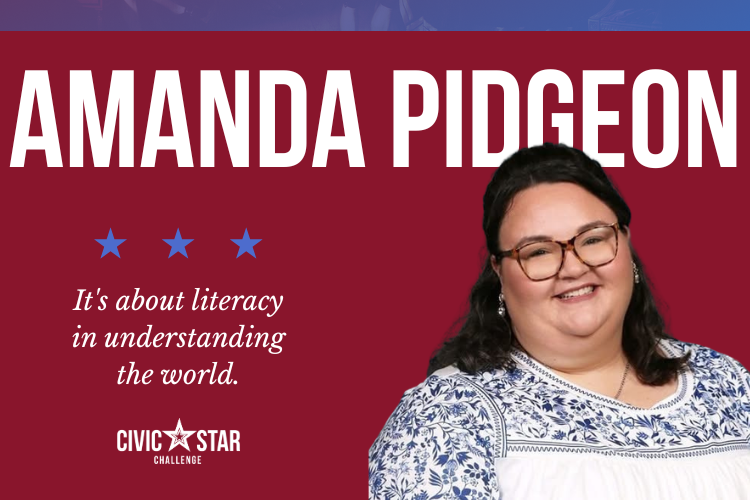
Amanda builds literacy that strengthens her students’ civic decision-making

My main drive as an educator is to teach literacy as a way of understanding the world. My focus is not just reading and writing, but building literacy in how students navigate the internet, politics, and the world around them. It’s about vetting sources, understanding if what you’re reading is biased, and extrapolating from it meaning that can apply elsewhere. 

The Civic Star Challenge speaks to those same goals. Literature always has a historical context, and it’s crucial for understanding the meaning of a text. Today, we’re bombarded with information every day. How do you decide what is relevant and actionable? This decision-making is at the heart of civic engagement.

Visual literacy is an element of the AP English test. And one of my favorite lessons in my AP seminar and research classes is around identifying patriotism and nationalism in visual media. We start by defining both terms in class. It’s often an unexpected challenge for the students: as one recently said, “I’ve never thought of those two things as being different.” And I thought, “Oh, you’re getting the lesson before I take you there! You’re doing it yourself!”

Then we turn to Merriam-Webster, where the differences are much more stark:

patriotism: love for or devotion to one’s country

nationalism: an ideology that elevates one nation or nationality above all others and that places primary emphasis on promotion of its culture and interests as opposed to those of other nations, nationalities, or supranational groups

Now the students are tasked with finding examples of both patriotism and nationalism in the media – and with finding  examples that demonstrate the differences between the two. We look at 50 images together and analyze them, from WWII political cartoons to t-shirts sold at Walmart. Sometimes the line is really clear. It can manifest as xenophobia or isolationism in a racist post. But other times, it’s subtler and harder to define – like using the flag for marketing products and services that have nothing to do with being a patriot. This iconography is powerful and effective because it’s so deeply connected to our love of country. But as one student said, “They’ll turn anything into a flag! Is this patriotism or is it just pandering?”

Right now, disagreeing with politicians can be seen as unpatriotic. I believe patriotism is about loving your country so much that you are willing to work to make it better, even when that work is unpopular. Most of my students are 18 years old, finally able to vote and make other decisions about how they want to live their lives. I want them to know that there are many ways to be a patriot. As I often tell them, “You can plant trees under which shade you will never sit. Planting the trees for the next people – that’s what it means to be a good person and a good American.”

About Sam

  • Teaching experience: 14 years
  • Currently teaching: American Government, State & Local Government, Introduction to Political Science (all dual enrollment); African American Studies.

A recipient of the 2018 James Madison Fellowship for Colorado, Sam utilizes her Master’s degree in Political Science, teaching primarily 11th and 12th grade students the significance of civics, civic engagement, and the importance of making connections in the community.