
At Nicolaus Copernicus School, our curriculum is demanding. My mission is to ensure that the challenge is met with excitement. To achieve this, I transform traditional lectures into interactive experiences. By integrating game mechanics like point systems, collaborative team missions, and healthy competition, I aim to turn every unit into a quest for knowledge.
Recently, as part of the Civic Star Challenge, I set out to turn the concept of taxation without representation into a felt, lived experience. I wanted my students to move from passive observers of history to active participants, feeling the colonists’ frustration and shifting from learning about liberty to demanding it.
So I built a physical simulation designed to spark a visceral reaction. I turned our classroom into a microcosm of the British Empire. I began taxing the very supplies the students needed to function as scholars. A stamp was required for everything: notebook paper, access to a pencil sharpener, and even the “luxury” of using a chair. The taxation wasn’t just a discussion; it was an active, bureaucratic obstacle. Each time they reached for a supply, I acted as the Crown’s agent, demanding their “stamps” before they could proceed. At first, there were giggles, but as their currency (merit points they had earned through gamification) dwindled, the mood shifted to genuine indignation.
The real aha moment happened when we transitioned from the Stamp Act to the Boston Tea Party. They realized that their hard-earned points and labor were being taken by a power (me, the teacher) who hadn’t consulted them on the rules—and that I could change those rules at any time. When we reached the First Continental Congress, the classroom literally erupted. It wasn’t just noise; it was organized dissent. Students who were usually quiet were suddenly at the front of the room, drafting petitions and arguing that the rules of our classroom needed to be a social contract, not a monarchy.
During our debrief, we explored the fine line between loyalty and liberty. The students began to articulate that loyalty is a choice made in exchange for fairness, and liberty is the right to have a say in one’s own destiny. Seeing their eyes bright with the understanding that ordinary people—farmers, shopkeepers, even 5th graders—could challenge the most powerful empire on Earth was the highlight of the year.
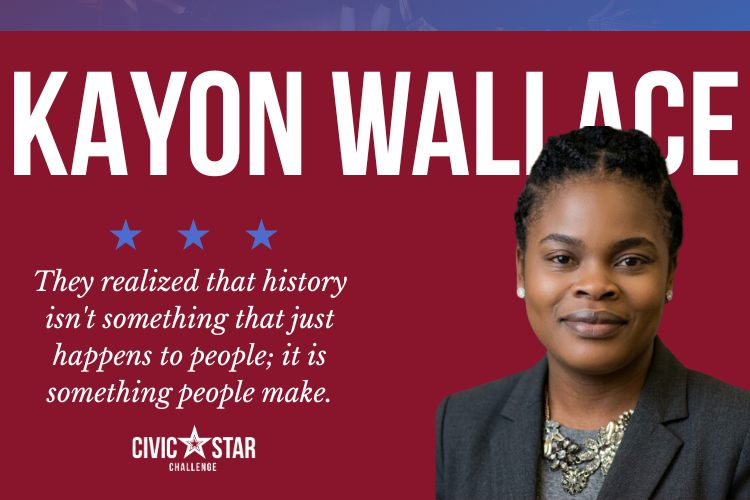
They realized history isn’t something that just happens to people; it is something people create.
About Kayon
- Teaching experience: 21 years
- Currently teaching: 5th grade HOPE (High Objectives for Program Excellence)
A dedicated educator and 2014 Teacher of the Year recipient, Kayon focuses on fostering holistic student development and creating a classroom environment where young learners feel empowered to excel both academically and personally.