Thank You, Educators!

Dear Educators,

They say it’s cheesy to start a letter with a pun, but honestly? I think you all are just grate. 🧀

As we kick off Teacher Appreciation Week (May 4–8, 2026), we want to take a moment to pause and recognize the heart of our iCivics community: you!

As Director of Educator Engagement here at iCivics, it’s a true privilege to work alongside such dedicated, thoughtful educators. The resilience, initiative, and care you show for your peers and students shape everything we create. Whether you are new to the profession or have spent years in the classroom, your commitment shows up in ways both big and small.

Beyond fostering curiosity and independent thought, you are helping build a healthier, more engaged democracy, one student at a time. That impact is not lost on us. Your work fuels our sense of purpose and keeps us grounded in what matters most. We know the communities, families, and young people you serve feel that same impact every day.

We also recognize that your time and energy are constantly in demand. While we can’t solve every challenge, we remain committed to supporting you in meaningful ways. Even as summer approaches and classrooms wind down, our work at iCivics is ramping up. We’re preparing for what we hope will be a strong, supportive start to the next school year.

We’ve heard your insights and feedback, and in that spirit, we’re excited to share a preview of what’s ahead:

A more intuitive iCivics experience
We’re working on a new way to find what you need in our vast library of resources, making it easier to send and track student assignments.

New ways to engage students
We’re partnering with a well-loved gaming company to bring you something exciting.

Expanding content
This fall, be on the lookout for some brand-new resources to help you teach the rule of law.

Thank you for being part of the iCivics community. Your ideas, your feedback, and your daily efforts shape not only your classrooms but the future we’re all working toward together.

Happy Teacher Appreciation Week! The iCivics staff, board, and donors are deeply grateful for all that you do each and every day.

Warmly,

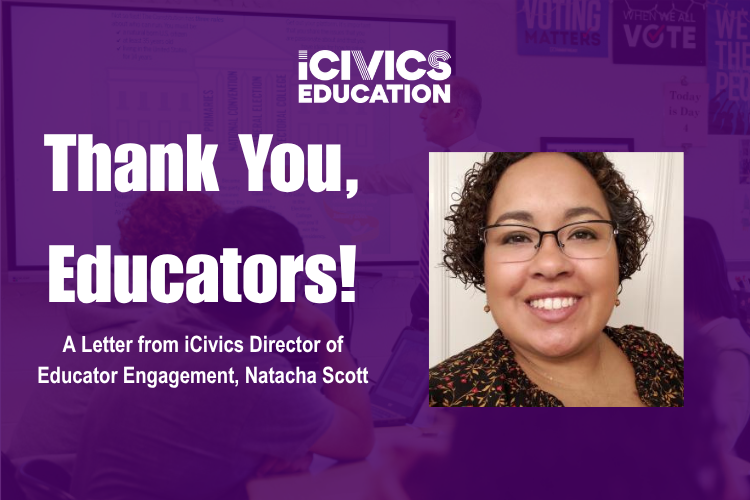
Natacha Scott, Director of Educator Engagement

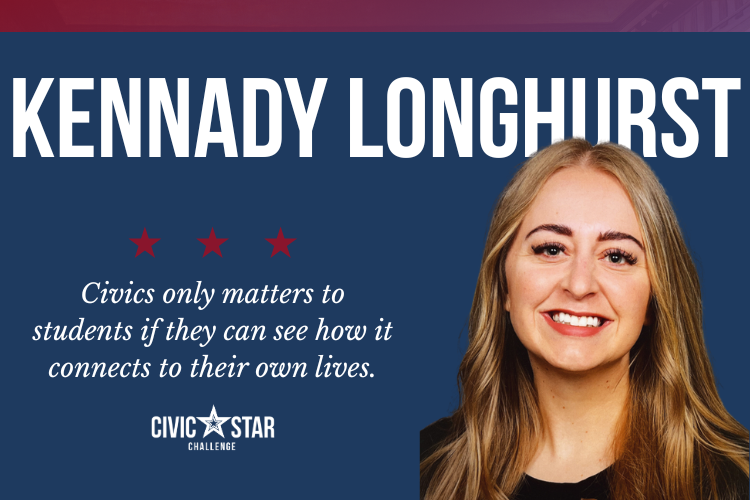
Kennady starts hyper local to teach history to her students

I teach history as the story of people making choices and living with the consequences. But one of the biggest challenges I find in telling that story is apathy in the audience; students pick up the “why bother” attitude from wider culture. So I try to start local—hyper local, even—by framing lessons around school, friend groups, and real choices students face. 

For the Civic Star Challenge, I created a lesson around one line from the Declaration of Independence: governments derive “their just powers from the consent of the governed.” The lesson had three parts: a quick, relatable hook (“What rules would you keep if you ran your ideal school or friend group?”); a close read of an annotated excerpt; and small‑group scenarios work with choice‑based roles. During that last part, students debated classroom policies and social dilemmas: “If the majority of your friend group votes to exclude someone, but you don’t, does that still count as consent?”

As the discussion deepened, one student suddenly said, “So it’s like America isn’t just something we have. It’s something we all have agreed to keep going.” That comment completely shifted the tone of the room. Students began connecting the idea of the “social contract” not just to 1776, but to their own lives. They saw it in the daily balance between personal freedom and responsibility to others. The Declaration became more than a dusty document; the students understood it as a living principle, a blueprint for creating community and cooperation today. 

The students decided consent in friendships is ongoing, that belonging involves trade‑offs (such as privacy and spontaneity), and that legitimacy needs clear information and fair processes. They also pointed out instances where consent breaks down, such as when someone accepts online terms without reading them. They even suggested reparative steps, including apologies, new norms, and stepping away, that mirrored civic remedies. 

Middle schoolers often don’t get enough credit for what they can understand. But I was impressed by how quickly they pulled 18th century ideas into modern situations. That transfer showed me that giving students clear, relatable stakes can turn apathy into agency and prove to them that civic life matters to everyone—not just old people!

About Kennady

  • Teaching experience: 6 years in education
  • Currently teaching: 8th Grade Honors US History and 9th Grade Honors World Geography

Kennady is a social studies teacher and department head focused on high expectations for honors learners and making history meaningful, relevant, and worth caring about.

“We Declare!” Challenge Launches to Engage Mass 8th Graders in Civics in Celebration of the Nation’s 250th Anniversary

8th grade students across the Commonwealth are invited to bring the Declaration of Independence to life through a statewide video competition for the opportunity to win scholarships and other prizes.


BOSTON, MA [April 14, 2026] – In honor of the 250th anniversary of the American Revolution, the We Declare! Challenge invites every 8th grade classroom in Massachusetts to read and celebrate the Declaration of Independence through video storytelling. 

As the birthplace of the American Revolution, Massachusetts is uniquely positioned to celebrate this historic milestone by empowering students to connect with the document that sparked it all. The We Declare! Challenge, sponsored by Fidelity Investments® with support from MA250, calls on Massachusetts 8th grade classrooms to submit short, creative, school-managed videos of students reading from the first two paragraphs of the Declaration of Independence. The winning class will receive $2,500 scholarships for each 8th grade student in the submitting class and the opportunity to attend the Boston Pops July 4th Fireworks Spectacular. Every participating class will receive a $100 gift card, with opportunities to win classroom prizes.

“This is a great opportunity for young people to connect with our history and see their role in shaping the future of our democracy,” said Massachusetts Governor Maura Healey. “I encourage every student to participate, speak up and share their perspective. Engaging with the Declaration isn’t just about understanding the past – it’s about thinking critically about what comes next. When young people use their voices with purpose, it strengthens our democracy for everyone.”

The idea for this statewide student challenge was sparked by Rob Waldron, a longtime education leader and chairman of Curriculum Associates whose career has focused on expanding access, strengthening civic understanding, and improving outcomes for students of all backgrounds. Inspired by the words of famed historian and author David McCullough, “You can’t be a full participant in our democracy if you don’t know our history,” the contest aims to meet young people where they are with a digital video project that calls for creativity to amplify the words that serve as the cornerstone of our country.

iCivics, the nation’s leading civic education nonprofit, is presenting this initiative to help students understand the founding ideas that continue to shape our democracy. Despite history, civics and our founding documents being widely taught, a 2024 survey by the US Chamber of Commerce Foundation revealed 70 percent of respondents failed a basic civics literacy quiz.

“The Declaration of Independence is more than a document, it’s a lens for understanding who we are as a nation, and there is no more important time to reflect on the Declaration than during our 250th anniversary,” said Rob Waldron, Founder of the We Declare! Challenge. “Through this challenge, Massachusetts students will engage with our history that connects to our technology-driven society. I look forward to seeing how eighth graders bring their voices, creativity, and excitement to this powerful text.”

A committee of educators and iCivics team members will select ten finalist videos. Once the finalists are selected, a distinguished panel of judges including Massachusetts Governor Maura Healey and First Lady Joanna Lydgate, Boston Mayor Michelle Wu, Lee Pelton, President and CEO of The Boston Foundation, General Joseph Dunford, former Chairman of the Joint Chiefs of Staff, Pedro Martinez, Commissioner of Elementary and Secondary Education, Keith Lockhart, Conductor of the Boston Pops, and more, will determine the winner and two runners‑up.

“This isn’t just about teaching history – it’s about inviting students into it,” said Louise Dubé, CEO of iCivics. “At iCivics, we believe democracy is strongest when young people understand our history and see themselves as participants in what comes next. Through the We Declare! Challenge, Massachusetts has a chance to lead this moment by giving students a platform to engage with the ideas that shaped our country and continue to guide its future.”

Educators can learn more, access guidelines, and submit videos here. All Massachusetts 8th grade classrooms are encouraged to participate and join this statewide celebration of America’s 250th anniversary.

Prizes include:

Winning Video

  • $2,500 to the school
  • $1,000 to the submitting teacher
  • $2,500 scholarship for each 8th grade student in the submitting class
  • A school spirit event and prize presentation
  • Planned broadcast of the winning video at the Boston Pops July 4th celebration
  • Tickets for the teacher, each student, and one guardian per student to attend the celebration

Two Runners-Up

  • $1,500 to each school
  • $250 to the submitting teacher
  • $250 to the class for materials or a celebration

The submission deadline for all entries is May 15, 2026.
ABOUT iCIVICS

Founded in 2009 by Supreme Court Justice Sandra Day O’Connor, iCivics is a nonpartisan organization dedicated to advancing civic learning by providing educators and students with the knowledge, skills, and resources needed to embrace and engage in our civic life together. iCivics empowers educators and leads the movement to make civic education a nationwide priority so all young people have the confidence to shape the world around them and believe in our country’s future. To learn more, visit www.icivics.org.

Media Contact
Brittney Feudo
[email protected]
978.587.1616

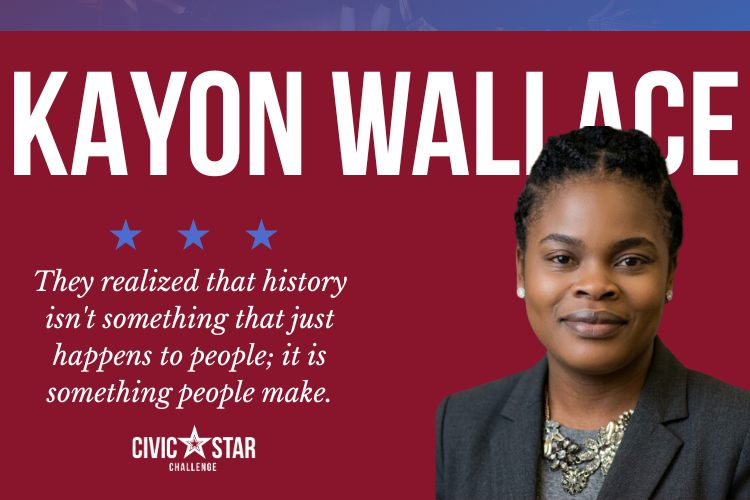
Kayon turns lessons into interactive quests for knowledge

At Nicolaus Copernicus School, our curriculum is demanding. My mission is to ensure that the challenge is met with excitement. To achieve this, I transform traditional lectures into interactive experiences. By integrating game mechanics like point systems, collaborative team missions, and healthy competition, I aim to turn every unit into a quest for knowledge.

Recently, as part of the Civic Star Challenge, I set out to turn the concept of taxation without representation into a felt, lived experience. I wanted my students to move from passive observers of history to active participants, feeling the colonists’ frustration and shifting from learning about liberty to demanding it.

So I built a physical simulation designed to spark a visceral reaction. I turned our classroom into a microcosm of the British Empire. I began taxing the very supplies the students needed to function as scholars. A stamp was required for everything: notebook paper, access to a pencil sharpener, and even the “luxury” of using a chair. The taxation wasn’t just a discussion; it was an active, bureaucratic obstacle. Each time they reached for a supply, I acted as the Crown’s agent, demanding their “stamps” before they could proceed. At first, there were giggles, but as their currency (merit points they had earned through gamification) dwindled, the mood shifted to genuine indignation.

The real aha moment happened when we transitioned from the Stamp Act to the Boston Tea Party. They realized that their hard-earned points and labor were being taken by a power (me, the teacher) who hadn’t consulted them on the rules—and that I could change those rules at any time. When we reached the First Continental Congress, the classroom literally erupted. It wasn’t just noise; it was organized dissent. Students who were usually quiet were suddenly at the front of the room, drafting petitions and arguing that the rules of our classroom needed to be a social contract, not a monarchy.

During our debrief, we explored the fine line between loyalty and liberty. The students began to articulate that loyalty is a choice made in exchange for fairness, and liberty is the right to have a say in one’s own destiny. Seeing their eyes bright with the understanding that ordinary people—farmers, shopkeepers, even 5th graders—could challenge the most powerful empire on Earth was the highlight of the year. 

They realized history isn’t something that just happens to people; it is something people create. 

About Kayon

  • Teaching experience: 21 years 
  • Currently teaching: 5th grade HOPE (High Objectives for Program Excellence)

A dedicated educator and 2014 Teacher of the Year recipient, Kayon focuses on fostering holistic student development and creating a classroom environment where young learners feel empowered to excel both academically and personally.