
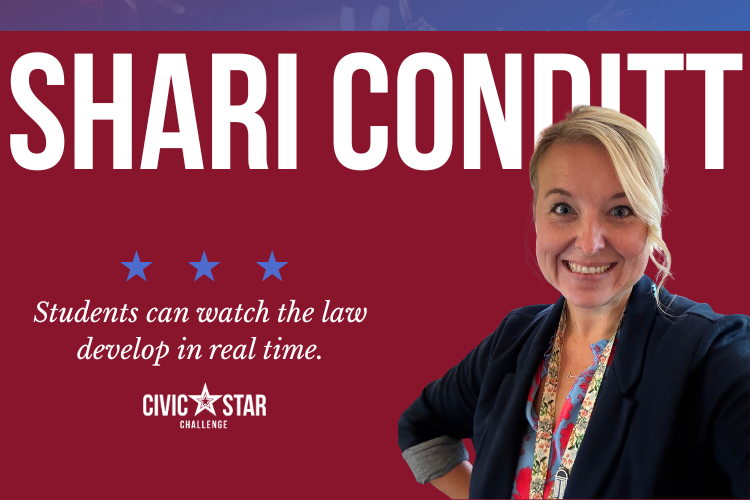
I recently heard a constitutional scholar say, “The law isn’t settled.” That idea stuck with me. Laws change. Court decisions are overturned. Constitutional interpretation evolves over time. That’s one reason I love teaching Supreme Court cases. Students can watch the law develop in real time.
As part of the Civic Star Challenge, my students and I zoomed in on specific Supreme Court cases to understand how the rights outlined in the Constitution have been interpreted and applied over the last 250 years.
When we started our unit on sex discrimination—looking at cases that considered the 14th, 15th, and 19th amendments—my students assumed we were going to focus on the rights of women. But the law helped them see the issue in a broader, more comprehensive way.
We jumped in with Reed v. Reed; it was obvious to the students that women should have property rights. Then, I introduced them to Craig v. Boren, which challenged a law that set the drinking age for women at 18, and men at 21. This really resonated with them—which was, of course, the point! Ruth Bader Ginsburg, then a lawyer for the ACLU, helped develop the strategy behind the plaintiff’s argument. She knew what teachers know, too: when you show people how a foreign concept can exist within their own experience, they understand it more deeply. From there, students easily made the leap to our discussions of Frontiero v. Richardson and Weinberger v. Wiesenfeld, in which the Justices ruled that husbands were eligible for the same benefits as wives.
However, the application of the First Amendment proved much more complicated to the students. I watched them weigh the desire for unfiltered expression with the impacts of that speech, especially when it involves falsehoods, threats, and the provocation of violence. We covered a range of cases, including free speech classics such as Schenck v. United States and Brandenburg v. Ohio. But Snyder v. Phelps really gripped the class. The case considered whether the First Amendment protected members of the Westboro Baptist Church when they shouted slurs and picketed outside the funeral of a gay serviceman. The students were surprised to learn that the court did not split down ideological lines, ruling 8 to 1 in support of the protesters. (In his dissent Justice Alito wrote that “our profound national commitment to free and open debate is not a license for the vicious verbal assault that occurred in this case.”)
Students also really wrestled with the idea that speech inciting violence is punishable but that if no violence occurs, the speech is allowable. They pointed to social media and wondered how difficult it was to determine if an influencer’s impact on a third party’s violent action could be traced.
Recently, my students and I listened to oral arguments in Trump v. Barbara together. I was struck by how dense the discussion was—but also, how our work in class is helping them to decode it. We caught mentions of Dred Scot, the Slaughter-House cases, and even the Civil Rights Act of 1866! We were witnessing the Court wrestling with its history, as it was simultaneously bringing the Constitution into our present moment.
About Shari
- Teaching experience: 26 years
- Currently: 11th grade AP US History (dual enrollment) and 12th grade AP American Government and Politics (dual enrollment)
Shari is a recent recipient of the Justice Sandra Day O’Connor Prize for Excellence in Teaching Civics and the 2024 Bill of Rights Institute National Civics Teacher of the Year. She is guided by the belief that when students learn civic virtues and practice civil dialogue they can become agents of change in their communities.