
NEW RULE. Once you’ve planned your lesson, turn off all ‘Breaking News’ alerts. Daily, weekly, even yearly—if you’re that far ahead. Current events are engaging, but they’re the icing, not the cake. Our first job is to teach the standards.
And trust me: standards never change as quickly as the headlines.
Of course, our jobs are more complicated than that. What does it mean to “teach the standards” when the context in which they were drafted feels different from the reality we’re experiencing today? Here are a few options:
Option A. Follow your state standards. Teach it the way you always have, and if a student raises their hand and says, “But wait, I saw some news the other day and…” just throw an eraser at them.
Option B. Walk in the door, chuck the textbook in the trash can, sit on your desk, and tell your students you have no idea what’s going on (note: this isn’t a real suggestion, but if the fantasy feels good, sit with it for a moment).
Option C. Follow your state standards. Teach it the way you always have and/or leverage some of the strategies and tips I enumerate below. Allow students to voice their questions, but resist the urge to provide an answer. This is an incredible teachable moment that calls for Captain Inquiry!!
(Hold while Emma uses AI to create the perfect “Captain Inquiry” graphic. Hold again while Emma realizes she should stop playing around with AI and just get to the point.)
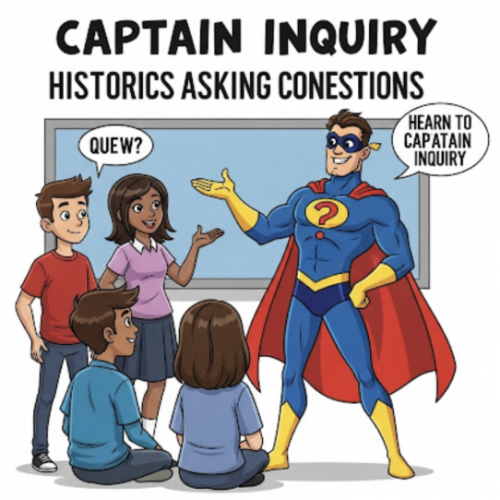
Thanks for your patience, folks. I’m back. Let’s go with Option C, but without the terrible AI-generated graphics.
All joking aside, this is not business as usual. And I don’t care who you ask, but that is not a political statement. Many Americans voted for a major change. Many other Americans can’t make sense of it all. Regardless of what we wanted, expected, or feared, our jobs as civic educators are harder than they’ve ever been.
What a moment to be alive!
That’s only partially a joke. Believe it or not, I mean it: what a moment to witness! What a moment to be a civics teacher. Sure, it’s harder than ever. But it’s also more complex, complicated, and interesting than anything I remember teaching. Remember when the hardest thing to explain was federalism? How adorable. This can be more fun, though. We just need to embrace it!
So, how does one teach all of these traditional topics turned tense? (#alliteration) Topics such as separation of powers, citizenship, due process, rule of law, and freedom of the press. Here are some of my favorite strategies and tips, which I’ll write about with more depth in the coming weeks and months:
- Every time
- Consult and follow your state standards
- Plan for a structured lesson with clear objectives tied to those standards
- Communicate with stakeholders ahead of time
- Sometimes
- Adopt an inquiry-based approach, even if loosely or informally
- Use primary sources, secondary readings, and/or digital media as “grounding texts”
- Lean into process for civics and government
- Use historical examples instead of current ones
- Build compare and contrast skills by asking students to distinguish current events as typical or not typical
- Try to direct students to focus on the office or institution, not the person or party
- Demonstrate intellectual humility
And whenever possible, follow your students’ lead — they’re curious, and that’s a gift!
Civics has never been harder—or more exciting—to teach. In the coming weeks, we’ll share strategies for navigating separation of powers, due process, and more. Think of this as your roadmap for teaching standards while embracing the questions that today’s world inspires.
Written by Emma Humphries
Dr. Emma Humphries, iCivics’ Chief Education Officer, brings extensive classroom experience teaching government, history, and economics, where she discovered the impact of engaging learning tools. With a deep commitment to empowering educators, she continues to champion innovative civic education resources and strategies.