Blog

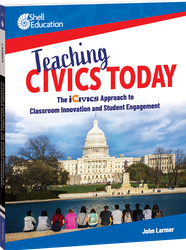
iCivics partners with Teacher Created Materials on new book, Teaching Civics Today

Developed in partnership with Teacher Created Materials, Teaching Civics Today: The iCivics Approach to Classroom Innovation and Student Engagement is a professional resource that shows teachers how to bring civics into their social studies classrooms in an engaging, meaningful way.

“We don’t teach civics like we used to, and thank goodness for that! Our students now benefit from a renaissance in civics instruction – an innovative revitalization of the frameworks, methods, and materials we use to prepare students for their critical role in our constitutional democracy,” said Emma Humphries, Chief Education Officer of iCivics. “All of this and more is succinctly captured in Teaching Civics Today.”

This book, written by John Larmer, explores key civics topics and provides teaching strategies that build content knowledge, develop 21st century skills, and engage students in practice and action. The book:

  • Explains why civic education is important
  • Supports teachers by outlining best practices for civics instruction
  • Helps teachers integrate literacy and civics
  • Includes useful implementation tools such as project and lesson examples

Whether used with the exciting iCivics Readers or by itself, this resource is the perfect tool to help teachers develop tomorrow’s leaders today by guiding students to understand the value of civic engagement.

iCivics Board Member, Supreme Court Justice Sonia Sotomayor, releases new children’s book, “Just Help! How to Build a Better World”

Sonia Sotomayor, Associate Justice, Supreme Court of the United States, and iCivics Board Member, released a new children’s book, Just Help! How to Build a Better World, her third book for young readers. (Read the official announcement on AP News.)

“This is a wonderful book asking young readers the simple question Justice Sotomayor’s mother asked her each morning: ‘How will you help today?’” said iCivics Executive Director Louise Dubé. “Much of civic education is about understanding one’s role in relation to others, in supporting family and community. I was honored to contribute some insight to this book showing young people some of the simple, yet significant, ways they can make a difference right in their own communities, as well as inspire others to do the same.”

In the book, children help in a variety of ways – from sending care packages to U.S. soldiers overseas to cleaning up a park to donating toys to a children’s hospital to volunteering at a nursing home. 

“I want kids to do this intentionally, to think that this is a requirement of living almost, that trying to figure out how they will make a better world should be a part of the charge of their living,” said Justice Sotomayor in a telephone interview ahead of the book’s publication.

Justice Sotomayor said she wants kids not only to help family and friends but also to actively think about and act to help neighbors and the community and change the world.

In her role on the Board of iCivics, Justice Sotomayor has demonstrated a tireless commitment to ensuring each and every child in the United States is informed and inspired for lifelong civic engagement through high-quality civic education. Specifically, she has visited with thousands of students across the country with the message that they can—and should—help make a difference as community members. 

The book is available from all major booksellers, or it can be purchased through the Supreme Court Historical Society’s Gift Shop. 

iCivics awarded $400,000 from the National Endowment for the Humanities to develop new game, Supreme Justice

iCivics is thrilled to announce a $400,000 grant from the National Endowment for the Humanities (NEH) to develop a unique game-based experience—Supreme Justice—aimed at engaging younger learners ages 12–18. Unlike anything in iCivics’ suite of game-based education materials, Supreme Justice will be a multimedia experience, building on best practices in civic education, including simulations and role-playing, and complete with supports for English language learners.

The game, which will be co-developed with game design studio Gigantic Mechanic, will allow students to engage in a live-action multiplayer simulation via technology that combines videos, individualized student profiles, and real-time voting. The game will focus on freedom of speech, freedom of expression, and due process rights—all while simulating the deliberation process of Supreme Court Justices. Students must hear cases and determine whether the law, regulation, or action at issue is constitutional.

“We are incredibly grateful for this NEH funding that will enable us to offer a new, innovative Supreme Court digital simulation,” said iCivics Executive Director Louise Dubé. “This grant makes possible the reimagining of one of our signature games that was close to the heart of our founder, Justice Sandra Day O’Connor.” 

Supreme Justice will model deliberation and critical thinking in a civic setting, grounded in historical cases and relying heavily on the U.S. Constitution as evidence. The gaming experience will guide students to engage in face-to-face discussions, while working together to craft arguments and debate issues central to civic and government life. Once the game is developed, it will be available—for free—on iCivics’ website.

Learn more about the other grantees and how the National Endowment for the Humanities (NEH) grant programs support research and learning in history, literature, philosophy, and other areas of the humanities by funding selected, peer-reviewed proposals from around the nation.

iCivics featured in New PBS Documentary Preserving Democracy: Pursuing a More Perfect Union

iCivics Executive Director Louise Dubé is featured in a new PBS documentary, Preserving Democracy: Pursuing a More Perfect Union, discussing the role of civic education in engaging and fostering an informed citizenry. 

iCivics’ Educator Network member and middle school civics teacher Mary Ellen Wessels’ students at Gate City Charter School in Nashua, New Hampshire, are also featured in the segment exploring the need for and impact of preparing all young Americans for informed citizenry from an early age. Wessels and her students show how iCivics’ nonpartisan games and lessons are used to educate millions of students in classrooms across the country in a fun, engaging, and impactful way.

The documentary reflects on the historical context of the democratic system, progress and threats to democracy at home and abroad, and lessons learned from our nation’s origin to the present day. It also highlights the Civics Secures Democracy Act, currently supported by a bipartisan alliance of Congressional leaders to invest $1 billion in civics and history education, ensuring more and better civic learning for all students in the United States.

In her closing remarks in the documentary, Louise emphasizes:

Civic education is the bedrock for a strong economy. Civic education is a national imperative because it’s so deeply related to national security issues. There are serious consequences to our nation and we need to change that right now.

Now is the time to seize this unique momentum and affect real and lasting change for future generations. Our investment in our students and their in-depth understanding of civics is an essential path forward for our country. 

Preserving Democracy: Pursuing a More Perfect Union premieres on January 6, 2022 on local PBS affiliates. (Check local listings for air times.) You can also see an excerpt of the segment on civic education on last weekend’s episode of PBS NewsHour (beginning at 11:39) below.

For educators looking for resources on facilitating classroom conversations, visit: Teaching About January 6, 2021: Resources for Classroom Conversations Surrounding the Capitol Siege.

2 New Infographics on Congressional Leadership

A picture is worth a thousand words which is why our infographics are so popular with students. Our newest set of Leadership & The Agenda infographics shows how party leaders shape the congressional agenda in both the House of Representatives and the Senate.


These two infographics pair perfectly with our Congressional Leadership mini-lesson or can be used as a stand-alone lesson with the help of our downloadable Teacher’s Guide. The guide includes base knowledge, emphasizes visual literacy skills, and provides conversation starters and activities for students.

Looking for More Infographics to Spark Conversation?

We have a whole library of them! From how a bill becomes a law to ranked-choice voting and the roles of the president, our downloadable and printable infographics provide visually appealing, graphically concise, and substantive overviews of key civic concepts.

Find Support, Collaboration, and Inspiration with the iCivics Educator Network

What a crazy time it is to be a teacher! The COVID-19 pandemic has created such uncertainty and much of what I thought I knew about teaching and learning has been upended. While trying to figure out how to handle this new environment, I’ve come to realize that my need for support, collaboration, and inspiration is greater than ever. I’ve found all that and more in the iCivics Educator Network.

I’ve been teaching ESOL and bilingual social studies in middle and high schools for more than two decades, but the past three school years have been unlike any in my experience. My students are among the most vulnerable to the economic, physical, and educational effects of this pandemic. As I approached the beginning of last school year, I felt such trepidation about going back into the classroom in-person. I worried about how safety protocols and hybrid scheduling would affect my ability to engage with my students and to share my love of all things government.

Fortunately, as a member of the iCivics Educator Network, I was able to connect with peers around the country and learn how they planned to deal with the same concerns. There was such camaraderie as we bounced ideas around and shared resources. During my five years in the Educator Network, I’ve always appreciated the passion and expertise of my fellow members, but now I more fully realize the exceptional nature of this group. Going back into the classroom was still scary, but thanks to this wonderful network, I felt more empowered to continue the work I love under trying circumstances.

Members of the iCivics Educator Network enjoy many more benefits than the wonderful collegiality. We have opportunities to beta test new iCivics resources, learn about the latest features and updates, and access amazing educational opportunities for ourselves and our students. I hope you’ll join us and share your own passions and expertise. We’d love to have you!

Written by Ada Bélanger

Ada teaches ESOL and US history/government in Bedford, New York. She has been a member of the iCivics Educator Network since 2016. She accidentally stumbled across iCivics during an Internet search several years ago, and today iCivics features prominently in her classroom.

4 Ways to Build Classroom Community Through Feedback Using Kami & iCivics

A strong classroom community is vital for empowering students and making them feel valued. Creating such an environment should foster kindness, responsibility, compassion, empathy, and more. Though there are many ways to build toward a strong classroom community—including through family involvement, identity, and predictability—feedback is one aspect that is often overlooked.

Feedback is an important component for building classroom community because it is what students rely on to understand and reflect on their actions. Decisions are based on this feedback and impact how students will operate in the future. Students need adequate feedback about their work in order to improve. Therefore, a method for providing feedback needs to give teachers plenty of options for communicating with students. Fortunately, iCivics and Kami have you covered!

Kami allows teachers to markup, discuss, and provide feedback on iCivics lessons using Kami’s text, comment, and media tools.

Here are four ways to use iCivics and Kami to provide feedback to students:

1. Utilize the comment tools

Kami’s comment tools allow teachers to respond directly to a specific spot in students’ work. This flexibility means that teachers can pinpoint targeted areas for improvement and praise. Kami’s comment tools also allow for teacher and student reply. Why not try using the comment tool to ask a scaffolded question that will help students rethink something they answered incorrectly? Then allow students to try again by replying to your comment! Rather than seeing feedback as failure, students will see it as an opportunity for growth and repeated practice.

2. Give praise with correction

Some students will respond well to corrective feedback, while others will struggle with it. One way to balance this is by offering praise along with corrective feedback. Studies show that praise boosts student confidence and motivates them to complete or stick with challenging tasks. Kami’s media tools allow teachers to add stickers to student work indicating “great effort”, “excellent work”, and “good idea.” You can follow up the visual appeal and excitement of a sticker with a more specific explanation of what the student did well with Kami’s comment tool.

3. Use student exemplars with the class

Using a projector or smartboard, share student exemplars with the class. Kami’s markup tools like the text highlighter and the drawing or shapes tool let you emphasize for students what to focus on. We recommend sharing a range of student exemplars at varying performance levels and discussing them with students. When students see and have opportunities to discuss examples of real student work, they gain a better idea of what success looks like at different levels.

4. Offer real-time feedback on assignments

As students think through their own ideas and grapple with an assignment, circulate around the room to monitor students’ progress. Take note of what students seem to be struggling with and what they are getting right. With students’ permission, select a sample to project on the whiteboard to model and discuss with the class. Use Kami’s annotation tools to draw students’ attention to important pieces of evidence or keywords that underscore the concept you are teaching. If you need to provide this feedback virtually, Kami allows teachers to make comments in real-time on iCivics lessons and provide students with the opportunity to improve their work as they continue to complete the assignment.

Using Kami’s tools with iCivics assignments will allow teachers to give students the formative feedback they need to build confidence, resilience, and a classroom culture of learning. Try using Kami with iCivics today!

iCivics & History’s Mysteries Partner to Expand Innovative History and Civics Curriculum for Grades K-5

iCivics acquired History’s Mysteries’ elementary curriculum, and will continue to work in partnership with the creators to further develop the product, making it available to K-5 students nationwide.

iCivics is partnering with History’s Mysteries to integrate its K-5 learning offerings into the iCivics suite of educational materials. This marks a significant investment for iCivics in elementary civic education, which has historically been underserved by the field. 

The partnership with History’s Mysteries will allow iCivics to address this fieldwide deficit, and provide a full library of learning materials for every grade level K-12, giving elementary educators an accessible way to engage younger learners in history and civics during the most foundational years of their education. 

Founded in 2009, iCivics reaches more than 145,000 teachers and 9 million students annually through free, nonpartisan games and interactive lesson plans that teach the fundamentals of civic education by putting students at the center of learning.

Similarly, History’s Mysteries places young learners in grades K-5 in the center of the action by challenging them to act as history detectives. Its curriculum asks students a “Big Question” such as “What does it mean to be a citizen?” and then guides them through a discussion with teachers in which students use primary sources such as images, videos and texts to form conclusions. 

Over the next few years, iCivics will expand History’s Mysteries’ K-5 content and make materials easier for teachers to use by aligning the content to standards in all 50 states. As part of the partnership, History’s Mysteries will be rebranded as Private “i”: History Detectives. The new, upgraded History’s Mysteries content will be available at iCivics.org in time for the 2022-2023 school year. 

Of the partnership, Kelley Brown and Laurie Risler, who created History’s Mysteries, said, “History’s Mysteries originated from educators asking for accessible primary sources, inquiry-based learning, and engaging materials. We developed a foundation of historical mysteries that will undoubtedly grow and improve with such an incredibly respected and knowledgeable organization. iCivics’ long track record of creating quality, balanced, and engaging materials for learners makes me so excited for the future of our partnership and the new Private “i” History Detectives in elementary classrooms all across the country.” 

“iCivics has wanted to expand into elementary curriculum for quite some time. The building blocks of lifelong civic learning can and should be laid in the earliest grades. We’re incredibly excited about History’s Mysteries and what it will bring to our youngest learners,” iCivics Director of Curriculum and Content Taylor Davis said. “We already know that K-5 students are eager to learn more about civics. What better way to do that than by building on young students’ natural curiosity and asking them to take on the role of history detectives in search of civic knowledge and skills through the close-reading of primary sources and critical thinking.”

This collaboration grew out of the Library of Congress’s Teaching With Primary Sources (TPS) initiative, which provides grants for organizations to build materials and tools that teach key concepts using the Library’s digitized primary sources and other online resources. iCivics and History’s Mysteries are both grantee organizations and members of the TPS Consortium.
More Untold Stories: 3 Unknown Women in History

Do your students want to drive change? Are they passionate about protecting the environment? Do they want to one day stand in the White House press room asking tough questions? Or make a run for Congress? All of these opportunities are open to them, thanks in part to the groundbreaking actions of three women: Rachel Carson, Ethel Payne, and Patsy Mink.

These names don’t often appear in history books. With our partners at Makematic, we’ve created three new videos that showcase the contributions of these lesser-known women in history. Each video includes a Teacher’s Guide with conversation starters, as well connections to iCivics lessons so you can incorporate the videos into larger units of study.

Do students see their communities and the issues they care about covered in the news? More inclusive coverage of national and world events is due in part to Ethel Payne, the second Black woman to become a member of the White House Press Corps. In her position, she asked leaders tough questions and wrote hard-hitting news stories. Her persistence brought civil rights issues to a national audience and put Black people’s experiences on the front page.

Does your school have a women’s soccer team? And do your students aspire to careers in law, science, or engineering, regardless of their gender? Patsy Mink helped make that possible as the co-author of Title IX, the landmark legislation that prohibits sex discrimination in educational programs that receive federal money. Mink was the first woman of color elected to Congress and in her 24 years as a Representative battled inequality by changing the laws.

The United Nations Climate Change Conference starts this weekend in Glasgow, Scotland. Many of the issues world leaders will be discussing and taking action on were first brought to light in Rachel Carson’s groundbreaking book, Silent Spring.

Looking for more lessons about how women have impacted history? Our suffrage resources will help you teach about the importance of voting and how women have had to fight for their right to vote.

Unity & GSV Venture Select iCivics Among Top 5 Winners of EdTech Creator Challenge

Today, iCivics was named one of the Top 5 winners of the Unity and GSV Ventures EdTech Creator Challenge, and one of the Challenge’s overall top 30 projects. 

The EdTech Creator Challenge celebrates creators who are leveraging 3D-powering immersive learning platforms and tools to advance the technical skills of the next generation and educational solutions to increase access to high-quality learning experiences.

iCivics was selected as a top 5 winner by a team of more than 60 internal and external judges, who reviewed and rated 250 submissions based on the following criteria:

  • People: Is the team inclusive, and what populations are supported by this organization? 
  • Product: Does this address a critical need and use real-time 3D technology in a unique way?
  • Potential: What is the traction and impact to date, and does this have global potential?
  • Predictability: What are the near-term milestones (financial and other), and are they achievable?
  • Purpose: What is the organization’s mission and what are the impact goals? 

“We are thrilled to receive this honor,” said iCivics Executive Director Louise Dubé. “We remain committed to offering educators and students across the nation the kind of high-quality civic education necessary for the sustained strength of our constitutional democracy.” 

Along with each of the Top 5 winners, iCivics will receive $100,000 in funding from Unity and $10,000 worth of cloud computing credits from Amazon Web Services EdStart. Learn more about iCivics and the other winners that are empowering creators to change the landscape of education and support all learners.

Unity is the world’s leading platform for creating and operating real-time 3D (RT3D) content. Creators, ranging from game developers to artists, architects, automotive designers, filmmakers, and others, use Unity to make their imaginations come to life. We believe creators are changemakers. 

iCivics currently utilizes Unity’s powerful and flexible platform to develop its award-winning games. 

GSV Ventures is the leading edtech investment firm, funding $7+ trillion in the education technology sector across “Pre-K to Gray.” With GSV and the EdTech Creator Challenge, we will empower creators to change the landscape of education to support all learners in expanding their professional and income-earning opportunities by accelerating the critical work of EdTech creators using Unity.