
As an English teacher, I approach civics through the lens of language.
One of the most memorable moments I’ve experienced teaching rhetoric happened during a lesson on the Declaration of Independence. I’d taught the document before, but as part of the Civic Star Challenge, I decided to shift my approach. Instead of beginning with vocabulary, I started by asking my students a simple question: “How do you convince someone to let you go when they hold all the power?” Suddenly, the document stopped feeling like a distant historical text, but a living argument.
As we began reading, students focused on how Thomas Jefferson carefully structured his argument. We examined the introduction and discussed how the author established credibility by appealing to universal values such as equality and natural rights. Students noticed how the phrase “We hold these truths to be self-evident” was not just a statement, but a strategic move, an assertion meant to sound unquestionable. As one student reflected, “It sounds like he’s saying, ‘Everyone already knows this, so you can’t argue.’” That observation opened the door to a deeper discussion about persuasion and authority.
We moved on to the body of the document, analyzing the list of grievances as part of the argumentative structure. I asked students to look for patterns, and they quickly noticed the repetition of “He has…”. This opened a discussion of craft, particularly the use of repetition to build momentum and emotional impact. A student shared that it felt similar to how people argue when they are frustrated, listing everything at once so nothing can be ignored. That’s Jefferson using the rhetorical strategy of accumulation, layering evidence to overwhelm the reader and strengthen his claim.
The most powerful moment came when we discussed the conclusion. I asked students why the colonists waited until the end to declare independence outright. One student quietly said, “Because if they said it at the beginning, no one would listen to the reasons.” That response captured the essence of argumentative structure better than any textbook definition. The student understood that persuasion requires timing, logic, and restraint. The declaration was not an emotional outburst; it was a carefully crafted argument designed to justify a radical decision.
By approaching the text in terms of its purpose, craft, and structure, my students realized that arguments follow patterns they already use in real life. They began comparing the Declaration to modern speeches, essays, and even social media posts. They recognized that rhetoric is timeless.
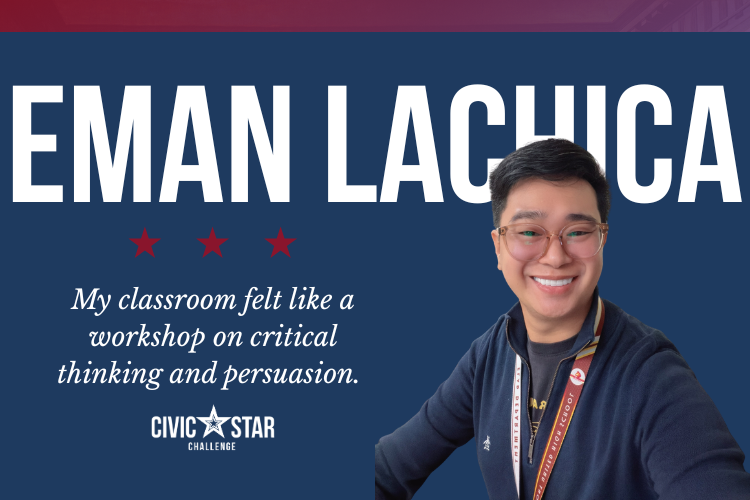
That day, my classroom felt like a workshop on critical thinking and persuasion. The Declaration became a mentor text that taught my students, and me, how powerful words can be when they are intentionally chosen and strategically arranged. This, in turn, allowed students to begin seeing themselves as authors of change. And for me, that is the heart of civics.
About Eman
- Teaching experience: 14 years
- Currently teaching: 9th & 10th Grade English I, English II, and ELDA classes
A semi-Finalist for the 2025 H-E-B Excellence in Education Award, Dr. Lachica’s work emphasizes civic engagement, historical inquiry, and the development of strong analytical writing skills. He is passionate about helping students connect foundational democratic principles to their own lived experiences, fostering confidence, intellectual curiosity, and purposeful participation within their communities.