
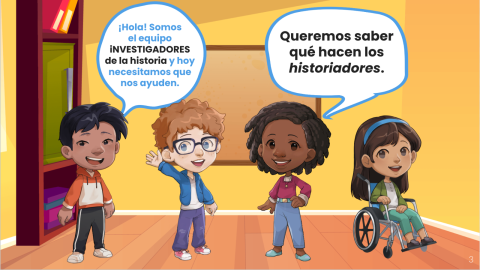
¡Hola, historiadores! Private i History Detectives, our supplemental mystery-themed curriculum, is now available in Spanish for select mysteries. These lessons teach strategies such as notice, wonder, inference, and comparison.
Private i History Detectives can be used in a wide variety of classroom settings, including multilingual and bilingual classrooms. Two mysteries at each grade level, including the Introduction to Inquiry mysteries, are available in Spanish, allowing Spanish-speaking students to practice exploring primary sources, analyzing information, and asking questions.
Each mystery lesson includes English and Spanish student and class materials such as transcripts, handouts, Google Slide decks with audible Spanish narrations, and lesson plans. These resources will help students build social studies content knowledge, foster critical thinking skills, and develop disciplinary language.
Explore these Private i History Detective Spanish Lessons:
What Is This and What Was It Used For?
¿Qué es esto y para qué se usaba?
Introduction to Inquiry Lesson for Grades K-1
Historians are observant. In this introduction to inquiry lesson, students will learn some of the skills and strategies historians use to learn about the past. Students will use their historian skills to uncover a mystery object as they notice, wonder, infer, and compare.
What Can You Learn from a Hat?
¿Qué podemos aprender de un sombrero?
Introduction to Inquiry Lesson for Grades K-1
Historians can learn a lot from a hat! In this lesson, students will look at images of historical and modern hats to learn how hats can give us clues about what people do for work and why their hats may need special features.
What Does It Mean To Belong to a Group?
¿Qué significa ser parte de un grupo?
Grade 1
Historians draw conclusions. In this lesson, students are introduced to the concepts of citizenship and leadership. They are asked to consider the different groups they belong to and how members of each group help one another.
What Are These Children Doing?
¿Qué hacen estos niños?
Introduction to Inquiry Lesson for Grades 2-3
Historians make inferences. In this lesson, students explore primary source images and learn some of the skills and strategies historians use to learn about the past.
What Are These Students Learning About?
¿Qué están aprendiendo estos estudiantes?
Introduction to Inquiry Lesson for Grades 2-3
Historians observe. In this lesson, students learn some of the skills and strategies historians use to learn about the past. Students will look at an image of a classroom from the past and try to figure out what the class is learning about.
What Can We Learn From Someone’s Pockets?
¿Qué podemos aprender de los bolsillos de una persona?
Introduction to Inquiry Lesson for Grades 4-5
Historians make inferences. In this lesson, students learn some of the skills and strategies historians use to learn about the past. They will analyze information and provide reasoning.
Why pass a law to grow corn?
¿Por qué aprobar una ley para cultivar maíz?
Introduction to Inquiry Lesson for Grades 4-5
Historians study the past. In this lesson, students learn some of the skills and strategies historians use to learn about the past. Students will gather evidence from primary sources, such as a law created in Virginia in 1617 that required everyone to grow corn.