
Teachers are teaching more than facts in high school history and government classes. If you ask them, most will agree the content is a platform for teaching life skills; cultural awareness, civic engagement, and communication come to mind. Above all, teachers want their students to leave their social science classes with strong critical thinking skills, the ability to analyze events, evaluate sources for reliability (and determine the validity of that source based on its biases), and understand multiple perspectives.
As the focus of our instruction has changed, so has the way we assess the learning of these skills. Teachers are moving away from straight multiple-choice tests (although there is something to be said about the ease of grading A, B, C or D) and focusing on students’ analytical skills demonstrated through essay or free-response prompts. Similar to the long division of old, teachers are looking for students to show what and how they are thinking and, while a “right” answer is appreciated, so is the process by which students arrive at that answer.
We all know practice makes “better” (nothing is perfect). Teachers can not hand students an essay question or send them off to take their AP test without practice answering these types of questions. It would be setting students up for failure. Speaking from experience, though, creating quality practice questions is time consuming, more so if you are not an expert in the topic. How can you find quality sources if your own understanding is rudimentary at best?
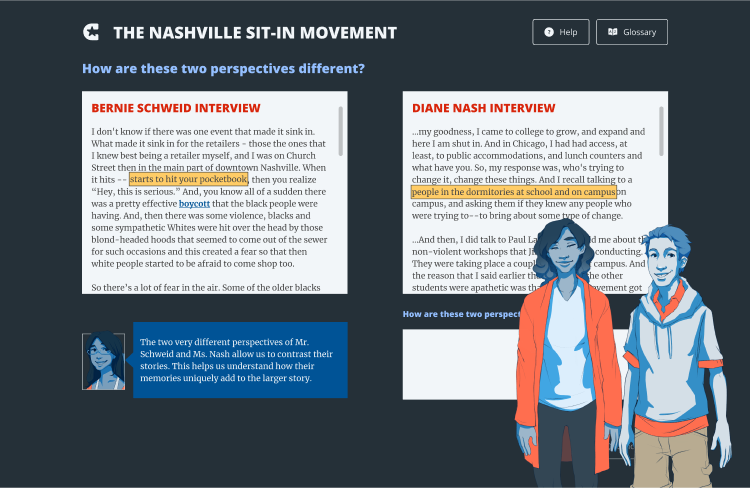
This is where iCivics DBQuests come in. DBQuests are a learning tool that uses document-based questions to guide students in primary source analysis. I have used the same ready-to-go DBQuests with middle and high school (Dual Enrollment no less), picking and choosing which supports from the teacher resources were needed for my English Language Learners and Gifted and Talented students as needed with great success thanks to the built-in support. DBQuests guide students through analyzing a primary or secondary source to identify its perspective and usefulness, identify the source type, and analyze it to answer a central question. The Teacher’s Guide includes supports like student printables and glossaries, perfect for your EL/ML students needing that reinforcement.
Students who are being introduced to DBQuests and essay writing will benefit from the guided mode. Guided mode prompts students to identify different parts of the source while thinking critically using that overarching question. More experienced students can be assigned the same activity without the support in freeform mode. This is more similar to what your AP students could expect to see in the FRQs. The true beauty? You can assign the different levels to students based on their individual needs simultaneously without anyone being aware of what level of support they are receiving using iCivics’ LMS. Set up different classes for students (all they would need is your class code) or assign Lesson A and Lesson B in the same class, specifying who does which version. It is up to the teacher.
As teachers, we understand how important it is to meet students where they are, rather than where we want them to be. By using these scaffolds I was able to meet the needs of all of my students (and no one knew they were doing different lessons), which encouraged each of them to stretch their skills. By the end of the year, I have seen significant growth in the reasoning and evaluative skills of all my students.
No prep. Personalized scaffolds. DBQ practice. What reason do you have NOT to use them?
Written by Anne Walker
Anne Walker brings a wide perspective to iCivics, having taught Kindergarten through Dual Enrollment American History and Government over her 20+ years in education. A proud Madison Fellow, she holds master’s degrees in both Curriculum, Instruction and Assessment, as well as American History and Government. A member of iCivics’ Steering Committee, she is also proud to have a seat on the National Constitution Center Teacher Advisory Council and RetroReport Teacher Ambassadors. She currently serves on the National Council of Social Studies Board of Directors.
Through the iCivics Educator Network, the perspectives of teachers across the country contribute to the public conversation about civic education in the United States. Each contributor represents their own opinion. We welcome this diversity of perspectives.