A Letter to Our Civics Community: Shifts in NAEP and Growth of Civic Seals Are Transformative Opportunities

On the doorstep of A250, two developments are unfolding in civic education that we hope history will note as transformative. 

The first is a landmark shift in how we measure civic learning in American schools. The National Assessment Governing Board (NAGB) has moved the voluntary state-level National Assessment of Educational Progress (NAEP) Civics assessment for 8th graders up to 2028 and, for the first time, results will be disaggregated by state. Simultaneously, NAGB will develop a new framework aligned with the needs of our digital democracy for the NAEP Civics assessment, with scheduled deployment in 2032. And with its evolved language around assessment, the Educating for American Democracy framework—the most rigorous, cross-partisan vision our field has ever produced for what pluralistic civic and history education should look like—now has a national yardstick behind it. Twelfth graders will be assessed in 2032 for the first time since 2010, with state-level results also available. An FAQ about the changes can be viewed here

This leap forward has been decades in the making, and we are hopeful that it will generate an accounting in the states of what resources are available and how they can be aligned to drive better outcomes in civics. We also hope to see healthy competition among states to innovate on civic learning and more powerfully integrate it across the K–12 experience. 

Relatedly, we are witnessing the rise of civic seals, formal credentials that recognize student excellence in civic readiness upon high school graduation. Seventeen states*, spanning the political spectrum, have now adopted civic seals programs, reaching nearly half of all K–12 students in the United States. In just the last few months, seven states have taken action on civic seals:

  • Legislation adopting civic seals was signed in three states: Connecticut, Idaho, and New Hampshire;
  • Legislation to establish civic seals passed state legislatures in Iowa and Maryland and awaits their governors’ signatures; and 
  • Civic seals bills were introduced in Alaska, Minnesota, Missouri, New Jersey, Pennsylvania, and await further consideration.

We’re also tracking new state and local pilots and planning by state coalitions to introduce civic seals legislation next session. 

These seals are more than extra symbols on a diploma. They are a mechanism for credentialing the skills our students need to thrive in the democracy and economy of the AI age: independent thinking, communication, collaboration, information literacy, and creativity. These are not just academic attributes; they are the skills and attitudes that self-governance demands and hiring managers seek. 

For years, we have sought leverage points that could sustainably bring educators, policymakers, business leaders, and communities to the same table to execute long-term efforts to strengthen civic learning and civic participation in their communities. Civic seals are the best organizing tool we have seen in this respect in quite some time. 

Arizona recently relaunched its civic seal program and saw recipients grow tenfold in a single year. California tripled the number of students earning its civic engagement seal in just five years. The momentum is real, it is bipartisan, and it is building. iCivics and the CivxNow coalition are committed to supporting every state in making this vision a reality.

These two developments—the NAEP evolution and civic seals—did not happen by accident. They are the fruit of years of organizing, advocacy, coalition-building, and the tireless work of educators, policymakers, and others across this country. Your participation in this movement is one essential component of these successes. Thank you for your support and engagement.

There is still hard work ahead. NAEP will need to be opted into by each state, so an organized effort to build interest in the states will soon commence. Adoption of seals is only the first step; implementation is everything. And measuring civic learning is only valuable if we act on what we find. But for this moment, let us be clear-eyed about the fact that we are driving essential changes in education that will benefit students and our nation for the next 250 years and beyond. 

With gratitude and determination,

Louise, Emma, and Shawn

*States that have adopted civic seal programs: Arizona, California, Connecticut, Georgia, Idaho, Indiana, Kentucky, Louisiana, Nevada, New Hampshire, New York, North Carolina, Ohio, Oklahoma, Pennsylvania, Tennessee, Virginia
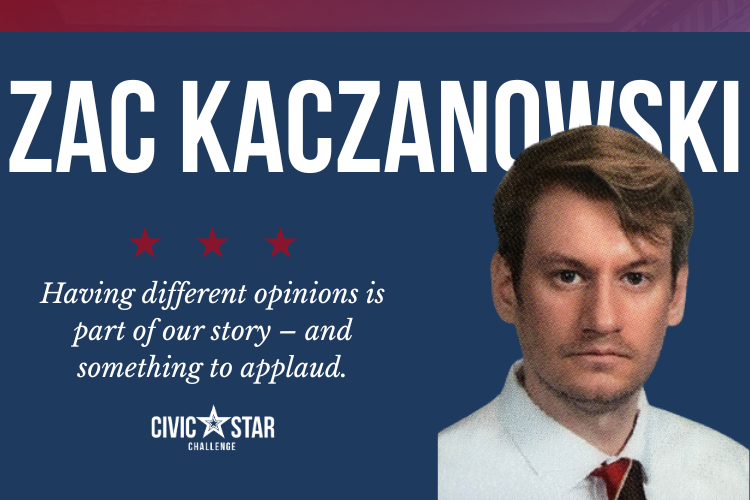
Zac introduces his students to Declaration themes through skits

My students love learning and they excel academically. And recently, I discovered that they also have a flair for the dramatic.

It was the beginning of the school year. As part of the Civic Star Challenge, I adapted a unit created by my mentor Jeannie Holloway. The goal was to help students see that the Constitution did not appear out of nowhere. It grew out of real arguments about power, rights, government, and human nature. I kicked things off with a short video introducing the Enlightenment thinkers: it’s a lecture/infographic featuring Thomas Hobbes, John Locke, Montesquieu, Jean-Jacques Rousseau, and others.

Then I asked the students to become those thinkers. In groups, they wrote skits that placed the philosophers in contemporary, sometimes wacky scenarios. Then they grabbed their scripts and got on their feet.

We were transported to a pizza parlor, where the thinkers tried to decide the best way to split a pizza – an allegory for the separation of powers. (Hobbes also argued that putting pineapple on pizza was evil.) Then we visited an extravagant hotel restaurant, where they debated effective leadership over pancakes. Another skit—considering life, liberty, and property—was set in a bank: Locke and Hobbes were security guards confronted by some would-be robbers, Jean-Jacques Rousseau and Montesquieu:

Montesquieu: (interrupting, now deeply focused on dividing the cash) Calm down, Hobbes. I’m simply restoring order—true order. (Starts separating the bills into neat piles.) Equal separation of power, just like how the government should work.

Hobbes: (near breakdown) This isn’t about power! You’re robbing the bank! We need strong laws, a king, someone in charge! Without that, everything falls into chaos—like this!

Rousseau: (shaking his head) Laws? Kings? Hobbes, you’ve been brainwashed by corrupt authority. Society is what corrupts people, not the other way around. We’re just taking back what society has stolen from us!

There were props (including tea cups and fake money), accents, and robust discussions after each performance.

America is a country founded on debate. Even the idea of establishing a federal government caused a vigorous disagreement, which continues to this day. I want students to understand that disagreement is not a problem to avoid. It is part of how our country was built. When students can step into different points of view, argue from them, and even laugh with them, they begin to see civic learning as something alive.

About Zac

  • Teaching experience: 13+ years
  • Currently teaching: 6th Grade World Geography, 7th Grade World History, 8th Grade US History

With experience in teaching in mainland China for 8 years, Detroit charter schools, and currently at a gifted and talented program, Zac brings a global and civic-minded perspective to social studies education. His work centers on civic education, constitutional literacy, and helping students think critically about democracy, government, and their role as informed citizens. He was recently named his district’s Teacher of the Year.

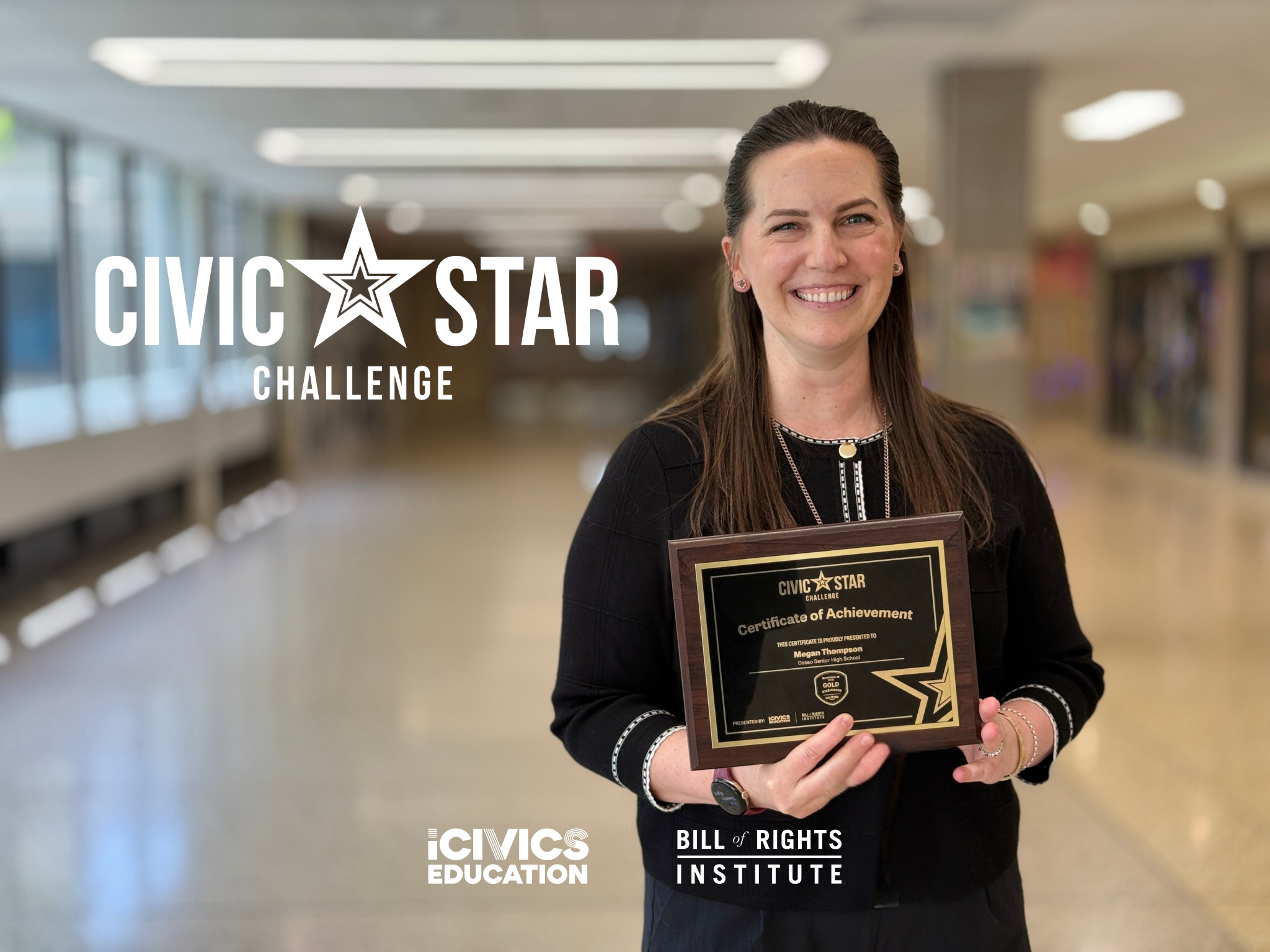
MINNESOTA TEACHER MEGAN THOMPSON WINS $10,000 CIVIC STAR CHALLENGE GOLD PRIZE

Thousands of educators from all 50 states participated in the Civic Star Challenge, an initiative of the Bill of Rights Institute and iCivics to teach themes of the Declaration of Independence in honor of America’s 250th anniversary.

MINNEAPOLIS [May, 15, 2026] – Megan Thompson has won the Civic Gold Star Award of the Civic Star Challenge essay contest, presented by the Bill of Rights Institute [BRI] and iCivics, earning her school a $10,000 grant and an all expenses paid trip to a national civic education event. 

Funded by Griffin Catalyst, Stand Together, and the Pedersen Foundation, the Civic Star Challenge is a nationwide initiative to inspire millions of acts of civic learning during the 250th anniversary of the signing of the Declaration of Independence. The contest is designed to make America’s founding principles relatable to today’s students. Thousands of teachers representing all 50 states have participated, with hundreds entering the essay contest.  

BRI and iCivics provided educators with lesson plans and activities about the Declaration’s key themes, including equality, natural rights, and life, liberty and the pursuit of happiness – to help them connect these concepts to today. All of the lessons are available at civicstarchallenge.org/.

In addition to regular drawings awarding $300 stipends, teachers were also eligible to enter an essay contest that asked them to write about why civic education is important now. 

Thompson, who teaches AP Government and Politics, along with Crime and Justice, won the top prize for her essay that describes how she makes the Declaration relevant and real to her students. During a period of profound civil unrest in Minneapolis, she helped her students make sense of their constitutional rights to privacy and peaceful protest, and helped them navigate real-world issues by connecting to America’s founding principles. “To support students professionally without inserting myself politically, I offered primary sources and the content to encourage natural connections,” Thompson wrote.

Thompson is a James Madison Fellow, a Sphere 100 Fellow, and a member of the National Constitution Center’s Teacher Advisory Board. 

“Civic learning depends on dedicated educators who help students connect founding principles to the world they live in today,” said Louise Dubé, CEO of iCivics. “Through the Civic Star Challenge, teachers in all 50 states brought the Declaration of Independence into their classrooms in powerful, practical ways—sparking discussion and deeper understanding of what it means to live in our democracy. Megan’s winning essay embodies the spirit we want to see in classrooms across the country.”

In addition to the $10,000 prize, BRI and iCivics also named 20 Civic Silver Star Award Winners who earned a $2,000 grant for their schools, and 50 Civic Bronze Star Award Winners with a $1,000 grant for their schools. 

“The principles of the American Founding are alive in our classrooms thanks to teachers like Megan,” BRI President and CEO David Bobb said. “By leading discussions and debate around foundational ideas that flow from the Declaration and Constitution, civics teachers are helping young people understand their rights and responsibilities, so they can positively shape our nation’s future.”

Gold Star Winner: Megan Thompson

Silver Star Award Winners: Ma Cristina Octaviano, Megan Philbrook, Mikaela Toegel, Shannon Salter, Amanda Pidgeon, America Sotelo, Andrea Bauck, Charles Oliver, Chris Keefe, Craig Specht, Eman Lachica, Glen Worthington, Ian Weissman, Jaimee Martin, Janet Key, Julie Eisenband, Mark Olsen, Rachel Cox, Serge Danielson-Francois, Verity Olliff

Bronze Star Award Winners: Aaron Garcia, Adam Maldonado, Allayne Smith, Amanda Dix, Amanda Runkel, Amanda Shaner, Andrew Hutchinson, Ann Reynolds, Charlotte Brooks-Mobley, Chris Kemp, Darcy Daniels, Emily Torres, Evangeline Mitchell, Evelyn Homan, Heather Savadel, Jacquelin Biggs, Jamie Naragon, Jason Bennett, Jennifer Graham, Jenny Phu, Jerra Skeen, Jesse Risley, Jessica Culver, Jessie Gamero, Joseph Normand, Karen Wagner, Katelynn Ryan, Katie Stillman, Kim Richards, Kimberly Huffman, Kimberly Mockler, Laura Edmonds, Leah Heskett, Marc Turner, Marie Criste, Maritess Medina, Megan Miller, Paula Stella Martinez, Pearl Stegner, Rachel Johnson, Rob VanderLinden, Sadie Curran, Sara Davis-Leonard, Sarah Conners, Sarah Smith, Seth Harris, Shae Parks, Susan Kernutt, Tia Costello, Tony Pirotta

For more information about the Civic Star Challenge and for media inquiries, please contact [email protected].

ABOUT iCIVICS

Founded in 2009 by Supreme Court Justice Sandra Day O’Connor, iCivics is a nonpartisan organization dedicated to advancing civic learning by providing educators and students with the knowledge, skills, and resources needed to embrace and engage in our civic life together. iCivics empowers educators and leads the movement to make civic education a nationwide priority so all young people have the confidence to shape the world around them and believe in our country’s future. To learn more, visit www.icivics.org.

ABOUT BILL OF RIGHTS INSTITUTE
The Bill of Rights Institute is a nonpartisan, nonprofit organization that works to advance civic and history education through market-leading curricula and programs for educators and students. To learn more, visit www.mybri.org

ABOUT GRIFFIN CATALYST

Griffin Catalyst is the civic engagement initiative of Citadel founder and CEO Ken Griffin, encompassing his philanthropic and community impact efforts. Tackling the world’s greatest challenges in innovative, action-oriented, and evidence-driven ways, Griffin Catalyst is dedicated to expanding opportunity and improving lives across six areas of focus: Education, Science & Medicine, Upward Mobility, Freedom & Democracy, Enterprise & Innovation, and Communities. For more information, visit griffincatalyst.org. 

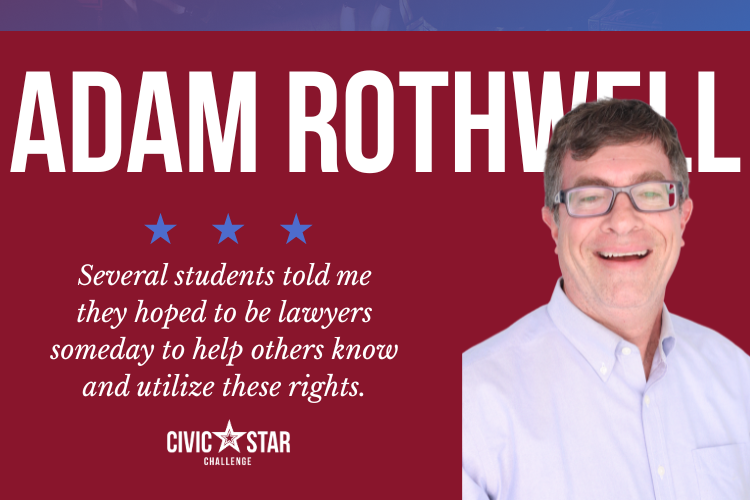
Adam helps students extend the Constitution beyond the classroom

I’m the only teacher in Baltimore County Public Schools focused solely on Homeland Security. I sometimes describe the subject as “social studies with all the lessons coming from the last 30 years.” We mainly focus on the government response to threats – foreign, domestic, natural, and man-made. My classes are part of a pathway program that supports students as they explore a range of careers; from law enforcement to law school, even cyber security. 

My students are especially interested in understanding their own rights, including at school. They ask direct questions: Can our phones be tracked? When can a locker be searched? Where is the line?

We ground the answers to those questions in the Constitution itself. In my Law class, we spend a lot of time talking about the Bill of Rights. I was searching for a resource that could help tie together ideas from across the unit and the Civic Star Challenge led me to Accused? Know Your Rights. It was exactly what I was looking for. The lesson considers the 4th, 5th, 6th, and 8th Amendments using a variety of formats, including narrative, match, and personal reflection. It spoke to students with a range of abilities, and I was impressed by the very high percentage completion rate.

I look for ways to extend learning beyond the classroom. As it happens, our area is resource-rich in lawyers! So following the iCivics lesson, I invited one to visit our class. Students were able to ask about how the rights we’d been discussing applied in a court of law. They were shocked to learn that the Miranda Warning they’d heard so often on TV wasn’t a common issue. Why? The proliferation of body cameras. But perhaps the ubiquity in pop culture is also part of the Warning’s effectiveness: students almost instinctively know they have the right to remain silent and request a lawyer. Now they also understand where those rights come from.

This year marks the 250th anniversary of the Declaration of Independence. It’s also the 25th anniversary of 9/11. For this course, those connections are immediate. To deepen that learning, I plan to take students to the 9/11 Memorial and Museum in New York City next fall. We are raising funds by selling small American flags, with a goal of 2,977, one for each victim. Students are also creating a display to honor those lives. It’s a way to connect what we study in class to real people and real events.

About Adam

  • Teaching experience: 6 years
  • Currently teaching: High school Homeland Security

Adam spent 20 years practicing immigration law before earning a Master of Arts in Teaching in Special Education. He now teaches the majority of a Homeland Security Pathway at Chesapeake High School in Baltimore County Public Schools. The views mentioned in this post are his own.