Introducing iCivics Learning Framework

I started my teaching career in North-Central Florida just over 20 years ago. I remember my job interview well. Yes, I was nervous, and yes, I brought a folder stuffed with surely too many assets printed on thick parchment-style paper. But I digress.

Beyond the usual interview questions, the principal asked how I viewed my central mission as a high school history and civics teacher. I didn’t skip a beat:

My mission, my job, is to ensure my students have the knowledge and skills they need to be informed and engaged citizens in our democratic republic. And I’ll make sure they improve their reading and writing skills.

The second sentence is probably why I got the job. This was peak “No Child Left Behind” era, and Florida had one of the tougher accountability systems.

But the first sentence was as honest and authentic as can be. At least it was back then.

Today, if asked how I view my central mission as a history and civics educator, I would give this response:

My mission, my job, is to ensure our nation’s students care. And I’ll make sure they improve their reading and writing skills.

I want students to care about community, including seeking to strengthen trust in people and institutions, feeling a sense of belonging, and feeling a responsibility to the common good. 

I want them to care about accuracy, which requires intellectual humility and curiosity, valuing credible information, and striving for informed participation. 

And I want them to care about pluralistic democracy, which shows up as respect for multiple perspectives, concern for others, belief in civic participation, dedication to democratic health, and civic confidence. 

Sure, I still want today’s students to have the knowledge and skills they need to be informed and engaged citizens in our democratic republic. But first and foremost, I want them to care about living in a healthy democratic republic. 

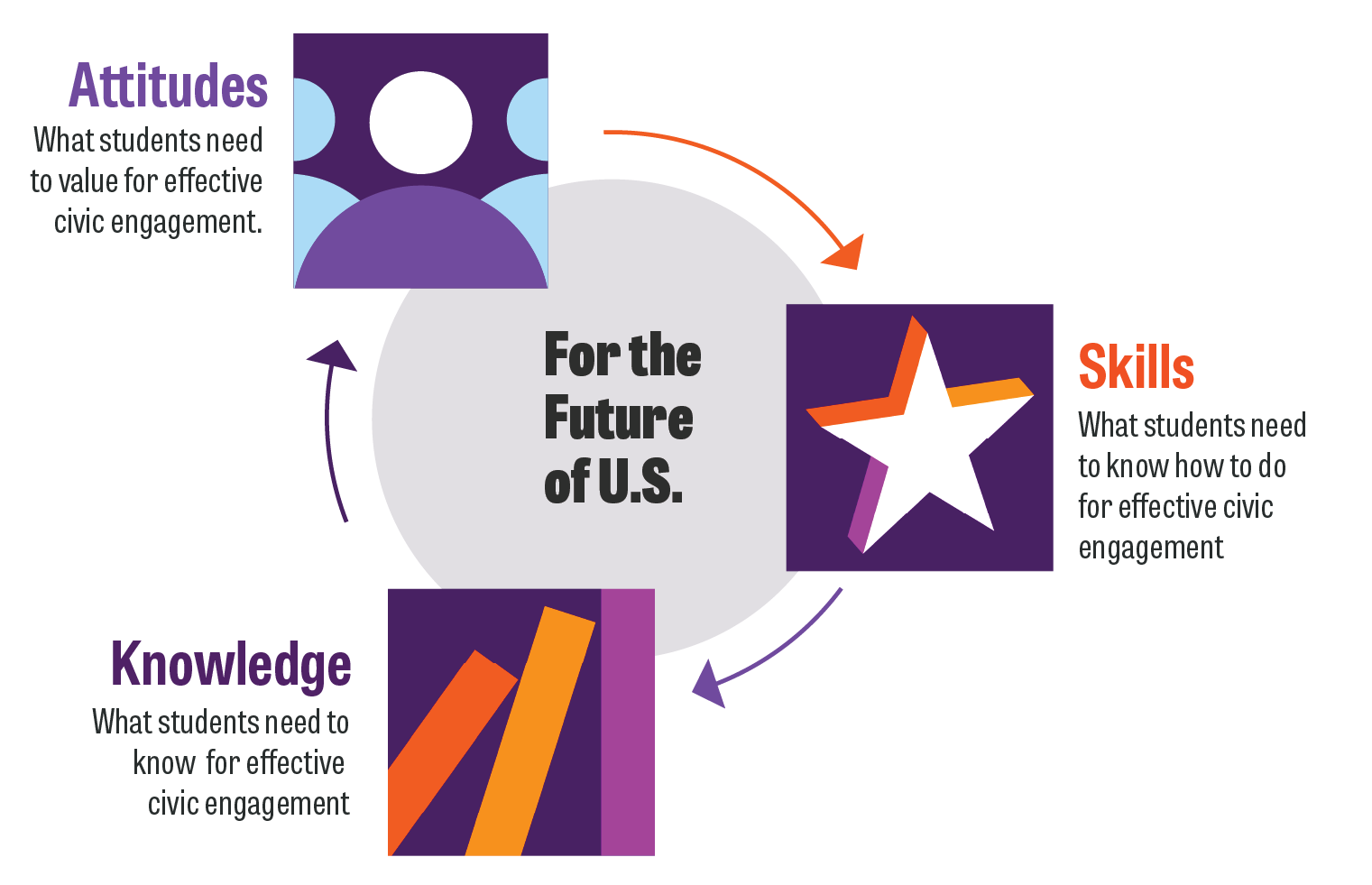
Let’s talk about how this caring shows up. Call them what you will: dispositions, habits, values, virtues, mindsets. At iCivics, we call them Attitudes, and they comprise the first pillar of our Learning Framework, joined, of course, by their co-equal counterparts: Skills and Knowledge.

I like to think of the three categories much like the three branches of our government. They are co-equal, sure. But the Legislative branch was given top billing, Article I, in the U.S. Constitution, and that was far from arbitrary. In the same way, while I believe that civic Attitudes, Skills, and Knowledge all matter in equal measure, I wouldn’t hesitate to give Attitudes that same top billing.

Also, I love a good acronym, and ASK—Attitudes, Skills, and Knowledge—is more perfect than I can say.

Here’s why: One of my favorite colleagues in civic education is Peter Levine, professor of citizenship and public affairs at Tufts University. According to Professor Levine, a citizen is someone who seriously asks, “What should we do?” I love this definition because it transcends legal status and gets to the heart of what it means to be a good person who cares about the common good: dialogue, collaboration, and action. 

Every day, I work with the incredible team at iCivics and so many others in our field to answer this question. I am consistently challenged and sustained by this profound network of humans who care just as much as I do about “keeping the republic,” which is our democratic inheritance. 

And that’s the inspiration behind the architecture of iCivics’ Learning Framework.

Written by Emma Humphries

Dr. Emma Humphries, iCivics’ Chief Education Officer, brings extensive classroom experience teaching government, history, and economics, where she discovered the impact of engaging learning tools. With a deep commitment to empowering educators, she continues to champion innovative civic education resources and strategies.
Investigating: iCivics Login Issues via Clever

STATUS: Resolved

Login issues have been resolved and all services are currently operating normally. We appreciate your patience while we worked through this.

If you continue to experience any difficulties accessing your account, please reach out to our support team for further assistance.

We are aware that some Clever users are unable to log in to their iCivics Accounts with their Clever credentials.

We are actively investigating with Clever. There is currently no estimated resolution time.

In the meantime, create your free account directly on the iCivics website and access all of your favorite resources. 

To Our Incredible Teachers: We Appreciate You

I have a confession to make: I didn’t want to write this post. What can I possibly say to express the magnitude of my appreciation for you without acknowledging the current moment and thereby wading into the political—something I’m neither supposed to do, nor want to?

But that’s been true for everything I’ve written or recorded for you this year. Every single message has been so hard to compose. I’ve obsessed over every word.

This is not my norm. I rarely struggle to find my words, especially when talking to teachers. You are my people, and I’ve always found it easy and natural to communicate with you. This year is different, not because of you, but because of the extraordinary circumstances in which you find yourself trying to teach for the maintenance of our constitutional democracy.

But here we go…

I appreciate you. All of iCivics appreciates you: our staff, our board (including Justice Sotomayor!), and our donors appreciate you.

And even though she is no longer with us, and I wouldn’t dare to put words in her mouth, I’m certain Justice O’Connor is smiling down upon you with awe and appreciation. We are all so grateful.

As the Chief Education Officer at a nonprofit organization, I necessarily wear a lot of hats. I know you get it. You do too.

You’re not just history or civics teachers. You’re counselors, coaches, club advisors, hallway monitors, test proctors, lunchroom attendants, and sometimes traffic directors. Every day when I drop my daughter off at school, I’m filled with both gratitude and cognitive dissonance when I see teachers with graduate degrees wearing professional clothing while blowing whistles and managing car lines in the south Georgia humidity.

That is insane. No other profession asks so much in the form of “other duties as assigned.”

My job description encapsulates many different things—important things, like academic integrity, impact research, youth engagement, and more. But my number one priority right now is supporting you in any way I can—not because you need my help, but because you need a friggin’ break.

So this is both a letter of appreciation and an invitation to HIT.ME.UP. Not to go to the club, although drinks are on me if we find ourselves in the same city. No, hit me up for what you need. How can I help? How can the team at iCivics make your job easier?

Because appreciation without action is like a terrible hug: hollow, unsatisfying, and oftentimes awkward.

We’re not here for that. We’re here for genuine, authentic appreciation—the kind that feels like a hug from your best friend after months or years apart.

Here’s what we’re doing at iCivics to put our appreciation into action:

  • We are LISTENING. As much as I want to delete all of my accounts, I continue to stay engaged on as many social media sites as possible to understand your daily struggles. The same is true for our marketing, product, and professional Learning teams. We’re also on a listening tour, scheduling 1:1 virtual meetings with educators.
  • We are CREATING. Every day, the award-winning product team at iCivics is researching, writing, revising, and uploading so that you have access to accurate, objective, engaging, and impactful resources.
  • We are ADVOCATING. Our Policy team is tracking bills, calling legislators, convening state-based commissions, and doing everything else in its power to ensure that states propose and pass bills that support civic education and civic educators.
  • We are PLANNING. We have our eyes on Constitution Day in September, NCSS in December, Civic Learning Week in March, and America250 from June 2025 to July 2026. We’re hard at work to make these special occasions and opportunities as meaningful as possible.

With that, I send you my biggest virtual hug—one that feels like a hug from veteran educator and iCivics Educator Network member Shannon Salter from Pennsylvania. Shannon gives the best hugs. They are whole-body, perfectly forceful, and just long enough for you to feel her affection without bystanders starting to wonder if something else is going on or if they should intervene. That’s the kind of hug I’m sending you.

With all of my gratitude,
Emma

P.S. We want to hear from you! Really, how can we help?
Here are some ideas that come to mind, but we are all ears for your specific suggestions:

Written by Emma Humphries

Dr. Emma Humphries, iCivics’ Chief Education Officer, brings extensive classroom experience teaching government, history, and economics, where she discovered the impact of engaging learning tools. With a deep commitment to empowering educators, she continues to champion innovative civic education resources and strategies.