New Game, New Partnership: Promoting Global Civics with the Council on Foreign Relations

As global tensions rise in Europe and the COVID-19 pandemic enters its third year, there is an increased urgency to help students build an understanding of U.S. foreign policy.

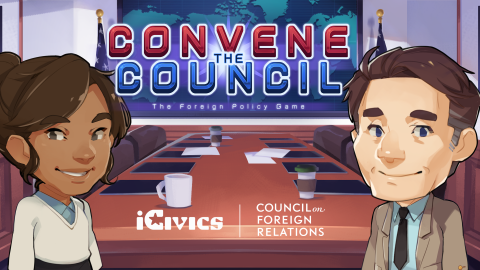
Our new game, Convene the Council, created in partnership with the Council on Foreign Relations (CFR), uses digital gameplay to teach important foreign policy and global civics lessons in an engaging way. Students who play Convene the Council step inside the Situation Room and assume the role of the president of the U.S., making foreign policy decisions through 20 different fictional foreign policy scenarios that reveal how foreign and domestic policy are intertwined and how decisions made in one corner of the world can affect us all. The game’s scenarios challenge students to use critical thinking skills to determine how the U.S. should respond based on recommendations from the president’s closest advisors.

As two organizations with the shared goal of empowering students and lifelong learners with the know-how needed to be responsible citizens, we are proud to have partnered with CFR on this game and to bring global civics, which expands and modernizes the field of civics education for our globalized era, into the spotlight.

This game was made in partnership with the Council on Foreign Relations, with support from The Peter G. Peterson Fund – New York Community Trust.

Meet the Council on Foreign Relations

CFR Education focuses on global civics, providing students with the knowledge, skills, and perspective—the global literacy—required to navigate our interconnected world, and preparing them to confront our era’s most pressing issues.Global civics recognizes that the world is more interconnected than ever before; that we live in an era when ideas, behaviors, products, and news spread more quickly and broadly than at any other time in history; and that the challenges and opportunities that define our era don’t stop at one country’s borders.

CFR is working to put global literacy back into the spotlight by meeting students where they are with relevant, compelling case studies and innovative multimedia content.It also acknowledges that learners of all ages must be equipped with the tools necessary to steer through the churn of the daily news cycle and a social media landscape often littered with misinformation.

CFR Education’s teaching global civics has involved using the intense, international popularity of Korean pop music to help students understand concepts like soft power; serving up avocado toast as an example of how the global supply chain affects what’s for brunch; and going behind the firewall to highlight how computer viruses now operate as modern-day tools of foreign policy.

Explore global civics resources from the Council on Foreign Relations:

CFR’s two award-winning digital learning products, World101 and Model Diplomacy, provide an essential baseline for a global civics curriculum and encourage learners ages 14 and up to embrace a world that functions on the fundamental principles of democracy.

  • World101 is a growing library of free educational resources that makes complex international relations and foreign policy issues accessible to all learners using videos, interactive maps, infographics, quizzes, and online teaching materials.
  • Model Diplomacy is a free classroom simulation program that invites students to step into the shoes of decision makers on the National Security Council or United Nations Security Council to debate the world’s most pressing issues.

CFR also recently released its first-ever music video—a guaranteed bop!

Black History Month: Lesson Plans and Resources for the Classroom

Black history is American history, and February is an opportunity to introduce classroom discussions and reflections about how Black Americans have shaped our nation. In celebration of Black History Month, we are sharing resources from iCivics, as well as partner organizations to support learning and conversations in the classroom.

Five iCivics Resources to Use This Month

Discover the people, groups, and events behind the Civil Rights Movement. Learn about means of non-violent protest, opposition to the movement, and identify how it took all three branches of the federal government to effect change. Protest posters, fictional diary entries, and a map of the movement’s major events develop a greater understanding of the struggle for civil rights.

This mini-lesson covers the basics of the Supreme Court’s decision that overturned “separate but equal” in public schools. Students learn about segregation and “equality under the law.” 

When President Eisenhower authorized troops under federal authority to desegregate Little Rock Central High School in 1957, he became the first president since Reconstruction to use federal forces to help enforce equal rights for African Americans. Using the example of Executive Order 10730, students will explore how executive orders can be used to enforce the law. The story of integrating Little Rock Central High School doesn’t start or stop with Eisenhower’s executive order. Dive into the downloadable teaching resources to share more of the history with your students through the use of primary source documents. 

More inclusive coverage of national and world events is due, in part, to Ethel Payne, the second Black woman to become a member of the White House Press Corps. In her position, she asked leaders tough questions and wrote hard-hitting news stories. Her persistence brought civil rights issues to a national audience and put Black people’s experiences on the front page.

Find all of our animated videos, lessons, and DBQuests for teaching Black history all month (and all year) long conveniently located together on a resources page.

Resources From Our Partners

Black history is more than teaching about the civic strategy and achievements of the Civil Rights Movement. As we work to expand our resources to better integrate the contributions as well as social, political, and historical contexts of Black Americans in civics, we invite you to check out these collections from a few of our partners:

The First 100 Days and Beyond: Lesson Plans and Classroom Resources for Teaching the Executive Branch

January 20th, Inauguration Day, marks the official start of the four-year term of the President of the United States, but the real work begins after the ceremony ends. The first 100 days of the presidency is a critical period for setting the stage for what is to come in the next four years. Explore the many resources we offer to help students understand what they should expect during this period and the steps the executive branch can take to turn campaign promises into a reality.

All Eyes on the First 100 Days

Just like with any job, there are a lot of expectations when a new presidential term begins. Use our lesson, The First 100 Days, to explore the history of this concept, its impact on the presidency, and how success is judged. A customizable Google Slides deck is available for this lesson.

From Campaign Promises to an Agenda

This mini-lesson explains what a presidential agenda is and how it’s executed and communicated to the American people. Students will also examine the relationship between the president and Congress as it relates to the presidential agenda.

Mini-Lesson: Vice President

The president may be front and center, but the vice president plays an important part in our nation’s government. This new lesson will help students better understand the history of this office and the modern role of the vice president. 

What’s It Like to Be President?

In Executive Command, students get to be the president and learn firsthand the many different responsibilities that come with the job. From proposing a legislative agenda and signing bills to commanding the military, this interactive game takes students deep into the Oval Office.

Answer Students’ Questions About the Election, Presidency, Cabinet, and More!

Our Election Headquarters is the place to find our curated collection of lessons, games, and activities all about the electoral process and the executive branch.